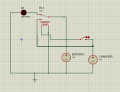
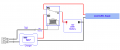
The circuit in post #42 still does not work for the reason that the TS only wants to switch it on using the mains power to the charger. So that switch would remain closed. Also, evidently, the TS only has one SPDT relay and is unable or unwilling to change anything, such as switching the radio off. And totally ignored my suggestion to use a separate supply just for the relay.
AND, for what reason is a ground symbol attached to the negative connection circuit???
First off you don't go re- posting other members suggestions without mentioning them.
Second you didn't read post #7 which explains why that circuit doesn't work but the circuit in post #8 does.
Yep, I missed post #7 and yes, post #8 works but he apparently didn't like it, or am I missing something? If he is unwilling to change anything, then there is no solution. The single pole, single throw switch is a necessity! The only solution (besides post #8) is to add an optocoupler with MOSFET or transistor output instead of the switch and the optocoupler input tied to the mains via suitable rectification and current limiting. The circuit would be like that shown in post #42 except for the switch replaced by the optocoupler.
Of course, a NC button to release the relay could work, OR how about a power filter for the radio power feed. if the filter prevents the noise in the radio then no need for the relay switching and it all becomes much simpler. The filter can start with a diode in series with the +12 volts,followed by an inductor and then a larger capacitor group, several 470 MFD 20 volt electrolytic caps in parallel. because tat is cheaper than one big cap. AND, between the first diode and the inductor, another diode, anode to the input of the inductor, cathode on the 12 volt negative line. That is so the inductor can deliver current as the input supply ripples. Just like in a switch-mode boost supply.
The inductor must be very low resistance but a fair amount of inductance, so it will be heavy and not small.
The radio was something I mentioned because that's how I have my setup. The charger is constantly on, holding my battery at 13.8V. The radio plays off the battery. If there was no battery the radio would play off the charger but it would play horribly. The TS mentioned his load was some LED's. We haven't discussed the load because that's not a part of the question other than it's a load.
The suggestion that the relay be controlled by mains instead of the charger is a sound one. I forget who mentioned it first, I think it was @sghioto. If mains comes on and the charger comes on then why not have the relay come on WITH the mains. The battery will be isolated from the load and connected to the charger. All other attempts to isolate the charger from the battery once the relay is latched have proven undoable - given the prohibition of a diode. The only OTHER way to do it according to the parameters set out by the TS is to have some kind of sensing circuit that includes logic. And even then I'm not so sure it is easily done. Perhaps an XOR gate along with some other components might accomplish the goal. I haven't given it any more grey matter, largely because I can't come up with a solution. But one might exist. It might involve a second source of power such as a transformer to switch the relay back and forth with the presence or absence of the mains. It all gets way over complicated. A 110V relay connected to the same mains the charger is connected to will solve the problem just like sghioto said.
Here's what @sghioto was describing. At least MY take on his thought.
When mains comes on so does the charger AND the relay. Only, what's different from the original post (the TS) is that the relay is NOT controlled by the charger but by the mains. No need for diodes or other components. And the relay can not self latch either because the relay coil is rated for 120 (or 240) volts AC, depending on where the TS is located.
You DO realize that if the power comes on the LED's will shut off. They will stay off until power is lost.
Is that what you want? If so - then you need to find a 120VAC relay that can stand being on for long periods of time. And the contacts need to be rated for the DC amperage the charger will deliver or the load draws, whichever is greater.
Here AGAIN is my comment from post #45, which would remove the requirement for a mains operated relay in place of the one referenced since post#1.
That separate supply scheme can be a serious cost reduction, depending on the TS ability to locate and obtain a suitable wall-wart power supply.
Separate power supply / 110VAC relay - what's the difference? The battery charger is mains powered. 110VAC relay or wall wart, it works out the same way.
At first the goal was to figure a way to cut the relay out when power dropped. The TS was using the charger to actuate the relay. The problem was that once the relay was actuated it continued to see battery power even after the charger shut off. Hence the issue was that the relay would not drop out.
The parameters were "Use no diode". The diode would have been the only way to properly prevent the relay from latching. But the forward voltage loss was undesirable to the TS. So I, me personally, tried to find a solution. But everything I came up with still lead to the relay latching. It was Sghioto who first proposed using mains power to control the relay. But stubbornly I continued to try and find a way to meet the requirements of the TS but to no avail.
In the end it became apparent to me, and obviously to you, that the relay had to be controlled by separate means. Whether a 110VAC relay or a low voltage relay controlled by a wall wart. I see very little difference. As you pointed out it was post #8 that first proposed mains relay. That OR a wall wart of sorts, as you suggested.
From what I gather, the TS might not have constant power. That there are times when the mains are live and times when they're not there. So when there, the TS wants to charge a battery of some sort. When mains are present the load (LED, Aqua) is shut off by the relay and the battery is charged. Perhaps this is a country where mains are intermittent. OR perhaps this is purely solar powered with an inverter. Daytime the battery charges. Night time the LED's illuminate a room. All this is supposition as we have not heard back from the TS. I posted a circuit that had the FET in backwards (according to Sghioto). I'm still not sure it wouldn't have worked but I'm everything far from an expert on FET's. In the end I could not find a solution better than post #8.
The second challenge , not mentioned at all, is how much understanding and skill the TS has as far as being able to understand a circuit with electronic components. some well worded questions have come from some folks who could not tell a microphone from a microfared.
A depletion mode P-mosfet will be on when its gate floats, it still conducts from source to drain with no voltage on the gate.
An enhancement mode P-mosfet will be on/off depending on the voltage difference between the gate and source, off if the gate floats.
How about a timer circuit that is generating say a one second pulse every 5 minutes. this pulse would break the drive to the relay coil. When the charger supply was removed the relay would remain latched until the next pulse occured. This would remove the back feed from the battery so there would then be no power to the relay coil. The timer would be powered from the charger side of the relay contact.
Les.
How about a timer circuit that is generating say a one second pulse every 5 minutes. this pulse would break the drive to the relay coil. When the charger supply was removed the relay would remain latched until the next pulse occured. This would remove the back feed from the battery so there would then be no power to the relay coil. The timer would be powered from the charger side of the relay contact.
Les.
That would certainly be a valid scheme, it will work. AND it could be implemented with just one counter IC like the CD4060, and one transistor to drive the relay. And the timer would not even need to be really accurate, four minutes will be just as good as five!!
The pulse would turn off a transistor or mosfet that was connected in series with rhe relay coil. At the end of the pulse the transistor /mosfet would go back to the conducting state but as the relay contact between battery and charger is now open there would be no power to make the relay close. If the charger was switched on the there would be power for the relay to close and connect the charger to the battery. stopping the charging for 1 second every 5 minutes would not have much effect on the time required to charge the battery. The pulse could probably be less than a second.

 Facebook
 Google
 GitHub
 Linkedin