Relay Latching Problem

Thread Starter

salal_87

Joined May 2, 2010
10
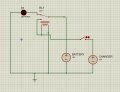
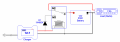
The circuit is for a Battery Load disconnection when the charger is turned on. But the relay remain latched when the charger turns off. I dont want to use a diod between NO and the charger. Kindly resolve the issue without use of any diode.
 

Attachments

Thread Starter

salal_87

Joined May 2, 2010
10
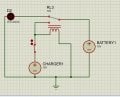
This is a circuit using relay to connect the load when the charger is off and disconnecting the load when the charger turns on. The switch is used just for the simulation purpose to show the turning on and off charger from the mains supply, in real the switch doesnot exist.
The problem is when the charger turns on, the coil activates and starts charging the battery but when the charger turns off (mains supply supplying the charger turn off)Capture1.JPG, the relay remains latched due to battery voltage being supplied to coil.
How can i achieve the same functionality without latching. any modification in the existing circuit or another approach to get the same operation.
 

meth

Joined May 21, 2016
298
Bro you posted this same circuit yesterday, you just moved the charger to the left. You got your solution there which I think should work. If you tried that solution post it in your original thread.

Mod: posts have been merged.
 
Last edited by a moderator:

Thread Starter

salal_87

Joined May 2, 2010
10
Bro you posted this same circuit yesterday, you just moved the charger to the left. You got your solution there which I think should work. If you tried that solution post it in your original thread.

Mod: posts have been merged.
Bro yesterday i gave a very confusing problem statement. Kindly look into the new problem statement. The switch is for just simulation purpose. In real the charger is supplied via mains supply and will turns on and off when the mains supply is present or absent. I need to operate the relay coil through the charger. The problem is how can i separate the relay from the battery when the relay is latched.
 

Ian0

Joined Aug 7, 2020
13,097
I’d suggest you use the mains voltage relay as @sghioto said, but if you want to deal with on the low voltage side, it is a common problem with auxiliary charging relays in vehicles, and it is solved by using a voltage comparator. If the voltage on the battery is >13.5V then it must be on charge.
 

Thread Starter

salal_87

Joined May 2, 2010
10
I’d suggest you use the mains voltage relay as @sghioto said, but if you want to deal with on the low voltage side, it is a common problem with auxiliary charging relays in vehicles, and it is solved by using a voltage comparator. If the voltage on the battery is >13.5V then it must be on charge.
can you draw me a circuit for this " If the voltage on the battery is >13.5V then it must be on charge. "
 

shaun123

Joined Nov 22, 2024
2
The circuit is for a Battery Load disconnection when the charger is turned on. But the relay remain latched when the charger turns off. I dont want to use a diod between NO and the charger. Kindly resolve the issue without use of any diode.
Try using a lower current. Sometimes high current causes the relay contacts to be weld shut.
 

Tonyr1084

Joined Sep 24, 2015
9,744
The problem is when the charger turns on, the coil activates and starts charging the battery but when the charger turns off • • • the relay remains latched due to battery voltage being supplied to coil.
How can i achieve the same functionality without latching. any modification in the existing circuit or another approach to get the same operation.
I've edited your quote. Helped me make more sense of the problem you're experiencing.
My question is why do you need to shut the load off while charging the battery? I'm sure there's a legitimate reason for that, but understanding the need will help us find a final solution.

In my shop (custom cabinet shop) I have an old car radio that I like to play when I'm in the shop. This is how I maintain that radio and its battery:
Screenshot 2024-11-22 at 7.50.35 AM.png
Playing the radio directly from the charger doesn't work well. I get a lot of hum and not enough power to hit the base notes. Adding a small battery, one big enough to handle the radio for long periods of time, allows me to play the radio a good 8 hours with minimal drop in voltage. The charger is always on. No switches for that, just on and maintaining a constant float voltage of 13.8 volts. The battery is a wet cell lead acid battery intended for use in lawn equipment. Small yet powerful enough to give a satisfying sound. At night the battery is topped off for charge. The next day it's ready to go again. The charger can deliver 2 amps, so it's enough to restore the battery over night.

You want to turn the load off while charging the battery. That, too, is easy. Just add a steering diode (a diode, 1n4004 is plenty). Through the diode the battery will charge. There WILL be a slightly lower voltage going to the battery; 0.7V drop. You may need to adjust your charger output. If you can live with a slightly lower voltage then the whole problem is solved by a single diode.
Screenshot 2024-11-22 at 8.07.21 AM.png
[edit] I just noticed the battery Plus sign migrated onto the charger. It's a "typo" of sorts. You can ignore the plus sign on the charger. Assume red is positive and black is negative.
[end edit]
 
Last edited:

sghioto

Joined Dec 31, 2017
8,633
The diode is the easy solution however the TS requested a solution without using a diode was the requirement.
Without any additional components a relay on the AC side of the charger is the only choice I see.
 

Tonyr1084

Joined Sep 24, 2015
9,744
Kindly resolve the issue without use of any diode.
the TS requested a solution without using a diode was the requirement.
Yeah, forgot that.

If it's the forward voltage drop that is of concern then a FET would be a better choice. I'm not good with FET's so I'll not draw a picture.

Is it that nothing is wanted besides just a relay? If so - I can't think of a way to accomplish the goal.
 

Thread Starter

salal_87

Joined May 2, 2010
10
I've edited your quote. Helped me make more sense of the problem you're experiencing.
My question is why do you need to shut the load off while charging the battery? I'm sure there's a legitimate reason for that, but understanding the need will help us find a final solution.

In my shop (custom cabinet shop) I have an old car radio that I like to play when I'm in the shop. This is how I maintain that radio and its battery:
View attachment 336440
Playing the radio directly from the charger doesn't work well. I get a lot of hum and not enough power to hit the base notes. Adding a small battery, one big enough to handle the radio for long periods of time, allows me to play the radio a good 8 hours with minimal drop in voltage. The charger is always on. No switches for that, just on and maintaining a constant float voltage of 13.8 volts. The battery is a wet cell lead acid battery intended for use in lawn equipment. Small yet powerful enough to give a satisfying sound. At night the battery is topped off for charge. The next day it's ready to go again. The charger can deliver 2 amps, so it's enough to restore the battery over night.

You want to turn the load off while charging the battery. That, too, is easy. Just add a steering diode (a diode, 1n4004 is plenty). Through the diode the battery will charge. There WILL be a slightly lower voltage going to the battery; 0.7V drop. You may need to adjust your charger output. If you can live with a slightly lower voltage then the whole problem is solved by a single diode.
View attachment 336441
[edit] I just noticed the battery Plus sign migrated onto the charger. It's a "typo" of sorts. You can ignore the plus sign on the charger. Assume red is positive and black is negative.
[end edit]
The reason to disconnect the load while charging is that i have a separate load (DC Fans, DC Lights) which i want/need to run when the mains supply is off (loadshedding), but when the mains supply is present i have separate AC load which starts running and dont need to run it from battery.
The second figure, you have given is the right solution but i dont want to use a diode due to its voltage drop and i have fixed voltage charger thus can not increase the charging voltage.
 

Tonyr1084

Joined Sep 24, 2015
9,744
The second figure, you have given is the right solution but i dont want to use a diode due to its voltage drop and i have fixed voltage charger thus can not increase the charging voltage.
Can you live with a slightly lower voltage? If you have a SLA or Wet LA battery (SLA = Sealed Lead Acid, Wet LA = Lead Acid battery with water (or acid)); its nominal voltage is 12V. Its float charge is 13.6 to 13.8 volts. If you're charging it to 12 volts you're not charging it. If you're charging to 13.8V then 0.7Vf (forward voltage drop) will drop your charge down to 13.1V. That'll still charge the battery but never to full capacity.

There IS a solution using a FET (Field Effect Transistor) which has minimal loss. FET's are something I'm in the process of learning. Slowly. Very slowly. I'll see if I can find some info on using a FET in place of a diode.
 

Tonyr1084

Joined Sep 24, 2015
9,744
Found this.
THIS LINK HAS BEEN REMOVED. It is not applicable to your project.
It's actually to protect from reverse hookup. Probably not going to be an issue but when the MOSFET is ON its Vf is very small. The video uses an P channel MOSFET.

AAC Members - correct me if I'm wrong.
 
Last edited:

Thread Starter

salal_87

Joined May 2, 2010
10
Found this.
It's actually to protect from reverse hookup. Probably not going to be an issue but when the MOSFET is ON its Vf is very small. The video uses an P channel MOSFET.

AAC Members - correct me if I'm wrong.
thank you, it seems to be a good option, i will try it in actual circuit to see the voltage drop
 
Top