Relay Latching Problem

MisterBill2

Joined Jan 23, 2018
27,602
It could work to have the diode in the relay coil circuit so as to not drop the charging voltage. And the MUCH SIMPLER scheme will be to use a different switch!!
The best choice will be a DPDT center off switch! In one side it will connect the charger to the battery directly. In the center, everything is off. In the third position it will connect the loads to the battery.

Of course, if the TS does not want to use a switch, but rather control everything by switching the charger on and off with a mains side power switch,, it does get more complicated. The simple fix then is to use a second, mains powered, cheap, small power supply, to operate the relay only. That supply will not even need to be regulated.
 

Tonyr1084

Joined Sep 24, 2015
9,744
UNDER REVIEW FOR CORRECTNESS!

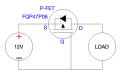
One more thing: If adding a P-FET then you'll want to protect it from Back EMF from the coil. The 1N4004 will be needed. Maybe even a bigger diode, a 1N4007 just to be safe.

This will not work. The drawing has been deleted.
 
Last edited:

sghioto

Joined Dec 31, 2017
8,634
How to use p-channel MOSFET as a switch?

To turn on a P-Channel Enhancement-type MOSFET, apply a positive voltage VS to the MOSFET's source and a negative voltage to the MOSFET's gate terminal (the gate must be sufficiently more negative than the threshold voltage across the drain-source region) (VGDS).Oct 28, 2021
 

Tonyr1084

Joined Sep 24, 2015
9,744
How to use p-channel MOSFET as a switch?

To turn on a P-Channel Enhancement-type MOSFET, apply a positive voltage VS to the MOSFET's source and a negative voltage to the MOSFET's gate terminal (the gate must be sufficiently more negative than the threshold voltage across the drain-source region) (VGDS).Oct 28, 2021
Believe me, I'm not picking an argument here. Since the gate is tied to the negative rail and the diode in the FET is conducting around the FET, source is tied to the positive minus the Vf of the diode. Therefore, isn't S at least at 11.3V positive and the gate is at 0V? Doesn't that turn the P-FET on?

I ask because I'm a graduate of YTC (YouTube College). I know, that's a worthless degree but if what I'm learning is right, I think I have it right. Again, I acknowledge that I may be 100% wrong. No argument from me.

Are you saying conduction is from S to D? I thought it was D to S.
 
Last edited:

Tonyr1084

Joined Sep 24, 2015
9,744
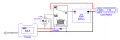
OK, today is a good day - for a Monday that is. This weekend I cleared the leaves from my yard. Saturday night the wind kicked up and my yard is covered with frozen leaves. So this Monday could be better. At least I've learned something. I hope it stays with me. I keep my drawings once I know they're correct. So that video I posted is bogus. I will delete it shortly. Meanwhile, this is the revised drawing. Again, if I missed something - someone please flag me on it.
Screenshot 2024-11-25 at 10.15.19 AM.png
 

Tonyr1084

Joined Sep 24, 2015
9,744
salal_87 please note there have been changes to my drawings. Incorrect drawings have been removed along with the link to the YT video. That video does not apply to your project.
 

Tonyr1084

Joined Sep 24, 2015
9,744
Upon further reflection it now appears that with the P-FET correctly oriented the relay will latch on and not shut off.

Back to where we started from.
 

Tonyr1084

Joined Sep 24, 2015
9,744
Admittedly I'm in WAY over my head. Please please please tell me I got this right this time.
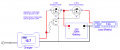
I think the relay needs to be ditched. From what I've read (hopefully understood correctly) an Enhancement mode P-FET and a Depletion mode P-FET can do the desired switching. An additional PNP transistor would be needed to switch the FETS from ON to OFF and vice versa. Here's my latest stab at a solution:Screenshot 2024-11-25 at 11.26.44 AM.png
 
Last edited:

Tonyr1084

Joined Sep 24, 2015
9,744
When it's charging the battery both gates are held to ground. This turns the D mode FET ON and the E mode FET OFF, thus isolating the load during charging. When the charger shuts off the transistor turns off as well. Both gates float (not at zero volts) and the D mode FET turns off and the E mode FET turns ON. I don't know if more is needed but I think this may be a good track to pursue.
 

Tonyr1084

Joined Sep 24, 2015
9,744
Nope! Wait a minute. I think the D mode will conduct battery power back to the transistor and switch the load off again. DANG IT!

I can't see a solution NOT using a diode in the power stream. Unless there's a D mode FET that doesn't have the internal diode. This is where the experts need to chime in. I know way too little on this subject to continue muddying up the waters.
 
Top