Relay delay vary with zero cross issue

Thread Starter

Benengineer

Joined Feb 6, 2016
133
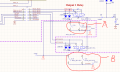
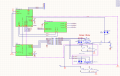
I have relay delay circuit as follow:

upload_2016-6-20_19-2-50.png
Relay for Channel A and Relay for Channel B
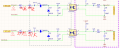
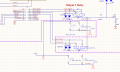
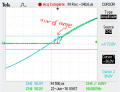
upload_2016-6-20_19-7-14.png

My question is that why zero cross delay varies at channel B while channel A is constant whenever I measure it. While I stop a while and go back to measure channel B, the zero cross delay varies. Firmware also controls its output too.
Please help why the zero cross delay in channel B are not stable, that in channel A stable.

Thanks
 

Attachments

EM Fields

Joined Jun 8, 2016
583
I have relay delay circuit as follow:

View attachment 108013
Relay for Channel A and Relay for Channel B
View attachment 108014

My question is that why zero cross delay varies at channel B while channel A is constant whenever I measure it. While I stop a while and go back to measure channel B, the zero cross delay varies. Firmware also controls its output too.
Please help why the zero cross delay in channel B are not stable, that in channel A stable.

Thanks
I'd suspect one of the coils in "B" isn't being driven hard enough, but I have some questions.
1. What's the voltage at D18 cathode
2. What's the relay coil voltage?
3. What's the purpose of the network R21 R22 C13?
4.Why are you using D11 and D123?
5.Why are you using R 25 and R199
6.Why are you using C12 and C86?
7.What's the voltage on PAD9?
 

Thread Starter

Benengineer

Joined Feb 6, 2016
133
I'd suspect one of the coils in "B" isn't being driven hard enough, but I have some questions.
1. What's the voltage at D18 cathode
2. What's the relay coil voltage?
3. What's the purpose of the network R21 R22 C13?
4.Why are you using D11 and D123?
5.Why are you using R 25 and R199
6.Why are you using C12 and C86?
7.What's the voltage on PAD9?
I'd suspect one of the coils in "B" isn't being driven hard enough, but I have some questions.
1. What's the voltage at D18 cathode
2. What's the relay coil voltage?
3. What's the purpose of the network R21 R22 C13?
4.Why are you using D11 and D123?
5.Why are you using R 25 and R199
6.Why are you using C12 and C86?
7.What's the voltage on PAD9?
Thank you for your reply.
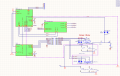
The voltage at D18 cathode is 24V. Please the whole picture
upload_2016-6-21_19-12-57.png

relay coil voltage is 24V
the purpose of the network R21 R22 C13 is filtering out low noise from flyback output 24V
D123 and D11 rectify AC input to trigger EL817SD(opccupler)
R 25 and R199 limit current, I don't know why they do this. I guess that they put 10K, later on, they found that it was not limit current and added a little more resistor value.
PAD9 depends on input,the line voltage for input has two, 120V and 277V.

The product is a light controller. So, the input is AC voltage, such as 120V and 277V. There is one flyback converter in the unit to generate 24V DC to power up uC and relay.

The issue is harder to reproduce. When relay B is close on the power in the next morning, the time delay is moving dynamically and voltage around relay close is out of range [-36V, 36V]. I guess the relay is factoring by temperature. Only the first time have this issue in the morning. After then, we can't see this issue anymore.
Please let me know if you need other information. Thanks,
upload_2016-6-21_19-50-6.png
The blue is input line voltage 120 at 60Hz and green is relay close. The voltage between -36V and 36V for 120V input
This voltage could be out of the range

upload_2016-6-21_19-54-29.png

This is zero cross delay. The blue is input for sine wave at 120V
 

Attachments

EM Fields

Joined Jun 8, 2016
583
Thank you for your reply.
The voltage at D18 cathode is 24V. Please the whole picture

relay coil voltage is 24V
the purpose of the network R21 R22 C13 is filtering out low noise from flyback output 24V
D123 and D11 rectify AC input to trigger EL817SD(opccupler)
R 25 and R199 limit current, I don't know why they do this. I guess that they put 10K, later on, they found that it was not limit current and added a little more resistor value.
PAD9 depends on input,the line voltage for input has two, 120V and 277V.

The product is a light controller. So, the input is AC voltage, such as 120V and 277V. There is one flyback converter in the unit to generate 24V DC to power up uC and relay.

The issue is harder to reproduce. When relay B is close on the power in the next morning, the time delay is moving dynamically and voltage around relay close is out of range [-36V, 36V]. I guess the relay is factoring by temperature. Only the first time have this issue in the morning. After then, we can't see this issue anymore.
Please let me know if you need other information. Thanks,
I'm not sure I understand your circuit, but it seems to me that you want to SET one latching relay with respect to a mains zero crossing and then, some time later, RESET that relay and SET another one with respect to another mains zero crossing, then some time later, RESET that relay and begin the cycle over again by SETting the first relay on a mains zero crossing.

Unless you're using a rather sophisiticated algorithm which measures the time between two successive zero crossings, calculates the time to the next zero crossing and then then pulses the relay's coil - after having compensated for its delay and bounce - you might want to try something rather crude, like this:

Zero crossing delay.png
 
Last edited:

Thread Starter

Benengineer

Joined Feb 6, 2016
133
I'm not sure I understand your circuit, but it seems to me that you want to SET one latching relay with respect to a mains zero crossing and then, some time later, RESET that relay and SET another one with respect to another mains zero crossing, then some time later, RESET that relay and begin the cycle over again by SETting the first relay on a mains zero crossing.

Unless you're using a rather sophisiticated algorithm which measures the time between two successive zero crossings, calculates the time to the next zero crossing and then then pulses the relay's coil - after having compensated for its delay and bounce - you might want to try something rather crude, like this:

View attachment 108117
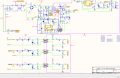
In order to understand the circuit, I put the clear circuit for you. Meanwhile, I also attach Relay spec and some other circuits. Please see the attachment.

Yes, I think you are right about main zero cross as reference.
I don't understand you want me to try other the way you showed a circuit. what does it mean? Is the firmware problem or hardware prolem?
Please let me know.


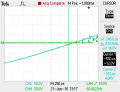
I got other capture from relay B in this morning after it is cool a long time. This capture show the relay is a little bit out of range when it is close.
upload_2016-6-22_15-8-49.png
 

Attachments

Thread Starter

Benengineer

Joined Feb 6, 2016
133
I'm not sure I understand your circuit, but it seems to me that you want to SET one latching relay with respect to a mains zero crossing and then, some time later, RESET that relay and SET another one with respect to another mains zero crossing, then some time later, RESET that relay and begin the cycle over again by SETting the first relay on a mains zero crossing.

Unless you're using a rather sophisiticated algorithm which measures the time between two successive zero crossings, calculates the time to the next zero crossing and then then pulses the relay's coil - after having compensated for its delay and bounce - you might want to try something rather crude, like this:

View attachment 108117
This is other document about uC ATmel Zero Cross Detector. Please see it.
 

Attachments

EM Fields

Joined Jun 8, 2016
583
In order to understand the circuit, I put the clear circuit for you. Meanwhile, I also attach Relay spec and some other circuits. Please see the attachment.

Yes, I think you are right about main zero cross as reference.
I don't understand you want me to try other the way you showed a circuit. what does it mean? Is the firmware problem or hardware prolem?
Please let me know.


I got other capture from relay B in this morning after it is cool a long time. This capture show the relay is a little bit out of range when it is close.
View attachment 108126
I don't want to spend the rest of my life on this project, fixing someone else's mistakes, and I don't really know how to say this in a nice way, but can we please stop what seems to be a never-ending cat and mouse game by just having you explain what it is you want to do and why you need to zero-switch the mains, please?
 

Thread Starter

Benengineer

Joined Feb 6, 2016
133
I don't want to spend the rest of my life on this project, fixing someone else's mistakes, and I don't really know how to say this in a nice way, but can we please stop what seems to be a never-ending cat and mouse game by just having you explain what it is you want to do and why you need to zero-switch the mains, please?
Sorry. I want to know why that issue I described and showed the capture above happen. How can I do test to approve it. Is it firmware issue and hardware issue? Zero Cross mains is reference.
Please help me since this one give me headache.
Thanks.
 
Top