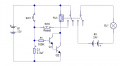
Relay disconnection delay with interlock.

Thread Starter

calmachicha

Joined Jan 18, 2025
15
Good day.
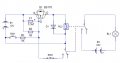
I built a very simple circuit that activates a light using a PIR sensor through a DPDT relay. The relay has a feedback that produces the latching and the light stays on until it is deactivated with a NC button that cuts the power to the relay.
Now I want to add a delay to the relay deactivation of a few seconds (4 or 5 would be fine).
I thought about a capacitor and a resistor that would keep the relay coil energized for those seconds, but I can't do it.
Does anyone have any idea where to connect the capacitor? Or some other simple way to do it. I don't want to use a timer for something so simple.
The circuit diagram is attached.
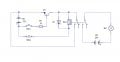
ENCLAVAMIENTO.jpg
 

Hymie

Joined Mar 30, 2018
1,347
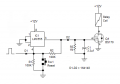
Rather than having the relay directly supplying the 24V lamp, use a thryristor with the gate switched by the relay, including a suitable RC time constant holding the thyristor on until the capacitor voltage decays to a level, switching off the thyristor.

Bear in mind that the thyristor in this application needs to be a gate turn off (GTO) type, otherwise it will remain on, regardless of the gate voltage.

For clarity of the above, below is a back of the envelope schematic.

You might need to experiment with the component values, but if you start with a ~2 second time constant (Ct = 47µF and Rt = 39kΩ) and see what you get – the thyristor gate will be drawing a small current.

Alternatively you could modify the circuit using a fet transistor rather than a thyristor – you can check out the component arrangement needed for a fet transistor on youtube.
 

Attachments

AnalogKid

Joined Aug 1, 2013
12,045
An adequate capacitor between the base and emitter should work.
In the #1 schematic, SW1 is a momentary, NO SPST pushbutton switch. Once the relay latches on, the button is released and R1 is disconnected from the battery. Q1 is off during normal operation.

The solution is a capacitor, but not at the Q1 base, plus other circuit changes. The relay left side contacts need to be moved so they are in parallel with SW1, not switching power to the coil directly. SW2 is moved so it is in series between the SW1/contacts node and B1. The hold-up capacitor is between the R1 left side and GND. When SW2 is pressed, the power is removed from the coil circuit. The timing capacitor begins discharging through R1 and Q1 to GND. After approx. 3 time constants, Q1 turns off and the relay coil is de-energized.

Schematic on request.

NOTE: This mod requires that SW2 be held down during the delay period. This probably is not what the TS wants. If he wants the relay to stay energized for a while *after the stop button is released*, that requires a circuit that remembers the turn-off command during the time delay, and then applies it to the relay circuit. If you think this all the way through, it gets a bit messy.

To the TS: Relay coil current / coil resistance / part number / datasheet / link to vendor page - anything ?

ak
 
Last edited:

AnalogKid

Joined Aug 1, 2013
12,045
I thought about mentioning that changing to a FET would greatly reduce the size of the timing cap, but we don't know anything about the relay coil current. A trade-off is that the relay will turn off much more slowly due to the FETs more rounded transconductance curve corner. This might cause some contact chatter. OTOH, a slow turn-off means you might be able to eliminate D1.

ak
 

sghioto

Joined Dec 31, 2017
8,633
The TS also mentioned using a PIR to activate the relay but doesn't show that connection in the schematic.
Appears Sw1 represents the PIR output but possible may require additional mods.
 

crutschow

Joined Mar 14, 2008
38,322
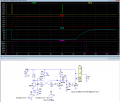
Below is the LTspice sim of a circuit with a two transistor bistable latch, controlling a transistor driver with a delayed off, that doesn't require a long off-pulse:
Rtst is just for test purposes to show the relay state.

Note that the relay can be a SPDT since no contacts are now used for latching.

1740940193220.png
 
Last edited:

Hymie

Joined Mar 30, 2018
1,347
Crutschow said //A thyristor will not turn off with a DC supply//

My simple thyristor circuit might work with a small impedance in the cathode path, raising the cathode by around 1V above 0V (with the gate needing to go slightly negative with reference to the cathode to switch off a GTO device).
 

sghioto

Joined Dec 31, 2017
8,633
The GTO device requires a negative pulse with sufficient current to shutoff the thyristor. Maybe as much as 20% of the load current.
 

Thread Starter

calmachicha

Joined Jan 18, 2025
15
Hola. Gracias a todos por sus respuestas. Realmente aprecio a las personas que dedican su tiempo y conocimientos a ayudar a los demás.
Mis conocimientos de electrónica son muy básicos y rudimentarios. Quizá por eso supuse que la solución a mi necesidad podría ser más sencilla. Carezco de conocimientos de FET. He fabricado algunos temporizadores con 555 y poco más.
Por el momento funciona lo que hice, solo que me resultaría más útil con el retardo de apagado, pero creo que tendré que meterme en aprendizaje de otro nivel, más avanzado para mí en este momento.
 

bertus

Joined Apr 5, 2008
22,885
Hello,

As said, please use only english on this site.
Google translation:
Hello. Thank you all for your answers. I really appreciate people who dedicate their time and knowledge to help others.
My knowledge of electronics is very basic and rudimentary. Maybe that's why I assumed that the solution to my need could be simpler. I lack knowledge of FETs. I have made some timers with 555s and little else.
For the moment what I did works, only I would find it more useful with the turn-off delay, but I think I will have to get into learning at another level, more advanced for me at this time.
 

sghioto

Joined Dec 31, 2017
8,633
"For the moment what I did works, only I would find it more useful with the turn-off delay"

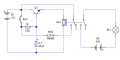
Couple of modifications possible with using most of the existing components.
Will need to experiment with the value of C1 for the desired delay and Sw2 must remained pressed until the relay shuts off.
1741032424827.png
Second version using two transistors in a darlington configuration.
1741033636630.png
 
Last edited:

Tonyr1084

Joined Sep 24, 2015
9,744
OK, I don't get it! The TS has a working circuit (post #1) but wants to delay the off signal. If you want it to turn off after 3 seconds (just a number for reference - not an actual requirement) then wait three seconds before pushing SW2. Why would anyone want to push a button and then have to wait for "Time-Out" (TO)?

If SW1 represents a PIR then wouldn't THAT have its own TO delay? My PIR porch lights have settable TO. Once triggered or re-triggered, it will remain on for a few minutes, depending on the setting, then if no further motion has been detected it will shut off. This thread seems to me like trying to invent an airplane with three wings (not Tri-Wing).

The circuit with the FET appears to be workable, but now the problem becomes having to hold SW2 open until the relay drops out.

Unless we're timing something AFTER the "Stop" command is given then I can see a use for such a circuit. But wouldn't there be even easier ways to control the TO?
 

MisterBill2

Joined Jan 23, 2018
27,186
It may be that there is a lot more to whatever is being switched off than we are aware of.
Consider how often that is the case "around here."
 
Top