Facebook
 Google
 GitHub
 Linkedin

Recently i needed relay board quickly and while there was several options, the option with fastest shipping (overnight) happened to be for this unit:
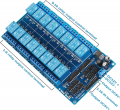
there was a warning that this product is frequently returned but i needed something quick and - it did arrive only few hours later. The delivery driver tossed it to my porch and due to light packaging got the Alu caps ripped off. Anyway, i was in a hurry to use it so i just replaced them. Unit was working - connecting any of the inputs to GND triggered relay. that was all that mattered at the moment.
As suspected, board did have few design issues though i was not bothered much. for example i know that it is not even isolated even though it sports 16 optocouplers. Also the GNDs are tied together - in the above image they are marked on silkscreen as GND and outside board both as "DC12V -" (on the blue terminal) and "Output DC5V-" (on the header next to it). Another thing is that buck converter is not used to power relays. that is what i would have done so board can be powered from various voltages such as 7-30VDC. In other words, if you come across this product, do not power it by higher voltage. Buck converter is just a "companion' circuit not really needed for this board since optocouplers did not do much anyway. Even to keep the optocouplers in place 78L05 would be more than enough.
so... what it the issue?
the issue is that lack of isolation was making controller have hard time starting up when relay board was connected, and controller was plugged to USB port. this was only at the moment controller is connected to USB - if relay board was powered or connected moment later, everything was working but i was not happy with that. so, i wanted to make those relay module optocouplers used... The Sainsmart has schematics and PCB layout available for download see attached). And while it is less than a perfect it made it easier the to hack the board. And since others may benefit from same workaround i decided to make this post...
The surgery is basically splitting +5V rail on relay module into two separate nodes:
one node connects the "+5V" pins on IO header only to resistor networks (left side of schematic - PR1, PR2, PR4, PR7).
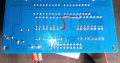
rest of the +5V circuit stays as is. for that i needed to make five small incisions (short vertical yellow lines) and solder two/three wires (curved thicker yellow lines).
To help illustrate how this +5V rail is split i changed default front side copper from red to two other colors:
the side connecting to external circuit is pink.
the side that is still internal 5V rail is light green.
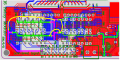
with that, i can connect the 16 lines to my controller, and the "+5V" pin header from relay module to positive rail of my controller (3V3 or 5V). do NOT connect GND from relay module to controller.
this completely eliminated problems.
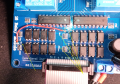
EDIT needed one more jumper wire (photoshopped)
there was a warning that this product is frequently returned but i needed something quick and - it did arrive only few hours later. The delivery driver tossed it to my porch and due to light packaging got the Alu caps ripped off. Anyway, i was in a hurry to use it so i just replaced them. Unit was working - connecting any of the inputs to GND triggered relay. that was all that mattered at the moment.
As suspected, board did have few design issues though i was not bothered much. for example i know that it is not even isolated even though it sports 16 optocouplers. Also the GNDs are tied together - in the above image they are marked on silkscreen as GND and outside board both as "DC12V -" (on the blue terminal) and "Output DC5V-" (on the header next to it). Another thing is that buck converter is not used to power relays. that is what i would have done so board can be powered from various voltages such as 7-30VDC. In other words, if you come across this product, do not power it by higher voltage. Buck converter is just a "companion' circuit not really needed for this board since optocouplers did not do much anyway. Even to keep the optocouplers in place 78L05 would be more than enough.
so... what it the issue?
the issue is that lack of isolation was making controller have hard time starting up when relay board was connected, and controller was plugged to USB port. this was only at the moment controller is connected to USB - if relay board was powered or connected moment later, everything was working but i was not happy with that. so, i wanted to make those relay module optocouplers used... The Sainsmart has schematics and PCB layout available for download see attached). And while it is less than a perfect it made it easier the to hack the board. And since others may benefit from same workaround i decided to make this post...
The surgery is basically splitting +5V rail on relay module into two separate nodes:
one node connects the "+5V" pins on IO header only to resistor networks (left side of schematic - PR1, PR2, PR4, PR7).
rest of the +5V circuit stays as is. for that i needed to make five small incisions (short vertical yellow lines) and solder two/three wires (curved thicker yellow lines).
To help illustrate how this +5V rail is split i changed default front side copper from red to two other colors:
the side connecting to external circuit is pink.
the side that is still internal 5V rail is light green.
with that, i can connect the 16 lines to my controller, and the "+5V" pin header from relay module to positive rail of my controller (3V3 or 5V). do NOT connect GND from relay module to controller.
this completely eliminated problems.
EDIT needed one more jumper wire (photoshopped)
Attachments
-
55.1 KB Views: 8
-
491.4 KB Views: 7
-
74.2 KB Views: 7
Last edited: