Delay a relay after startup

Thread Starter

andrew74

Joined Jul 25, 2022
204
Assume an ntc that connected to Vin (like 80V) limits inrush current at startup (e.g. 100A lasting 3ms).
At the startup, with its cold resistor it limits current by warming up.

I would like after those 3ms a relay (solid state given the high switching speed) in parallel with the ntc to close by shorting the ntc, so as to disconnect it from the circuit.

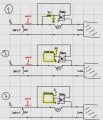
I have thought of 3 different "solutions" that I would like you to comment on (with pros and cons), but I would also like your design solutions (schematically).
SmartSelect_20250930_214757_Samsung Notes.jpg

1) Classic RC circuit ..too good to be true .. where's the catch??

2) Complex solution requiring a TIMER (not necessarily the 555). But I don't remember if its output generates a constant signal after x ms or if it generates a square wave, that is, an oscillation of period x ms

3) A supervisor that generates a logic signal (high/low) after a defined delay (a few ms) following the power-on. That logic signal is then to be used to activate the gate/solid state relay (SSR) input that actually closes the connection

4) Your designs..
 

MrAl

Joined Jun 17, 2014
13,667
Assume an ntc that connected to Vin (like 80V) limits inrush current at startup (e.g. 100A lasting 3ms).
At the startup, with its cold resistor it limits current by warming up.

I would like after those 3ms a relay (solid state given the high switching speed) in parallel with the ntc to close by shorting the ntc, so as to disconnect it from the circuit.

I have thought of 3 different "solutions" that I would like you to comment on (with pros and cons), but I would also like your design solutions (schematically).

View attachment 356611

1) Classic RC circuit ..too good to be true .. where's the catch??

2) Complex solution requiring a TIMER (not necessarily the 555). But I don't remember if its output generates a constant signal after x ms or if it generates a square wave, that is, an oscillation of period x ms

3) A supervisor that generates a logic signal (high/low) after a defined delay (a few ms) following the power-on. That logic signal is then to be used to activate the gate/solid state relay (SSR) input that actually closes the connection

4) Your designs..
Hi,

A couple of points to think about...

1. A relay coil driven with a raw RC is prone to open and/or close too slowly. This can cause arcing and early failure.
2. The contacts should be grossly overrated for long life. This is a serious design flaw in many commercial devices as the designers thing they can use relays with the same rating as the current to be passed when closed.

To get around #1 there should be some way to provide a nice clean on/off drive to the relay coil. There are different ways to do this, including a circuit to switch on (and off) at certain thresholds. Perhaps a simple comparator circuit with hysteresis.

#2 is self-explanatory. Using a relay with contacts rated for 10x the expected normal current would be good if the relay has to drive a motor. Maybe even 20x. 6x would be typical for long life. For light bulbs you probably want to go at least 10x.

Oh and also, don't use a flyback diode use a zener or carefully calculated resistor. That helps speed up contact opening.
 
Last edited:

panic mode

Joined Oct 10, 2011
4,864
Vi is DC.
50kW? Why not 8kW? ..80V*100A
But what interests me is the circuit/logic to implement, for the calculations we can also change the data
correct, 8kW is fine if one can find them. 100A is a lot. the largest one i ever saw was fraction of that. checking with Mouser or DigiKey, they do have variants that are good for up to 80A.
3ms is too short for mechanical relay or contactor so ICL would need to hold up a bit longer... or you can use SSR or MOSFET
 

sghioto

Joined Dec 31, 2017
8,633
2) Complex solution requiring a TIMER (not necessarily the 555). But I don't remember if its output generates a constant signal after x ms or if it generates a square wave, that is, an oscillation of period x ms
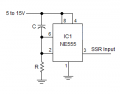
A NE555 wired as below gives a delayed High output when first powered ON equal to 1.1RC and remains ON until powered OFF.
Fulfills circuit designs in #2 and #3.

1759361382103.png
 
Last edited:

Thread Starter

andrew74

Joined Jul 25, 2022
204
Hi,

A couple of points to think about...

1. A relay coil driven with a raw RC is prone to open and/or close too slowly. This can cause arcing and early failure.
2. The contacts should be grossly overrated for long life. This is a serious design flaw in many commercial devices as the designers thing they can use relays with the same rating as the current to be passed when closed.

To get around #1 there should be some way to provide a nice clean on/off drive to the relay coil. There are different ways to do this, including a circuit to switch on (and off) at certain thresholds. Perhaps a simple comparator circuit with hysteresis.

#2 is self-explanatory. Using a relay with contacts rated for 10x the expected normal current would be good if the relay has to drive a motor. Maybe even 20x. 6x would be typical for long life. For light bulbs you probably want to go at least 10x.

Oh and also, don't use a flyback diode use a zener or carefully calculated resistor. That helps speed up contact opening.
Thank you very much for your reply.

If I understand correctly, what you are proposing is a comparator with the Vin voltage containing inrush on an input, and a resistor (or zener) divider that determines a threshold on the opther input.
If I'm right ..how does this affect 'time'? (I mean 3ms I want to wait before closing)
Doesn't it simply compare two input signals?

I have no experience, I would like to understand how it works, perhaps even with a qualitative sketch of the circuit/logic you propose
 

Thread Starter

andrew74

Joined Jul 25, 2022
204
correct, 8kW is fine if one can find them. 100A is a lot. the largest one i ever saw was fraction of that. checking with Mouser or DigiKey, they do have variants that are good for up to 80A.
3ms is too short for mechanical relay or contactor so ICL would need to hold up a bit longer... or you can use SSR or MOSFET
Right, thanks for the clarification.
Any opinions on the proposed circuits?
 

Thread Starter

andrew74

Joined Jul 25, 2022
204
I suggest the circuit in post #6.
C = 33nf
R = 82K
Delay = 2.97ms
Will need to limit the supply voltage to the 555.
What do you mean by limiting the 555's power supply?
Do you mean adding a DC-DC because it can't be powered by the Vin 50V at which the inrush arrives?
 

MrAl

Joined Jun 17, 2014
13,667
Thank you very much for your reply.

If I understand correctly, what you are proposing is a comparator with the Vin voltage containing inrush on an input, and a resistor (or zener) divider that determines a threshold on the opther input.
If I'm right ..how does this affect 'time'? (I mean 3ms I want to wait before closing)
Doesn't it simply compare two input signals?

I have no experience, I would like to understand how it works, perhaps even with a qualitative sketch of the circuit/logic you propose
Hi,

Yes, a comparator 'compares' two input signals, then provides a logical output depending on the states of the two inputs.
Let's call the inputs P for the + input and N for the - input.
If P>N then the output is positive max
if N>P then the output is negative max (often just ground 0v)
If P=N we have a problem because the output becomes a linear function which we don't want, so we normally use a resistor from output to the P input so the P input is forced to keep the output in the current state. That brings us back to just P>N or N>P with no other input states to worry about (in most cases).

So yes, it compares the two inputs, but most importantly, it provides ONLY a max positive or max negative output. In your case, that would mean the relay is either turned fully on or turned fully off, and will do so at the speed of the relay itself which is usually good enough.

Now the implementation is next. You can use a low cost comparator like the LM339 or you can possibly roll your own using transistors. You can find schematics for that on the web.
Using an LM339 you have to limit the DC voltage for the power supply connections. You might have to use a regulator.

A quick thing of interest here: you could test your relay to see what the natural delay is to turn it on. It could be 5ms already, or even up to maybe 20ms. That would mean just a comparator and driver transistor most likely.

Did you mention what the voltage was of the relay you intend to use? That would help narrow down the best type of implementation.
 

Thread Starter

andrew74

Joined Jul 25, 2022
204
Hi,

Yes, a comparator 'compares' two input signals, then provides a logical output depending on the states of the two inputs.
Let's call the inputs P for the + input and N for the - input.
If P>N then the output is positive max
if N>P then the output is negative max (often just ground 0v)
If P=N we have a problem because the output becomes a linear function which we don't want, so we normally use a resistor from output to the P input so the P input is forced to keep the output in the current state. That brings us back to just P>N or N>P with no other input states to worry about (in most cases).

So yes, it compares the two inputs, but most importantly, it provides ONLY a max positive or max negative output. In your case, that would mean the relay is either turned fully on or turned fully off, and will do so at the speed of the relay itself which is usually good enough.

Now the implementation is next. You can use a low cost comparator like the LM339 or you can possibly roll your own using transistors. You can find schematics for that on the web.
Using an LM339 you have to limit the DC voltage for the power supply connections. You might have to use a regulator.

A quick thing of interest here: you could test your relay to see what the natural delay is to turn it on. It could be 5ms already, or even up to maybe 20ms. That would mean just a comparator and driver transistor most likely.

Did you mention what the voltage was of the relay you intend to use? That would help narrow down the best type of implementation.
Thank you for the explanation!
Very kind.

I know that with a simple resistive divider (fed with a Vin) on input P and a zener on input N the output of the comparator varies between HIGH and LOW (obviously referring to its supply Vcc and GND or -Vcc). More specifically, I divide with the resistive divider on P the Vin so that when it exceeds a certain threshold voltage, the output of the divider matches/matches the Vz of the zener.
However, this works well when I have to switch the output of the comparator between high and low depending on the voltage Vin..

..it is still not very clear to me how to apply it in the case of inrush current.
I'm talking about inrush currents of tens of amperes and a few ms ...should I convert them to voltage? Should I use an Rsense and then an opamp?
 

panic mode

Joined Oct 10, 2011
4,864
what NTC did you have in mind? is the load capacitive?
how often is this powered up and how?

i could see NTC/ICL/R in series with the load and simple relay or contactor rated for load voltage and current. and since circuit is 50VDC, it is very close to standard coil voltage of 48VDC. before power is applied it is off and relay will be off (NO contact open). this means NTC/ICL/R is part of the circuit and ready to limit the current. when power is applied relay closes but not instantly - few ms it takes for relay to close is the time that inrush current is limited on every power up. then with relay contact closed, NTC/ICL/R are out of picture.

and example of suitable candidate is DCNLEV100-ES
https://www.littelfuse.com/products...ge-dc-contactor-relays/dcnlev100/dcnlev100-es
as a current limiting resistor, something like TE2500B1R0J will do. it is a beast but it should handle full current continuously (if relay timing is off or there is a failure)
 
Last edited:

Thread Starter

andrew74

Joined Jul 25, 2022
204
what NTC did you have in mind? is the load capacitive?
how often is this powered up and how?

i could see NTC/ICL/R in series with the load and simple relay or contactor rated for load voltage and current. and since circuit is 50VDC, it is very close to standard coil voltage of 48VDC. before power is applied it is off and relay will be off (NO contact open). this means NTC/ICL/R is part of the circuit and ready to limit the current. when power is applied relay closes but not instantly - few ms it takes for relay to close is the time that inrush current is limited on every power up. then with relay contact closed, NTC/ICL/R are out of picture.

and example of suitable candidate is DCNLEV100-ES
https://www.littelfuse.com/products...ge-dc-contactor-relays/dcnlev100/dcnlev100-es
as a current limiting resistor, something like TE2500B1R0J will do. it is a beast but it should handle full current continuously (if relay timing is off or there is a failure)
Are you actually thinking of using a NTC to limit the current and why delaying for only 3ms?
What is the actual load that surges at 100 amps?
Hi guys.

Since I asked this question in the Homework Help section I don't really have any design specifics, it's more of a theoretical doubt with assumptions.
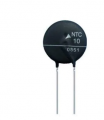
Regarding the NTC, since the idea/hypothesis is a pcb ... I had seen this type:
1759779281912.png
So I would like to continue on this path.
(don't look at the code on the ntc! the picture is only demonstrative ... I would say, however, that we agree that an NTC with a cold resistance of 10 ohms is enough to decimate the current(?))

On your question concerning the load that surges at 100 amps, I would like to hypothesize a system that causes inrush because of capacitors and that, when they are finished charging, must be able to draw up to 20-30A

How, however, does this information affect my initial question about design ideas to short NTC?
 

MrAl

Joined Jun 17, 2014
13,667
Thank you for the explanation!
Very kind.

I know that with a simple resistive divider (fed with a Vin) on input P and a zener on input N the output of the comparator varies between HIGH and LOW (obviously referring to its supply Vcc and GND or -Vcc). More specifically, I divide with the resistive divider on P the Vin so that when it exceeds a certain threshold voltage, the output of the divider matches/matches the Vz of the zener.
However, this works well when I have to switch the output of the comparator between high and low depending on the voltage Vin..

..it is still not very clear to me how to apply it in the case of inrush current.
I'm talking about inrush currents of tens of amperes and a few ms ...should I convert them to voltage? Should I use an Rsense and then an opamp?
Hi again,

Well if we define the 'inrush' current as a current that increases very fast but then after a somewhat sort time it decreases to some normal level, then we want to detect the higher current and then after a delay (where we assume the current has then decreased) turn the relay on to short out the limiter component (resistor or thermistor). That might help to think about this clearly.

What this means is that the comparator will be set at some level with a voltage reference (like a zener) and when the voltage gets over that value it starts the delay countdown. The voltage is of course developed from across the limiting resistor or thermistor, or perhaps a second resistor just to sense current.

If the output of the comparator is normally 0 volts, then when the current shoots up the voltage across it shoots up, and the comparator output goes from 0 volts to say 5 volts and that starts the delay. After the delay period, the relay coil turns on and a second set of contacts bypasses the delay and comparator and keeps the relay turned on.
This means the comparator needs to have enough built in hysteresis to keep the relay energized for enough time so the relay contacts actually close, or that alone keeps the relay turned on.

Just for example, let's say we are using a 1 Ohm sense resistor which also limits the current, and say the normal current is 1 amp and the surge is 2 amps. That develops 1 volt and 2 volts respectively.
If the comparator is set for 1.6 volts (detecting 1.6 amps) then when the current goes to 2 amps that trips the comparator and the output goes to +5v thus initiating the turn on of the relay. Now say the current drops to 1 amp, then the relay contacts actually close. The comparator lower limit would be set to say 0.5 amps, and so it will remain with the output at +5 volts. Only when the system is shut off will the comparator and thus the relay be reset to the starting state.
So in this example we set the upper limit of the comparator to 1.6 volts and lower limit to 0.5 volts. We can look at the formulas for those settings. It involves the usual comparator connections plus an extra resistor from the output of the comparator to the non-inverting input of the comparator, which will also have other resistors connected to it.

The calculation for the hysteresis resistor value is not that difficult. When you come up with the basic circuit you can post that and then we'll look at calculating that resistor value.
 
Top