regulator on hall effect

Thread Starter

Rangerover

Joined Aug 18, 2018
31
HI All,
as mentioned in a couple of other posts, im looking to build a kids battery operated car using a hall effect throttle

i understand that hall effect and potentiometer are two different technologies although is there something out there that i can regulate the speed of the hall effect throttle (like a dial) that the regulator stops the hall effect from its full range?

would have to be a simple setup and easy to use

thanks
Sam
 

Dodgydave

Joined Jun 22, 2012
11,395
An Hall effect sensor works on Magnetism, so it's either On or Off ...whereas a potentiometer gives a Linear output per rotation position.
 

Ya’akov

Joined Jan 27, 2019
10,235
You need to investigate how the hall effect sensor is used to control the speed of the motor then you won’t have the same question.

To begin with, the hall effect sensor senses the position of the throttle. That’s all it does. It doesn’t control the motor, it is an input to the circuit that controls the motor. If you want to set limits, that sensor is the wrong place to be looking.

If you are willing to learn a little you will get more out of it than a thousand questions you can, in your current position, think of to ask.

What you need to work out, even though it seems a little roundabout, is how the board that controls the motor operates, that’s foundational. Then you will find your question either vanish or change. You don’t even know what question to ask yet.

You know your goal, but you don’t have any idea how to get there and you have started out wrong. Concentrate on understanding the basics of how your particular motor controller operates and the light will come on.
 

Tonyr1084

Joined Sep 24, 2015
9,744
The only thing I can think of if you must use a HET (Hall Effect Transistor) is to use a bunch of them with a magnet on the throttle. As you turn the throttle you switch on different HET's. Each is connected to your motor speed controller and wired in a configuration so that the controller sees an increasing demand of power to the motor. Please don't ask me how to do that - honestly, I'd have to do a lot of research before I could begin to point in the right direction.
 

Alec_t

Joined Sep 17, 2013
15,119
I've never heard of a 'Hall effect throttle', but there are Hall sensors with analogue outputs, so one of those with a moving magnet could be the basis of a throttle.
 

Ya’akov

Joined Jan 27, 2019
10,235
I've never heard of a 'Hall effect throttle', but there are Hall sensors with analogue outputs, so one of those with a moving magnet could be the basis of a throttle.
Here's an example. It has proportional output in this case, and in theory, the TS could monkey with the signal but I don't think that is the first line way to create a governor in this case. I am hoping he can learn a bit about how his controller works, and decide on the best way to ensure a top speed is set.

https://www.amazon.com/JCMOTO-Throttle-Accelerator-Electric-Scooter/dp/B01ICAWLLU/
 

Tonyr1084

Joined Sep 24, 2015
9,744
Years ago I was watching some survivor show about what would happen after an apocalypse. Scrounging parts they made a solar powered cart using five car batteries in series. They built a switch that would tap power from 1, 2, 3, 4 or all 5 batteries for having five different speeds. Don't recall what kind of motor they used, that was years ago.
 

ElectricSpidey

Joined Dec 2, 2017
3,335
You could connect the output of the throttle to an op-amp, then by adjusting the offset of the op-amp you could change the range of the throttle.
 

debe

Joined Sep 21, 2010
1,417
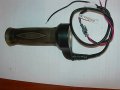
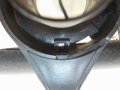
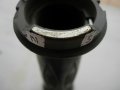
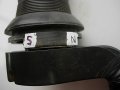
This is a Hall sensor throttle control & it used a Vcc of 5V DC. It puts out a linear voltage in relation to a varying magnetic field. The type of Hall sensor is UGN3503 linear output. You could probably alter the twist throttle to have a limiting stop to it.1.JPG 2.JPG 3.JPG 4.JPG
 

Ya’akov

Joined Jan 27, 2019
10,235
@Rangerover I think I would feel more comfortable if you even used some mechanical device to limit throttle travel than to try to alter the sensor output which, if your method failed, could fail full on—not a nice prospect.
 

Thread Starter

Rangerover

Joined Aug 18, 2018
31
Thanks for everyones comments...
I had a thought and by all means it might be a silly one, athough, can i just get a pot, connect the pot to the signal and negative wires of the HE which when turning the dial on the pot changes the resistance, therefore limiting the HE?
 

Ya’akov

Joined Jan 27, 2019
10,235
Thanks for everyones comments...
I had a thought and by all means it might be a silly one, athough, can i just get a pot, connect the pot to the signal and negative wires of the HE which when turning the dial on the pot changes the resistance, therefore limiting the HE?
You can wire the potentiometer as a voltage divider and use it to change the output of the throttle sensor but it will not be a limiter, it will change the entire range to something different. In other words, if you wanted to limit the speed to 50%, using the voltage divider would make the throttle range 0-50% rather than limiting the throttle at 50.

This might be OK, but it also might not work as expected. You could test it.
 

Thread Starter

Rangerover

Joined Aug 18, 2018
31
Just so i understand... if i wire in the pot, turn the pot 50%, when you press the HE throttle all the way, the HE throttle will only be 50% at its max speed?
 

Ya’akov

Joined Jan 27, 2019
10,235
Just so i understand... if i wire in the pot, turn the pot 50%, when you press the HE throttle all the way, the HE throttle will only be 50% at its max speed?
That's how I would expect it to work, but you'd have to test the behavior of the controller with it in place.
 

Thread Starter

Rangerover

Joined Aug 18, 2018
31
Thanks...ill have a test run in the next day or so.
Hopefully it works as that should be sufficient for what i need

Appreciate everyone's help and support
 

Tonyr1084

Joined Sep 24, 2015
9,744
@Rangerover I think I would feel more comfortable if you even used some mechanical device to limit throttle travel than to try to alter the sensor output which, if your method failed, could fail full on—not a nice prospect.
I had a mechanical throttle fail full on once on my mini-bike. I was 16 when that happened. The first thing I had to do was head for grass, then dump the bike over deliberately, then rush back to the bike to kill the power. My throttle hung up on the air filter. Quite a scary scenario. If my cable would have broken the bike would have only merely rolled to a stop. Shortly after that incident, and determining why the throttle hung wide open I added a kill switch to the bike. Formerly I would just choke the bike, but when you're suddenly accelerating to full speed and you need both hands on the bars, reaching down to the engine is not a doable feat. Especially when on uneven terrain.

Always do your best to engineer for failure in safe mode. In other words, loss of control means loss of power. A bike or cart that can't go can't hurt you. But one that can't stop - - - . Get the point?
 

ElectricSpidey

Joined Dec 2, 2017
3,335
Thanks for everyones comments...
I had a thought and by all means it might be a silly one, athough, can i just get a pot, connect the pot to the signal and negative wires of the HE which when turning the dial on the pot changes the resistance, therefore limiting the HE?
The problem with using a pot on the output of the throttle is many fold, first if you wire it the wrong way you risk shorting the output directly to either ground or positive, second without knowing the internals of the throttle, it would be quite difficult to determine the correct value for the pot.

I’m telling you…using an op-amp in between the throttle and the controller is just about foolproof, first the input impedance of an op-amp is very high, and you risk very little as far as damaging the throttle. Second you can trim off as much or as little of the output of the throttle as you want.

The circuit is also very simple, and you won’t need anything special as far as the amp is concerned.

As far as being an extra failure point…well you need a emergency cutoff switch and good brakes to begin with, without those the car is not safe to begin with.
 

Ya’akov

Joined Jan 27, 2019
10,235
The problem with using a pot on the output of the throttle is many fold, first if you wire it the wrong way you risk shorting the output directly to either ground or positive, second without knowing the internals of the throttle, it would be quite difficult to determine the correct value for the pot.

I’m telling you…using an op-amp in between the throttle and the controller is just about foolproof, first the input impedance of an op-amp is very high, and you risk very little as far as damaging the throttle. Second you can trim off as much or as little of the output of the throttle as you want.

The circuit is also very simple, and you won’t need anything special as far as the amp is concerned.

As far as being an extra failure point…well you need a emergency cutoff switch and good brakes to begin with, without those the car is not safe to begin with.
I suggested he wire it as a voltage divider, not a rheostat. In any case, simple as the op amp is, he's not even prepared to learn basics of the controller, he's not going to learn op amps for this.
 

Thread Starter

Rangerover

Joined Aug 18, 2018
31
I suggested he wire it as a voltage divider, not a rheostat. In any case, simple as the op amp is, he's not even prepared to learn basics of the controller, he's not going to learn op amps for this.
Yaakov - without being rude, you have no idea what i have learnt in the last 12months regarding circuits, dc voltage, hall effect etc. i am a complete novice when it comes to electronics although am searching the internet to learn as this has now become a new hobby for me and thought this forum was to help people like me that has an interest to learn. i find this forum very informative as im learning from people that has experience and knowledge.
im sorry that i didn't comment/acknowledge your post above although i am grateful for everyone that responds to my questions

i have taken notes to look up rheostat and op amps to learn more as it could help me in the future with other projects that i have planned

i hope that this doesn't discourage you from helping/supporting me (or anyone else) in the future

take care
Sam
 
Top