Hello , so If its a voltage source we need to have high output impedance so the amplifiers (low input impedance)
Will have all the 5V.
So given the simulation below I can use R1=10K R2=3K and I can use 10 time larger values or 100 times larger values which will make the same ratio.
What is the intuition regarding choosing the proper resistor ratio?
Thanks. View attachment 354546
do not think of the regulators impedance, nor the thing your providing power to.
it has been mentioned a few times,
the only thing that matters for r1 abd r2 is the ratio, that sets constant output voltage of the regulator.
the choice of values is absolutely user controlled.
as mentioned in previous posts, there is a small current coming out of Vadj, which adds to the current coming down R1.
you want the R1 current to dominate ,
R1 and R2 are in series across the constant output voltage, thus simple ohms law , and knowing that the Vadj pin is high impedance , no current flows into it, we can determine ypthe current flowing through R1 R2.
we want the R1 current to dominate , so say the current out of Vadj us 10uA, we want R1 current to be at least 10 times that.
you suggext 10 k and 3k2, what current would flow through R1.?
what would the voltage at Vadj be ?
now try 100 K and 32K , what would the current be and voltage at Vadj,
now try say 10 ohms and 3.2 ohms, what would the current through R1 be and the voltage at Vadj ?
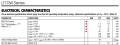
Yes, Iref is always the same, with a max. value of 3μA (edit: 10μA).
As I stated, you use an R1 resistor no larger that 1.21kΩ to give a minimum output bias current of 1mA with Vref = 1.21V.
Then you select R2 to give the desired output voltage.
For example to give 5V output with R1 = 1.21kΩ, R2 = (5V-1.21V) / 1mA = 3.79kΩ (pick nearest 1% value of 3.83kΩ).
For those values of resistors, the reference bias current will have negligible effect on the output voltage.
@yef smith
yes, @dl324 is correct , Iadj is variable over temptature , voltage and process , nominal 3uA , up to 10 uA
thats why you set the current through R1 , R2 at around 1 mA, this current is stable , and much bigger than Iadj, so the change in Iadj has insignificant effect on the output voltage
so to a first approximation, the Iadj is constant
BTW. I was wrong, in this chip Iadj follows into the pin.

 Facebook
 Google
 GitHub
 Linkedin