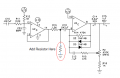
Putting a resistance in parallel with R13 *increases* the gain of the circuit. To lower the circuit gain, add a resistance in series with R13. 4.7K would reduce th gain by something like 75%, too large for a first pass. I'd start with something like 1K.
The gain of the opamp itself, called the open-loop gain, is irrelevant. For proper operation, the feedback components assure that the overall circuit gain is much less than the individual opamp gain.
This is the second on-going thread about an electric guitar preamp that has a highpass filter that cuts most guitar fundamental low and medium frequencies.
Maybe it makes up for the very poor high frequency response of guitar speakers?
One thing I noticed are resistors R7A and R8A form a voltage divider that cuts the signal output from U1A by 50%. Reducing the value of R8A will further reduce the signal before getting to U2D and U2C.
One thing I noticed are resistors R7A and R8A form a voltage divider that cuts the signal output from U1A by 50%. Reducing the value of R8A will further reduce the signal before getting to U2D and U2C.
SO, I went from 1.5k to 2.7k for R13. Still too much drive. Should I keep going on R13? I guess I need to get some higher value resistors and try R14, R15 mods....
Thx for the on-going thoughts and suggestions
So it comes down to this: Basically, there are two different ways to alter the effect of the distortion stage.
1. Change the gain of the stage. This is what happens when you add a resistor in series with R16, or in parallel with R15.
2. Change the amplitude of the signal going into the stage. This is what happens when you add a resistor to GND between R13 and C12.
Note that because of the capacitors around the stage, changing the effective value of any resistor will change the tonal characteristics of the stage, most notably when the Drive pot is set for minimum distortion.
Note also that messing around in the R13-C12 area changes both the signal amplitude *and the gain of the stage*, because those components are the shunt leg of the U2C feedback loop. Adding a resistor to GND obviously attenuates the signal amplitude at that point. BUT, it also reduces the Thevenin equivalent resistance "seen" by the series leg (C13, R15, etc.) U2C feedback network, and this *increases* the gain of the stage. The math for this is not complex, although it is messier because of those pesky capacitors. So the fun question is this: What is the real effect of adding the resistor to GND? Is the net signal amplitude change an increase or decrease ? ? ?

 Facebook
 Google
 GitHub
 Linkedin