reducing gain on multi-function wah-wah pedal....

Thread Starter

bigbearth

Joined Nov 27, 2023
14
So it comes down to this: Basically, there are two different ways to alter the effect of the distortion stage.

1. Change the gain of the stage. This is what happens when you add a resistor in series with R16, or in parallel with R15.

2. Change the amplitude of the signal going into the stage. This is what happens when you add a resistor to GND between R13 and C12.

Note that because of the capacitors around the stage, changing the effective value of any resistor will change the tonal characteristics of the stage, most notably when the Drive pot is set for minimum distortion.

Note also that messing around in the R13-C12 area changes both the signal amplitude *and the gain of the stage*, because those components are the shunt leg of the U2C feedback loop. Adding a resistor to GND obviously attenuates the signal amplitude at that point. BUT, it also reduces the Thevenin equivalent resistance "seen" by the series leg (C13, R15, etc.) U2C feedback network, and this *increases* the gain of the stage. The math for this is not complex, although it is messier because of those pesky capacitors. So the fun question is this: What is the real effect of adding the resistor to GND? Is the net signal amplitude change an increase or decrease ? ? ?

ak
Ooohh. Do you have any other suggestions that can be done w lower value resistors(I dont have any larger values to change R14 or R15)?
Trial and error until I hear a reduction in drive....

Thx again.
 

AnalogKid

Joined Aug 1, 2013
12,145
I agree with all that above but still think the best way is to reduce the value of R14 as I described in post #11.
Disagree. Eliminate the capacitors and diodes and look at the stage. The stage gain is R14 / R13 = 470K / 1.5K = 313, or 50 dB. At that gain, the feedback loop opens up at 10 kHz. Worst case, P2 and R16 feed back 9% of the output signal for a much

My guess is that R14 is there only to stabilize the output operating point, and is sized large enough to have minimal impact on the intended operation of the circuit. It will come into play when P2 is turned all the say down.

Could be wrong; simulation could prove it.

ak
 

sghioto

Joined Dec 31, 2017
8,634
Could be wrong; simulation could prove it.
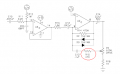
Breadboarded the circuit shown below:
Stage gain at 1000hz with the pot at max is 63 and 10 at minimum.
Reducing R14 to 100K: Max gain 25, minimum 10. No significant reduction in gain at the minimum setting.
Reducing R15 to 22K: Max gain 45, and minimum 5.5.
1702066764179.png
 
Last edited:

AnalogKid

Joined Aug 1, 2013
12,145
Reducing R14 to 100K: Max gain 25, minimum 10. No significant reduction in gain at the minimum setting.
Not surprising. At the minimum setting, the series feedback impedance that is in parallel with R14 is at its lowest value, so the large R14 value has the least effect.

Reducing R15 to 22K: Max gain 45, and minimum 5.5.
Post #5, sentence #1.

ak
 

MisterBill2

Joined Jan 23, 2018
27,591
How about INCREASING R16? That will allow MORE negative feedback. Try 4.7K or even 10K. AND changing it will not alter any RC time constants.
 

AnalogKid

Joined Aug 1, 2013
12,145
How about INCREASING R16? That will allow MORE negative feedback. Try 4.7K or even 10K. AND changing it will not alter any RC time constants.
Again, post #5.

AND - R16 and P2 form a Thevenin-equivalent resistance that is in series with R15 *and C13*. With the values on the schematic, this resistance varies from 0-ish when the wiper is at the top, to 5.5K when the wiper is near the center of rotation, to 909 ohms when the wiper is at the bottom.

ak
 

sghioto

Joined Dec 31, 2017
8,634
Increasing R16 to a 10K will reduce the max gain to 20 but has no effect on the low end. Minimum gain remains at 10 which is apparently too high according to the TS.
 

MisterBill2

Joined Jan 23, 2018
27,591
Increasing R16 will allow more negative feedback, and that will allow a greater gain reduction. see the circuit in post #44. A greater resistance for R16 will increase the signal voltage at the bottom of P2
 

sghioto

Joined Dec 31, 2017
8,634
Increasing R16 will allow more negative feedback, and that will allow a greater gain reduction. see the circuit in post #44. A greater resistance for R16 will increase the signal voltage at the bottom of P2
It does when the pot is at the bottom reducing the max gain but at the top end the gain remains at 10 regardless of the value of R16. The pot and R16 become just a load on the output of U2C. I verified these readings on the breadboard at 1kHz. The problem at hand is to further reduce the gain at the minimum gain setting of the pot.
1702151514690.png
 
Last edited:

sghioto

Joined Dec 31, 2017
8,634
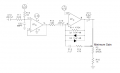
Another option is to add RV1 as a level control to the input of U2D to reduce the input to U2C.
Should be easy to install off of SW1.
1702155428079.png
 
Top