Reduce noise from OP Amp + Low pass filter for accelerometer data

MisterBill2

Joined Jan 23, 2018
27,587
Is it possible that there is an error in the frequency calibration, and that the noise is actually 60 hZ??
AND, while that accelerometer can only use the 3.3 volt supply, if the amplifier can be powered separately than it can use a much more sensible higher voltage.
One likely noise source is any nearby lighting. Florescent tubes can radiate a huge electrostatic noise field, as can CRT displays. Not sure about other types of display, but they all are suspect radiation sources. So moving away is the simple reduction trick.
 

Audioguru again

Joined Oct 21, 2019
6,826
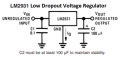
All low dropout voltage regulators oscillate if they do not have the output capacitor to ground shown and discussed on their datasheet. This one (AP2112) is the first Cmos low dropout voltage regulator I have ever seen. The datasheet says, "Stable with 1uF input/output capacitors".
 

nsaspook

Joined Aug 27, 2009
16,330
Is it possible that there is an error in the frequency calibration, and that the noise is actually 60 hZ??
AND, while that accelerometer can only use the 3.3 volt supply, if the amplifier can be powered separately than it can use a much more sensible higher voltage.
One likely noise source is any nearby lighting. Florescent tubes can radiate a huge electrostatic noise field, as can CRT displays. Not sure about other types of display, but they all are suspect radiation sources. So moving away is the simple reduction trick.
Yes, the OP has some major problems with the signal chain. Low level signals with what looks like unshielded cables, to unshielded amplifier boards, to a unshielded microcontroller, producing likely more digital hash noise.

These types of noise issues are why I prefer to use modern digital interfaces (i2c, spi) to an Accelerometer instead of analog if I'm connecting to a microcontroller. The inside chip analog processing and digitization process is usually much better than regular external processing and the typical ADC inside a controller and you reduce external RMI/EMI generated analog noise in the processing chain.

The original analog device from the paper is in the range of $130 : https://www.mouser.com/datasheet/2/418/9/ENG_DS_805M1_Accelerometer_A3-3351118.pdf ,
the OP is using a substitute $15 analog device board : https://www.analog.com/media/en/technical-documentation/data-sheets/ADXL335.pdf
with overall much worse specifications on the low level analog output signal.

A modern $15 3-axis accelerometer, ultra high resolution (16 bit), low-noise, SPI 4-wire digital output, ±2.5g full-scale
https://www.st.com/en/mems-and-sensors/lis3dhh.html

A higher end $75 (355 for digital, 254 for analog) device for low level signal detection (digital 20 bit)
https://www.mouser.com/datasheet/2/609/adxl354_adxl355-3121962.pdf
 

MisterBill2

Joined Jan 23, 2018
27,587
In times long past, early 1970's, I was routinely connecting both accel devices to both charge amplifiers and just high gain amplifiers, all with shielded cables, nothing digital anywhere. And NO NOISE ISSUES at all. Of course the coaxial cables were very special, low tribo-electric properties( non-microphonic) and quite high impedance types. The setups were in areas with no special effort to avoid noise fields.
So it certainly is very possible to avoid noise pickup on analog systems, which none of that effort is evident in any of the photos. And a design engineer should already be aware of noise radiation and also electronic component noise.
So two recommended first steps are to start with a quiet power source, quiet amplifiers, AND adequate shielding. The anticipated signal levels may be close to those from a radio receiver antenna, which is to say, MICROVOLTS. The radiation from typical tech workbench lights is a few MILLIVOLTS at several inches away.
 

nsaspook

Joined Aug 27, 2009
16,330
In times long past, early 1970's, I was routinely connecting both accel devices to both charge amplifiers and just high gain amplifiers, all with shielded cables, nothing digital anywhere. And NO NOISE ISSUES at all. Of course the coaxial cables were very special, low tribo-electric properties( non-microphonic) and quite high impedance types. The setups were in areas with no special effort to avoid noise fields.
So it certainly is very possible to avoid noise pickup on analog systems, which none of that effort is evident in any of the photos. And a design engineer should already be aware of noise radiation and also electronic component noise.
So two recommended first steps are to start with a quiet power source, quiet amplifiers, AND adequate shielding. The anticipated signal levels may be close to those from a radio receiver antenna, which is to say, MICROVOLTS. The radiation from typical tech workbench lights is a few MILLIVOLTS at several inches away.
Exactly, that's why I digitize (digital from the sensor) the signal today in most projects.
 

JDiaz

Joined Nov 4, 2019
13
You must place an electrolytic capacitor 470uF and one disc 0.1uf every 2 or 3 in along VCC to GND.Also you should have a very ground plane to avoid noise on signal.
 

HaldorPhil

Joined Mar 8, 2019
16
The ADXL335 you are using has a 32k ohms output impedance. Analog Devices specifically did this to make adding a low pass filter simple, just add an external cap across the output and ground. Table 4 on page 11 of the ADXL335 data sheet lists what value caps to put across the output to get the desired low pass filter. This high impedance output means it is unable to directly drive a cable. I have used the ADXL356 in an industrial application and you must add a buffer op-amp located near the ADXL355 in order to drive any kind of load.

If you are driving a cable, this buffer amp needs to be able to handle higher capacitance (most op-amps can't drive more than a couple of hundred picofarads which is a really short cable. Analog devices and TI both have app notes on driving capacitive loads and both sell op-amps optimized for this purpose. At a minimum you should at least add a 100 ohm resistor in series with the output to prevent op-amp oscillation. Check for this oscillation with a scope looking in the MHz range.

https://www.ti.com/lit/an/snoa424c/snoa424c.pdf
https://www.analog.com/en/analog-dialogue/articles/ask-the-applications-engineer-25.html

The output already reaches 3V max so technically you could just connect the output directly to your ADC input (assuming it is on the same PCB. Even so, I would still add a buffer amp that is able to drive your ADC input (delta-sigma ADCs are capacitive loads). There are ADC driver op-amps designed for this specific purpose.

Also what frequency bandwidth do you need for your application? These MEMS accelerometers have an unpleasant mechanical issue that Analog Devices tries their best to hide. If the IC is exposed to high levels of vibration above 2 kHz they will experience DC rectification of noise which in extreme cases makes the output completely unusable. This DC noise rectification issue is reduced by selecting a higher range accelerometer instead (the ADXL335 is only +/-3g range, so you may want to pick a higher range or multiple range sensor instead). I had to switch an oil well pump controller design from an ADXL355 to an ADXL357 because of this. If higher frequency vibration is not present in your application you can ignore this issue.

My background is in signal processing circuitry design for load cells. My experience is the key to low noise is to use low impedance, differential signals with twisted pair wiring as much as possible. DC precision is super important to me, so I also tend to use zero, 1/F noise op-amps as well. A cap across the ADXL335 output signal followed by unity gain voltage follower op-amp plus a 100 ohm resistor in series with the buffer amp output may be all the circuitry you need.

On power supply noise issues, be aware that older 3 linear regulators (like 7805 or LM317) ripple rejection is poor. If you are using a switching AC to DC power supply you will want to follow it with an LDO regulator that has extended frequency PSRR specs to filter out switching noise. I like TI's TPS7A20 for regulating 5VDC down to 3.3V. If your input DC supply voltage is higher, there are family members in the TPS7A family than can handle higher input voltage.

https://www.ti.com/product/TPS7A20
 

HaldorPhil

Joined Mar 8, 2019
16
You must place an electrolytic capacitor 470uF and one disc 0.1uf every 2 or 3 in along VCC to GND.Also you should have a very ground plane to avoid noise on signal.
WTF? Follow the datasheet recommended caps for the LDO you select. Add a 0.01uF to 0.1uF decoupling cap at the power input pin of each IC and you are good to go.
 

HaldorPhil

Joined Mar 8, 2019
16
All low dropout voltage regulators oscillate if they do not have the output capacitor to ground shown and discussed on their datasheet. This one (AP2112) is the first Cmos low dropout voltage regulator I have ever seen. The datasheet says, "Stable with 1uF input/output capacitors".
While output caps are a good idea and rarely hurt (unless ridiculously large), there are plenty of LDO regulators that do not require an output cap to be stable.
 

HaldorPhil

Joined Mar 8, 2019
16
Yes, the OP has some major problems with the signal chain. Low level signals with what looks like unshielded cables, to unshielded amplifier boards, to a unshielded microcontroller, producing likely more digital hash noise.

These types of noise issues are why I prefer to use modern digital interfaces (i2c, spi) to an Accelerometer instead of analog if I'm connecting to a microcontroller. The inside chip analog processing and digitization process is usually much better than regular external processing and the typical ADC inside a controller and you reduce external RMI/EMI generated analog noise in the processing chain.

The original analog device from the paper is in the range of $130 : https://www.mouser.com/datasheet/2/418/9/ENG_DS_805M1_Accelerometer_A3-3351118.pdf ,
the OP is using a substitute $15 analog device board : https://www.analog.com/media/en/technical-documentation/data-sheets/ADXL335.pdf
with overall much worse specifications on the low level analog output signal.

A modern $15 3-axis accelerometer, ultra high resolution (16 bit), low-noise, SPI 4-wire digital output, ±2.5g full-scale
https://www.st.com/en/mems-and-sensors/lis3dhh.html

A higher end $75 (355 for digital, 254 for analog) device for low level signal detection (digital 20 bit)
https://www.mouser.com/datasheet/2/609/adxl354_adxl355-3121962.pdf
My digital sensor preference is the ADXL357 (ADXL356 is the analog version of the same chip). I got burnt by the DC rectification of noise issue and have switched to the ADXL357 to be able to use the +/-40g range if necessary. The ADXL357 has the same issue, but it requires a much higher amplitude, high frequency vibration before negative effects occur.

Have you looked at the new ADXL358? This the latest addition to the family and claims lower noise performance. These are such low noise, high resolution parts that is almost always a good idea to use a higher measurement range than you think you will need.
 

HaldorPhil

Joined Mar 8, 2019
16
F.Y.I. The DC rectification of noise problem is a physical effect, similar to valve float on an internal combustion engine. This become noticeable any time the IC is subjected to vibration above 2 kHz with an amplitude greater than 50% of the measurement range. I have also seen the tuned mass get stuck when subjected to shock loads (like because you dropped the PCB). You can try using the internal calibration function to unstick the tuned mass, or just rap it with a knuckle.

If you see this happening in use, the solutions I know of are to build frequency isolation (compliant rubber mounts) into your design to prevent the vibration from reaching the IC or easier still, just substitute a higher range version of the sensor in your design.
 

nsaspook

Joined Aug 27, 2009
16,330
My digital sensor preference is the ADXL357 (ADXL356 is the analog version of the same chip). I got burnt by the DC rectification of noise issue and have switched to the ADXL357 to be able to use the +/-40g range if necessary. The ADXL357 has the same issue, but it requires a much higher amplitude, high frequency vibration before negative effects occur.

Have you looked at the new ADXL358? This the latest addition to the family and claims lower noise performance. These are such low noise, high resolution parts that is almost always a good idea to use a higher measurement range than you think you will need.
Those look pretty nice. If I need another board spin those will be possible choices.
 

HaldorPhil

Joined Mar 8, 2019
16
One more bit of unsolicited advice. If you are interested in measuring the waveform shape or phase, then your sampling frequency must satisfy Nyquist (measurement rate must be at least 2.5x faster than the low pass filter corner frequency). If you have issues reading data that fast, the digital versions of these parts can buffer and hold up to 32 samples internally which will let you can read all 32 data samples in a single operation. I used that mode for a battery powered, wireless sensor. The IC was measuring data at a 1.6kHz rate and I was reading the measurement data out of the IC at a 50Hz rate which greatly extended battery life.
 

Audioguru again

Joined Oct 21, 2019
6,826
While output caps are a good idea and rarely hurt (unless ridiculously large), there are plenty of LDO regulators that do not require an output cap to be stable.
I disagree. An ordinary high dropout voltage regulator uses its output transistor as an emitter-follower without any voltage gain, then it does not oscillate without an output capacitor to ground.
But a low dropout voltage regulator uses its output transistor as common emitter with lots of voltage gain then it oscillates without a fairly large capacitor at its output to ground.
 

Attachments

HaldorPhil

Joined Mar 8, 2019
16
I disagree. An ordinary high dropout voltage regulator uses its output transistor as an emitter-follower without any voltage gain, then it does not oscillate without an output capacitor to ground.
But a low dropout voltage regulator uses its output transistor as common emitter with lots of voltage gain then it oscillates without a fairly large capacitor at its output to ground.
Older parts you are totally correct, but newer parts this is no longer true as a blanket statement.

Extending the PSRR frequency range of newer parts has had the side effect of making the LDO less dependent on the output cap. This trend is spreading since almost every AC/DC power supply we use is a switching supply and getting instrumentation grade clean power supplies from that requires extended range PSRR performance from linear regulators.
 

MisterBill2

Joined Jan 23, 2018
27,587
Consider the application stated in post #1, and realize that the input is low amplitude audio frequency, with probably two or three primary frequency bands.
My experience with an oscillating three terminal regulator was a LARGE high frequency in the output. Many volts, really. Based on the waveform presented, that is not what is happening. So the problem is something else.
 

Thread Starter

Gusti_made

Joined Oct 31, 2023
15
Hi Gusti,
Was that last wav file recorded with the amplifier input shorted to 0V
Have you listened to it, it's a 66Hz buzz, deafening, there is something radically wrong in the wiring and layout of your circuit.

I must have a clear image of the project, why is part of your photo image pixelled out????

E
Update:
@Gusti_made
Check your sampling rate of your wav file audio recorder.
I suspect it's set for 40KHz not 44KHz
If I replay it at 44KHz it shifts the noise frequency by (40KHz/44KHz)* 66KHz = 60Hz
Is that your local mains frequency?


View attachment 309480
Hi eric,
Yes I think so, there is something wrong in my circuit but I don't know exactly. You can see on my second post, the ADXL data can be less noise with adding LM358 module.
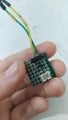
Sorry for blurry image of my project, I have another image, I attached here.

I logged ADXL335 data with 8000data per second to SDcard, so the suitable sampling rate for audio player is 8KHz I think.

I don't know what local main freq, because I'm not set a target to it. Obviously my target is to log less noise audio data.
 

Attachments

ericgibbs

Joined Jan 29, 2010
21,448
Hi G,
The power distribution wiring needs to be better organised, especially the 0V/Gnd line.
I do not see any decoupling capacitors on the power lines?

E
 

Thread Starter

Gusti_made

Joined Oct 31, 2023
15
Yes, the OP has some major problems with the signal chain. Low level signals with what looks like unshielded cables, to unshielded amplifier boards, to a unshielded microcontroller, producing likely more digital hash noise.

These types of noise issues are why I prefer to use modern digital interfaces (i2c, spi) to an Accelerometer instead of analog if I'm connecting to a microcontroller. The inside chip analog processing and digitization process is usually much better than regular external processing and the typical ADC inside a controller and you reduce external RMI/EMI generated analog noise in the processing chain.

The original analog device from the paper is in the range of $130 : https://www.mouser.com/datasheet/2/418/9/ENG_DS_805M1_Accelerometer_A3-3351118.pdf ,
the OP is using a substitute $15 analog device board : https://www.analog.com/media/en/technical-documentation/data-sheets/ADXL335.pdf
with overall much worse specifications on the low level analog output signal.

A modern $15 3-axis accelerometer, ultra high resolution (16 bit), low-noise, SPI 4-wire digital output, ±2.5g full-scale
https://www.st.com/en/mems-and-sensors/lis3dhh.html

A higher end $75 (355 for digital, 254 for analog) device for low level signal detection (digital 20 bit)
https://www.mouser.com/datasheet/2/609/adxl354_adxl355-3121962.pdf
Hello,
Thanks for replying, yes I agree that digital interface accelerometer is better and also more cheaper. The reason I still use analog accelerometer is currently my Arduino firmware best for analog data to log 8000data per second to SD card (https://forum.arduino.cc/t/try-this-super-fast-analog-pin-logger/222361)
And the reason why must 8000 data per second is to become a good audio data (8KHz sampling rate).
I haven't try the firmware to digital accelerometer. I also read LIS3DH datasheet it say maximum ODR output data rate is 5.3KHz
 

Thread Starter

Gusti_made

Joined Oct 31, 2023
15
Hi G,
The power distribution wiring needs to be better organised, especially the 0V/Gnd line.
I do not see any decoupling capacitors on the power lines?

E
Hello Eric,
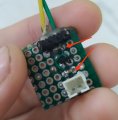
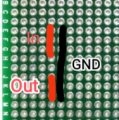
I reattach the picture, I give two arrow sign to input an output decoupling cap.
Is the distance of decoupling need more close to LDO?
Sorry the image so small, I can't re-take the picture because currently in holiday. Maybe on Monday I can.
 

Attachments

Top