Reduce noise from OP Amp + Low pass filter for accelerometer data

Thread Starter

Gusti_made

Joined Oct 31, 2023
15
Hello,

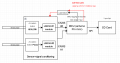
I'm beginer in amplifier circuit and filter circut. I'm working on a project that detects small vibrations from larvae inside tree trunk, I am inspired by this research ( Sensors | Free Full-Text | In-Vivo Vibroacoustic Surveillance of Trees in the Context of the IoT (mdpi.com) ). The research says use accelerometer + OPamp + lowpass filter. I follow the idea and here is my system block diagram
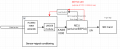
1701934709359.png

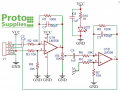
I use LM358 module like this LM358 Operational Amplifier Module - ProtoSupplies it also include schematic information.
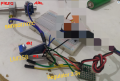
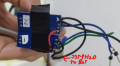
I build the prototype for testing like picture below,
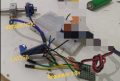
1701935529505.png1701936183343.png

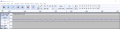
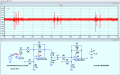
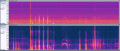
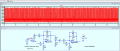
I logged the data 8000 data/second, convert it to audio data (.wav) and here is the result. looks many static noise (red stripes)
1701935940736.png

I also use protoboard instead of breadboard but the noise still exist. How to reduce the noise in my circuit?
 

Thread Starter

Gusti_made

Joined Oct 31, 2023
15
sure, here is the audio file, make sure rename .txt to .wav . this data is from scratching and knocking my table and I also tested using my voice (the voice data is in 21s - 23s)
 

Attachments

ericgibbs

Joined Jan 29, 2010
21,390
Hi G,
You have a high level of background 'hum' noise, most likely from the power supply to the project.
Check the DC supply to the sensor and OPA with a oscilloscope.

E
EG57_ 1326.pngEG57_ 1327.png
 

ericgibbs

Joined Jan 29, 2010
21,390
Hi Gusti,
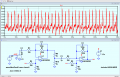
This is a LTSpice simulation of your circuit using your wav file as an input.
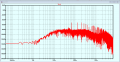
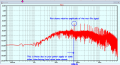
Note the 66Hz repetitive noise, which maybe a power supply or some other vibration on the work table.

E
EG57_ 1328.png
 

ericgibbs

Joined Jan 29, 2010
21,390
Hi,
This plot shows those 'spikes' on the wav file.
It looks like the sensor is being 'tapped' by you??

E

Added the Fourier Analysis plot. & your Voice signalEG57_ 1332.png

EG57_ 1330.pngEG57_ 1331.png
 
Last edited:

MisterBill2

Joined Jan 23, 2018
27,159
There are available OP-Amp ICs that are much lower noise than the LM358, and they may even have the same pin out arrangement. AND at least to see if it is power supply noise, run the amp on a battery to see if that reduces the noise.
 

Thread Starter

Gusti_made

Joined Oct 31, 2023
15
Hi,
This plot shows those 'spikes' on the wav file.
It looks like the sensor is being 'tapped' by you??

E

Added the Fourier Analysis plot. & your Voice signalView attachment 309354

View attachment 309352View attachment 309353
Thanks a lot for your reply, yes the spike is from tapped on table by me. What is fourier analysis plot use for? Honestly I don't understand information from fourier analysis plot from yours.
How do you know that hum noise frequency is 66Hz? Sorry I'm so beginer
 

Thread Starter

Gusti_made

Joined Oct 31, 2023
15
There are available OP-Amp ICs that are much lower noise than the LM358, and they may even have the same pin out arrangement. AND at least to see if it is power supply noise, run the amp on a battery to see if that reduces the noise.
Thanks for replying, can you share another example OP-amp that much lower noise? I'm using LM358 because it's popular. My power supply is use 1s i-ion battery with ap2112-3.3 LDO that give 3.3v output
 

ericgibbs

Joined Jan 29, 2010
21,390
Hi Gusti,
Ref the Fourier plot,
it could be due to some external source vibrating the sensor or work table, place some plastic foam between the table and sensor.
E

Add decoupling capacitors on the power supply, say 100Uf and a 100nF

EG57_ 1336.png
 
Last edited:

Audioguru again

Joined Oct 21, 2019
6,826
The LM358 dual and LM324 quad opamps are not used for audio because they produce a high noise level and crossover distortion. Use a modern audio opamp instead. Most opamps need a supply more than only 3.3V.
I agree that your power supply is very noisy.
 

ericgibbs

Joined Jan 29, 2010
21,390
Hi,
I would say the TS has to find and fix the source of the environmental or PSU noise first, and then choose a better specification OPA that will operate from a 3.3v supply.
E
 

Thread Starter

Gusti_made

Joined Oct 31, 2023
15
Hi Mat,
Ref the Fourier plot,
it could be due to some external source vibrating the sensor or work table, place some plastic foam between the table and sensor.
E

Add decoupling capacitors on the power supply, say 100Uf and a 100nF

View attachment 309387
Hi Eric,
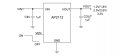
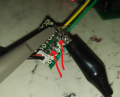
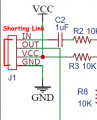
Thanks for explanation of FFT plot, I will learn more about it. In last testing I have add decoupling capacitor, 1uF for input and output, check picture below (2 red arrow sign) , I follow datasheet spec AP2112 (diodes.com) 1702008254648.png1702008166536.png

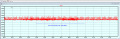
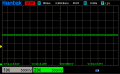
and here is output from my LDO circuit, is it looks noisy?
1702008372621.png
 

Thread Starter

Gusti_made

Joined Oct 31, 2023
15
The LM358 dual and LM324 quad opamps are not used for audio because they produce a high noise level and crossover distortion. Use a modern audio opamp instead. Most opamps need a supply more than only 3.3V.
I agree that your power supply is very noisy.
Hello,
thanks for the advice, I also tested using 4.2V input (no LDO) and another accelerometer, yes the noise decreased. But I use ADXL335 which has max supply input 3.6v, so I can only use 3.3V power supply.

I will search for another OPA that suitable for audio and 3.3V input. If you can share some example of OPA it will help me.
 

ericgibbs

Joined Jan 29, 2010
21,390
Hi Gusti,
Please post a clear photo of the complete layout of the project, your wiring looks very loose and untidy, which could introduce electrical noise.
Also, did you put some foam under the sensor/mike to prevent any work top vibration?

Try the following test.
Disconnect the sensor input to the amplifier and short the input to 0V
Run the project for say 10 Seconds and save the output of the amplifier as a wav file and post it.

E
Incorrect image deleted
 
Last edited:

Thread Starter

Gusti_made

Joined Oct 31, 2023
15
Hello,

I'm beginer in amplifier circuit and filter circut. I'm working on a project that detects small vibrations from larvae inside tree trunk, I am inspired by this research ( Sensors | Free Full-Text | In-Vivo Vibroacoustic Surveillance of Trees in the Context of the IoT (mdpi.com) ). The research says use accelerometer + OPamp + lowpass filter. I follow the idea and here is my system block diagram
View attachment 309335

I use LM358 module like this LM358 Operational Amplifier Module - ProtoSupplies it also include schematic information.
I build the prototype for testing like picture below,
View attachment 309336View attachment 309338

I logged the data 8000 data/second, convert it to audio data (.wav) and here is the result. looks many static noise (red stripes)
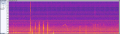
View attachment 309337

I also use protoboard instead of breadboard but the noise still exist. How to reduce the noise in my circuit?
You can see in my first setup picture, that there are two sensors (Piezo-accelerometer and Adxl335)
1702025160160.png1702026028805.png
and LM358 module #2 has longer cable than module #1
1702024775285.png

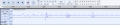
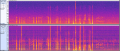
Honestly I also record vibration data use Piezo at same time use ADXL335, and strange result happen. vibration data from module #2 (piezo sensor) is less noise (check picture below), I also attach .Wav data here
1702025553566.png

I also test to swap ADXL335 to connect LM358 #2and Piezo to connect LM358 #1, and data from ADXL using module #2 became less noise, here is the result (I'm record new vibration data)
1702025798933.png

I don't understand why this could happen
 

Attachments

Thread Starter

Gusti_made

Joined Oct 31, 2023
15
Hi Gusti,
Please post a clear photo of the complete layout of the project, your wiring looks very loose and untidy, which could introduce electrical noise.
Also, did you put some foam under the sensor/mike to prevent any work top vibration?

Try the following test.
Disconnect the sensor input to the amplifier and short the input to 0V
Run the project for say 10 Seconds and save the output of the amplifier as a wav file and post it.

E
View attachment 309461
Hi Eric,
thanks for advice.
0V you mean is OUT or GND? if it means GND I have done a test like that, I attach the result here,
but if 0V you mean in OUT, I want to do test again,
 

Attachments

ericgibbs

Joined Jan 29, 2010
21,390
Hi Gusti,
Was that last wav file recorded with the amplifier input shorted to 0V
Have you listened to it, it's a 66Hz buzz, deafening, there is something radically wrong in the wiring and layout of your circuit.

I must have a clear image of the project, why is part of your photo image pixelled out????

E
Update:
@Gusti_made
Check your sampling rate of your wav file audio recorder.
I suspect it's set for 40KHz not 44KHz
If I replay it at 44KHz it shifts the noise frequency by (40KHz/44KHz)* 66KHz = 60Hz
Is that your local mains frequency?


EG57_ 1345.png
 
Last edited:
Top