Reduce noise from OP Amp + Low pass filter for accelerometer data

HaldorPhil

Joined Mar 8, 2019
16
Hello,
Thanks for replying, yes I agree that digital interface accelerometer is better and also more cheaper. The reason I still use analog accelerometer is currently my Arduino firmware best for analog data to log 8000data per second to SD card (https://forum.arduino.cc/t/try-this-super-fast-analog-pin-logger/222361)
And the reason why must 8000 data per second is to become a good audio data (8KHz sampling rate).
I haven't try the firmware to digital accelerometer. I also read LIS3DH datasheet it say maximum ODR output data rate is 5.3KHz
Oversampling the analog signal is required if you are looking for accurate frequency/phase information. This is handled for you in the digital versions. SPI is one of the simplest serial interfaces to code for. I never used Arduino hardware, does the processor have a hardware SPI port? The data bandwidth of these accelerometers is low enough that you can just bit-bang the data in using a GPIO if you don't have a hardware SPI port available.

Here is an article about a bit-bang implementation of a SPI port on an Arduino.

https://circuitdigest.com/article/i...-spi-communication-in-arduino-via-bit-banging

On the 8 kHz data rate, it is easy enough to upscale the data from 1.6 kHz to 8 kHz:
* Use a timer interrupt at a 8 kHz rate.
* Every 5 timer interrupts read the 1.6 kHz data from the IC
* Use linear interpolation to fill in the 8 kHz values in-between chip reads. Note: This means the data you are sending lags one chip read period.
 
Last edited:

MisterBill2

Joined Jan 23, 2018
27,587
Looking back to post #1, the purpose of the project is to detect the sound of munching midget monsters, AKA grubs, inside a tree trunk. I suspect that neither high frequency response nor exact phase information will be required. My guess is that experimenting with a microphone may also yield some signals that can be identified as grub specific. But it may be that initial research has already determined an accelerometer is a better choice.
Is there any information as to the magnitude of the resulting vibration that must be detected??
Quite probably Analog Devices already has a suitable amplifier IC along with a handy application note. My guess is that the signal level is so low that it would only provide a very few bits of the internal A/D conversion.
Discussing amplification will be far more productive than arguing about voltage regulators.
 

ericgibbs

Joined Jan 29, 2010
21,448
Hi,
The current problem source of this project is the way the proto-model as been built and wired.
This will cause all types of noise problems.

The layout must be cleaned up, and the wiring screened and routed for minimum noise. [ref to posted photo's]

Fitting higher performance OPA's or Sensors, will not fix the current noise problem

E
 

MisterBill2

Joined Jan 23, 2018
27,587
Certainly adequate arrangements are required to avoid noise entering the system, but even prior to that it would be very useful to have an understanding of both the signal amplitude and frequency range.
What is already known is that the incoming signal level will probably be below the ambient noise level, so that the shielding required will be rather extensive. and that low noise amplifiers will be needed.
There have been a few articles published about inexpensive shielding made from steel cans, since aluminum cans are difficult to solder. If the sensor and the first few amplifier stages can be assembled in a single shield then a useful evaluation can be made. And the firs prototype does not need to be compact, but it does need to be physically able to function without accidental circuit faults.
 

Thread Starter

Gusti_made

Joined Oct 31, 2023
15
Oversampling the analog signal is required if you are looking for accurate frequency/phase information. This is handled for you in the digital versions. SPI is one of the simplest serial interfaces to code for. I never used Arduino hardware, does the processor have a hardware SPI port? The data bandwidth of these accelerometers is low enough that you can just bit-bang the data in using a GPIO if you don't have a hardware SPI port available.

Here is an article about a bit-bang implementation of a SPI port on an Arduino.

https://circuitdigest.com/article/i...-spi-communication-in-arduino-via-bit-banging

On the 8 kHz data rate, it is easy enough to upscale the data from 1.6 kHz to 8 kHz:
* Use a timer interrupt at a 8 kHz rate.
* Every 5 timer interrupts read the 1.6 kHz data from the IC
* Use linear interpolation to fill in the 8 kHz values in-between chip reads. Note: This means the data you are sending lags one chip read period.
Hi HadorPhil,

Thanks for the advice to use interpolatio, I will try it. My MCU (Arduino Pro mini and ESP32-C3) has SPI port so I can test any digital accelerometer. what processor or MCU that you usually use?
 

Thread Starter

Gusti_made

Joined Oct 31, 2023
15
Certainly adequate arrangements are required to avoid noise entering the system, but even prior to that it would be very useful to have an understanding of both the signal amplitude and frequency range.
What is already known is that the incoming signal level will probably be below the ambient noise level, so that the shielding required will be rather extensive. and that low noise amplifiers will be needed.
There have been a few articles published about inexpensive shielding made from steel cans, since aluminum cans are difficult to solder. If the sensor and the first few amplifier stages can be assembled in a single shield then a useful evaluation can be made. And the firs prototype does not need to be compact, but it does need to be physically able to function without accidental circuit faults.
Hi MisterBill2,
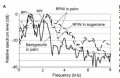
I have read some research, one is from Mankin, 2008 (Mankinetalfe91p241.pdf (usda.gov) ) that says larvae activity can be identified at around 2.4Khz.

1702270475533.png

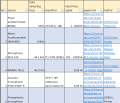
I also have summarized larvae activity frequency range from another research, I attached the table here

1702270408570.png

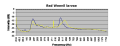
(2010) Abelardo Gutiérrez (Development of a bioacoustic sensor for the early detection of Red Palm Weevil (Rhynchophorus ferrugineus Olivier) - ScienceDirect) detailed plot larvae frequency in this graph
1702270611660.png
 

MisterBill2

Joined Jan 23, 2018
27,587
Interesting data! And an interesting choice of amplifiers also. It looks like low noise devices were carefully selected. And it also seems that response down to almost DC is required. So now the frequency response can be tailored. The absolute gain is still not clear yet.
It might be that two separate paths will be needed, one for the very low frequency portion of the signal, below 30 Hz, and another for the 1 to 8 KHz band. That will allow avoiding the mains frequencies that would tend to cause problems. It also means that probably the amplifier system should not include voltage regulators or switching power supplies of any kind.
Direct battery operation from strings of rechargeable batteries seems to be the way to go. Enough voltage to avoid the low-voltage pains, though.
 
Hi MisterBill2,
I have read some research, one is from Mankin, 2008 (Mankinetalfe91p241.pdf (usda.gov) ) that says larvae activity can be identified at around 2.4Khz.

View attachment 309754

I also have summarized larvae activity frequency range from another research, I attached the table here

View attachment 309753

(2010) Abelardo Gutiérrez (Development of a bioacoustic sensor for the early detection of Red Palm Weevil (Rhynchophorus ferrugineus Olivier) - ScienceDirect) detailed plot larvae frequency in this graph
View attachment 309756
NOTE: The analog devices parts I have been discussing are not usable above 1.6 kHz. Pick a part with more than 5 kHz bandwidth.
 

MisterBill2

Joined Jan 23, 2018
27,587
Probably AD has a selection guide on it's website. They may even have an applications engineer available. Especially for unique projects that they can reference in advertising.
 

Thread Starter

Gusti_made

Joined Oct 31, 2023
15
NOTE: The analog devices parts I have been discussing are not usable above 1.6 kHz. Pick a part with more than 5 kHz bandwidth.
Hi Haldor and All,

with some consideration, my team decided to leave analog accelerometer and choose digital accelerometer (LIS2DH) datasheet, that has Output data Rate max 5333Hz. I can read it via I2C via ESP32-C3 using ESP-IDF firmware. Currently I have not succeeded in logging the vibration data into 8KHz audio. Still find a way write best firmware.
 
Top