If this is to be battery-powered (?) then the LED current consumption with most/all LEDs energised continuously could be a concern. Blinking the LEDs occasionally, as well as energising the probes occasionally, will extend battery life.
Hello Friends, I'm very sorry. The time delay in LEDs was because of oxidation of the probes. Many of you were right.
Today again I checked the probes and found that a small layer was formed on them. I cleaned them and found no delay as before. It took four months for the oxidation of the probes. And it is not because of electrolysis.
Also, the circuit is not always on. I use to check the water level once or twice in a day.
If I solder the tips of the probes with lead free solder, will that be helpful?
I want with a low cost.
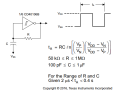
Change to a CD40106. Still a hex inverter, same pinout, but you need only one gate for the oscillator. Here is an image from a Texas Instruments document.
For the CD106, the input stage has hysteresis. This means that the input transition level (the voltage at which the output changes state) is not one value for both positive- and negative-going edges. There are two transition levels, called Vp and Vn in the image. Unfortunately, these are not well controlled (or specified), and vary from one manufacturer to another. In your case this does not matter because the oscillator frequency is not critical.
R = 10K and C = 0.1 uF will yield a frequency around 500 Hz to 1 kHz. Seems like a good starting point to me, but others with more experience in plating systems might have a better opinion.
Change to a CD40106. Still a hex inverter, same pinout, but you need only one gate for the oscillator. Here is an image from a Texas Instruments document.
For the CD106, the input stage has hysteresis. This means that the input transition level (the voltage at which the output changes state) is not one value for both positive- and negative-going edges. There are two transition levels, called Vp and Vn in the image. Unfortunately, these are not well controlled (or specified), and vary from one manufacturer to another. In your case this does not matter because the oscillator frequency is not critical.
R = 10K and C = 0.1 uF will yield a frequency around 500 Hz to 1 kHz. Seems like a good starting point to me, but others with more experience in plating systems might have a better opinion.
If the probes are oxidizing with only a few checks a day, your circuit is most likely not the problem. Unless you find a better probe, more than likely you will have to do maintenance on them on a regular basis.
OK, are you saying the problem is the oxidation of the probes and it took 4 months for the problem to first show, is that correct?
Now you need to clean the probes every day to eliminate the delay, is that correct?
From what I have read the sensor probes commonly used are stainless steel.
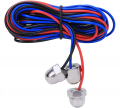
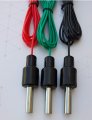
Found this on Amazon, looks home made using acorn nuts and epoxy.
OK, are you saying the problem is the oxidation of the probes and it took 4 months for the problem to first show, is that correct?
Now you need to clean the probes every day to eliminate the delay, is that correct?
From what I have read the sensor probes commonly used are stainless steel.
Found this on Amazon, looks home made using acorn nuts and epoxy. View attachment 260513
Yes, it took 4 months. I do not clean them every day.
How about soldering a copper wire? Is solder corrosion resistant? I have read that lead free solder is corrosion resistant.
I don't know if it will help. In post #65 you said the probes were aluminum now are you saying "It is a single lead insulated wire". Are you saying the insulated wire is made from the metal Lead?
Coating the wire with solder (if you can do it -when you heat aluminum it grabs oxygen quickly, forming a film that often prevents soldering, would probably only be slightly better than aluminum.
I think I have already my the point that aluminum is the worst possible material for this job because of its affinity to oxygen. You are proving the point. Even copper would be better. stainless steel if you can get it would be much, much better.
Coating the wire with solder (if you can do it -when you heat aluminum it grabs oxygen quickly, forming a film that often prevents soldering, would probably only be slightly better than aluminum.
I think I have already my the point that aluminum is the worst possible material for this job because of its affinity to oxygen. You are proving the point. Even copper would be better. stainless steel if you can get it would be much, much better.
I ran a stainless steel distiller for many years...maintenance is just part of the deal.
One change in the original system tho...I would use 2 probes on the final water level, just for redundancy, perhaps one just a little higher than the other.
My purpose is just to check the water level once or twice in a day. So, DC current passes only when I switch on to check. The only thing is by using these SS probes is.. oxidation rate Decreases.

 Facebook
 Google
 GitHub
 Linkedin