Facebook
 Google
 GitHub
 Linkedin
If you want to get away from monthly maintenance of rods dipped into water there IS another approach. Back on post #19 I postulated the idea of using a float with magnets to activate reed switches. That was one approach to getting around having to clean the rods. Since then there has been a lot of discussion about rods, oxidation and electronic circuitry, some with an oscillator. Frankly I've never seen the need for an oscillated circuit.
Here's another idea: If you want to get away from the maintenance and are willing to do some work - you can get pressure sensitive switches and mount them above the water level. Each switch has a length of CPVC pipe with trapped air. As the water level rises so will the air pressure, causing the switches to switch on sequentially. As the water level drops the sensors will switch off. Every time the water level drops below the end of the CPVC fresh air will become entrapped. The only switch (switch A) will likely be constantly submerged. Care would need to be taken to create a perfect seal so that the trapped air doesn't leak out and cause a false reading.
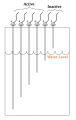
In the diagram below the water level is at about 60% full. Switches A, B, C and D should be active (switched ON). Switch E, though the tip is submerged doesn't have enough air pressure to activate the switch. As the water level rises (from pumping) eventually the water level is high enough to trigger switches E & F. This way you're not having any metal in the tank to corrode and be in need of cleaning. Of course this means re-thinking your approach, but this way you get away from integrated circuits, resistors and capacitors. All you need is a push button switch to test the water level and some LED's to indicate the level. Of course the LED's will need to have current limiting resistors, so you're not fully away from resistors, but that's a given since you're using LED's as indicators.
Here's my latest drawing. Beyond this I can't think of anything else that could be of help. Floating switches like others have suggested are also good approaches. I'm just trying to think outside the box. Or outside the tank.
Here's another idea: If you want to get away from the maintenance and are willing to do some work - you can get pressure sensitive switches and mount them above the water level. Each switch has a length of CPVC pipe with trapped air. As the water level rises so will the air pressure, causing the switches to switch on sequentially. As the water level drops the sensors will switch off. Every time the water level drops below the end of the CPVC fresh air will become entrapped. The only switch (switch A) will likely be constantly submerged. Care would need to be taken to create a perfect seal so that the trapped air doesn't leak out and cause a false reading.
In the diagram below the water level is at about 60% full. Switches A, B, C and D should be active (switched ON). Switch E, though the tip is submerged doesn't have enough air pressure to activate the switch. As the water level rises (from pumping) eventually the water level is high enough to trigger switches E & F. This way you're not having any metal in the tank to corrode and be in need of cleaning. Of course this means re-thinking your approach, but this way you get away from integrated circuits, resistors and capacitors. All you need is a push button switch to test the water level and some LED's to indicate the level. Of course the LED's will need to have current limiting resistors, so you're not fully away from resistors, but that's a given since you're using LED's as indicators.
Here's my latest drawing. Beyond this I can't think of anything else that could be of help. Floating switches like others have suggested are also good approaches. I'm just trying to think outside the box. Or outside the tank.
Last edited: