I don't know but looking back at your original circuit I still suspect a battery problem. Appears that the battery voltage is dropping shortly after first powered on when all five LEDs are on. Are you sure you have a good battery installed?
Can you get a voltage reading on the battery when powering on?
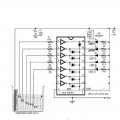
Is the circuit in your original post the exact circuit we have been dealing with?
It is a 9v Eveready battery. Also checked with other batteries. Its the same when I checked with a DC adapter. The circuit is same as in original post.
Having once worked in an anodizing job I can tell you that eventually some of the rods will bond with oxygen from the water making an aluminum oxide (ruby) film and eventually that electrode or those electrodes will be insulated from the water. That will probably take a long time to happen so you can save replacing the electrodes as a future improvement.
Having once worked in an anodizing job I can tell you that eventually some of the rods will bond with oxygen from the water making an aluminum oxide (ruby) film and eventually that electrode or those electrodes will be insulated from the water. That will probably take a long time to happen so you can save replacing the electrodes as a future improvement.
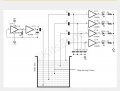
I have made some changes in the circuit below
1. Replaced ULN 2003A with ULN 2004A
2. Replaced 47KΩ resistors with 0.01μF capacitors as coupling capacitors
3. Added 0.001μF capacitors from each input to ground
When I switched on, I observed that LEDs were not glowing.
It worked out later when I removed the coupling capacitors. The delay was reduced to 1 second. Previously it was 3-4 seconds.
Delete R1 - R5, and connect probes P1 - P5 directly to the ULN2003. This should reduce the current needed to turn on an LED, shortening the response time.
I see no reason to change the 2003 to a 2004. The only difference between the two parts is that the 2004 has a larger input resistance. As above, to me this works to increase the response time, not decrease it. Also, because it is the impurities in water that conduct current, the larger the input resistance is, the more impurities it takes to conduct sufficient current to activate an LED. IOW, with the 2003, the circuit will work with cleaner water.
Delete R1 - R5, and connect probes P1 - P5 directly to the ULN2003. This should reduce the current needed to turn on an LED, shortening the response time.
I see no reason to change the 2003 to a 2004. The only difference between the two parts is that the 2004 has a larger input resistance. As above, to me this works to increase the response time, not decrease it. Also, because it is the impurities in water that conduct current, the larger the input resistance is, the more impurities it takes to conduct sufficient current to activate an LED. IOW, with the 2003, the circuit will work with cleaner water.
1. The ULN2003 is not a CMOS part. It has a much lower input impedance, so the impedance of the R-C network would have to be much lower.
2. It also has an open-collector output. the circuit in #63 will not work with open-collector outputs.
3. While each section of a 2003 can act as an inverter, it is not a true logic device. It's input stage is very different, and will not function in that oscillator circuit. I was thinking that two 2003 sections might work as a traditional 2-transistor multivibrator circuit. This circuit is a bit more complex, with two matched R-C networks.
1. The ULN2003 is not a CMOS part. It has a much lower input impedance, so the impedance of the R-C network would have to be much lower.
2. It also has an open-collector output. the circuit in #63 will not work with open-collector outputs.
3. While each section of a 2003 can act as an inverter, it is not a true logic device. It's input stage is very different, and will not function in that oscillator circuit. I was thinking that two 2003 sections might work as a traditional 2-transistor multivibrator circuit. This circuit is a bit more complex, with two matched R-C networks.
If I take circuit with CD 4049 as in thread #63 and use it as it is, I get only 4 inputs. I need 5 inputs.
I need an oscillator to reduce the oxidation of the electrodes. Which may reduced the time delay of LEDs also.
I want the circuit not to be more complex.
Kindly suggest if you have any idea.
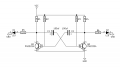
If you consider each inverter (or NOT gate if you prefer) to be a transistor, this circuit will probably work for your application:
Omit the LEDs D1 and D2 and the current limit resistors R5 and R6 and take your pulse train from either collector.
The frequency is dominated by capacitors C1 and C2 in conjunction with base bias resistors R2 and R3. C1 = C2, R2=R3. The larger the values the lower the frequency of oscillation.
By making one of the capacitors larger than the other you can change the duty cycle.

 Facebook
 Google
 GitHub
 Linkedin