Reason behind time delay for LEDs(Water level indicator)

Tonyr1084

Joined Sep 24, 2015
9,744
A stack of magnets inside the float could bridge the distance between reeds. In fact, once a reed switch is activated the magnetic field can deteriorate quite a bit before the switch lets go. With the diodes in-between, as long as one or more switches are closed the level will indicate the water level at and below the level. Without the diodes you'll need enough magnetism to close one switch while another is still held closed by the close proximity of the magnet(s).

From top down - the second and third reeds can be active if the magnet is large enough. OR just two magnets with a space in between so as to always have one switch closed.
 

DickCappels

Joined Aug 21, 2008
10,661
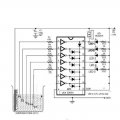
For now, if you can increase R1 through R6 it will lessen the problem. Beyond that you need to find a method other than using immersed electrodes.
My opinion.
 

ThePanMan

Joined Mar 13, 2020
921
It won't matter how large the tank is. If there's a pipe containing a column of water 10 feet high then the pressure at the bottom will be 4.33 pounds. Whether that pipe is half inch or 24 inches in diameter, the pressure will be the same. The overall weight will be grossly different, but the pressure will be the same. Therefore, with a gauge and a known height of water column it can be determined how high the water level is. Not how many gallons or liters, just the elevation of the surface of the water. Assuming a common home with a common roof and a tank above the roof, with a tank that can be six feet high, a full tank of water at an elevation of 30 feet will have a pressure reading at waste high (assume 2 feet up from the floor) (that's 28 feet of head pressure) 12.2 pounds of pressure. With the tank surface level at the very bottom (empty) the pressure will be 9.526 pounds. So the difference in 12.2 and 9.5 represents the difference between "Tank Full" and "Tank Empty".

No batteries, no need for electrical power, no electrodes to corrode or pollute the water source. If you want to use the water level low limit to turn on a pump then two pressure transducers and a window comparator can determine when the pump comes on and when it shuts off. Even an overflow pipe with a weather vane switch to sense when water flows down can trigger the stop pump function. The vane will dry off quickly and be ready for the next time the tank overfills. You may even want two transducers to start and stop the pump and the overflow as a backup emergency cancelation sensor.
 

ThePanMan

Joined Mar 13, 2020
921
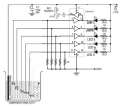
You're using a darlington high output chip. You could use an SN74HC04 chip which is a hex inverter. Each LED can be connected to power and to the output pin of the inverter. When the corresponding input is high the corresponding output will go low and switch on your LED. Each input should be tied to ground via a 10KΩ resistor. The tank should have a power source (as you've shown) and each probe line can be connected to the inputs of the inverters. When the water level is low the high level sense rod will not see a voltage and be held to low via the resistor, therefore switching the output too high and shutting off the LED. (I can't find or remember the CMOS version of the hex inverter buffer).
 

Thread Starter

rafiec14

Joined Dec 14, 2019
71
You're using a darlington high output chip. You could use an SN74HC04 chip which is a hex inverter. Each LED can be connected to power and to the output pin of the inverter. When the corresponding input is high the corresponding output will go low and switch on your LED. Each input should be tied to ground via a 10KΩ resistor. The tank should have a power source (as you've shown) and each probe line can be connected to the inputs of the inverters. When the water level is low the high level sense rod will not see a voltage and be held to low via the resistor, therefore switching the output too high and shutting off the LED. (I can't find or remember the CMOS version of the hex inverter buffer).
Thanks for the reply. If the same 10K resistors are placed in the circuit using ULN 2003, (from each input to ground) will it solve the problem of LEDs delay?
 

LowQCab

Joined Nov 6, 2012
5,101
The ULN2003A has an Input-Impedance of 2.7K-Ohms,
this means that it takes a substantial amount of Current to turn them fully "On",
this WILL cause plating problems in a very short time on your Probes.
The Mineral and Metal Deposits that accumulate on the surface of your Probes will

tend to decrease their conductivity, and cause the LEDs to come "On" very gradually, or maybe not at all.

The CD4049UB is a "CMOS" device which has extremely high Input-Impedance,
which takes almost zero Current to turn "On" so additional Resistance must be added
to reduce the tendency of the Wiring to act like Antennas that will pick-up Noise from everywhere.
This is also the purpose of adding the 100nf-Capacitors.
The much-much higher Input-Impedance will slow-down,
or maybe even eliminate, the inevitable plating of the Probes.

The CD4049UB also has a "Schmitt-Trigger" Input,
this means that it only has 2-States, fully "On" and fully "Off",
there are no "in-between" States, like with the ULN2003A Chip.

The ULN2003A Chip is a poor choice for the application that You have.
Don't use it.
.
.
.
 

LowQCab

Joined Nov 6, 2012
5,101
When You separate 2 Part-Numbers with a slash/,
that generally means that the 2 numbers are interchangeable.

The CD4049 is rated for ~18-Volts, and the SN74HC04 is only rated for ~6-Volts.
Also, the SN74HC04 does not have a Schmitt-Trigger-Input,
which could cause some strange behaviors in an application like this one.
.
.
.
 

Thread Starter

rafiec14

Joined Dec 14, 2019
71
When You separate 2 Part-Numbers with a slash/,
that generally means that the 2 numbers are interchangeable.

The CD4049 is rated for ~18-Volts, and the SN74HC04 is only rated for ~6-Volts.
Also, the SN74HC04 does not have a Schmitt-Trigger-Input,
which could cause some strange behaviors in an application like this one.
.
.
.
So, I have to go with CD4049. Thanks again.
 

DickCappels

Joined Aug 21, 2008
10,661
The CD4049 would be a better choice but you should use higher value resistors, like 100k or more to ground, and then to prevent electrostatic or environmental discharge put another 100k between the input of the CD4049 and its input, to protect the input protection diodes on the CD4049.
 
Top