Radio failure

Thread Starter

Icanmakeit67

Joined Sep 23, 2018
210
I have asked this learned group many things and it great how you all help those of us learning…
That said I built a simple AM radio circuit just for fun. I know nothing about radios. I read it was simple and worked well. So I’ve built many things and love building circuits and was looking for a different direction.
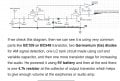
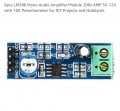
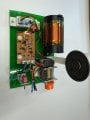
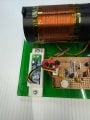
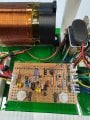
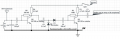
This circuit was a google search, seemed straightforward. I built it exactly but I get nothing—-nothing. I used an 8 ohm speaker and a simple 386 amp board I found online. Not a peep. My tank circuit is the 300uH air coil inductor and the variable tuning capacitor is the range specified. I have gone through the circuit and there are no errors. Please look at it and if possible offer me some direction to go…
 

Attachments

Thread Starter

Icanmakeit67

Joined Sep 23, 2018
210
I have asked this learned group many things and it great how you all help those of us learning…
That said I built a simple AM radio circuit just for fun. I know nothing about radios. I read it was simple and worked well. So I’ve built many things and love building circuits and was looking for a different direction.
This circuit was a google search, seemed straightforward. I built it exactly but I get nothing—-nothing. I used an 8 ohm speaker and a simple 386 amp board I found online. Not a peep. My tank circuit is the 300uH air coil inductor and the variable tuning capacitor is the range specified. I have gone through the circuit and there are no errors. Please look at it and if possible offer me some direction to go…
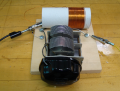
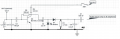
Below is pic of amp I’m using to save time.
 

Attachments

MrChips

Joined Oct 2, 2009
34,629
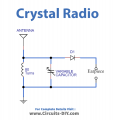
If you want to pick up an AM radio with a simple circuit, start with the basic crystal radio.
The basic circuit looks like this:
1754838514703.png

Here are the essential ingredients:
1) A long wire antenna strung up outdoors, about 30 feet or 10 meters.
2) A connection to a cold water metal pipe, for a good ground connection.
3) 80 turns of magnet wire wound on a cardboard toilet roll.
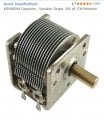
4) A variable tuning capacitor, 10-500 pF
5) A germanium diode, 1N34

Instead of the earpiece, you can use your LM386 amplifier.
 

MisterBill2

Joined Jan 23, 2018
27,187
For the circuit that you have assembled, there are certainly a number of tests that can allow you to know where the problem is. I have no intention of suggesting an alternate circuit.
The very first step will be to test the audio amplifier module to verify that it works. So the very first step is to connect your speaker to the output of the amplifier module, and connect the appropriate power<(a 9 volt battery will work, positive ti the VCC pin, negative ti the GND pin. to the module power connection. There may be a sound produced when the power is connected. If not, some testing is in order.
I HOPE that the TS has at least a cheap digital multimeter. If there is no sound, the first step is to check that there is a correct voltage from the battery.Then check the voltage at the module ins, with the meter negative connected to the GND pin and the positive connected to the Vcc pin. The voltage should be close to 9 volts DC.
 

Thread Starter

Icanmakeit67

Joined Sep 23, 2018
210
Have you verified the Amp module is working? Did you install C1?
Yes the amp module works. I went through and checked every component too. I did see that C1 and C2 (both 104’s) were both testing at +\- 84nf so I added a 10 nf (103) in parallel to each to get the value closer to 100. Both are now 95/96nf. When I tried again I got a bit of noise/static. Had to turn the amp volume down. Goin to try an antenna even though it says optional.
 

Attachments

panic mode

Joined Oct 10, 2011
4,867
the circuit posted by TS does not make sense. more specifically the detector, because within fraction of a second any signal (noise or otherwise) will be rectified and charge C2. this will happen fast (fraction of a second). after that D1 is permanently reverse biased and NOTHING will get through D1 or C2. to prevent that, C2 need a path to discharge. try putting resistor after D1 to GND.
 

Thread Starter

Icanmakeit67

Joined Sep 23, 2018
210
the circuit posted by TS does not make sense. more specifically the detector, because within fraction of a second any signal (noise or otherwise) will be rectified and charge C2. this will happen fast (fraction of a second). after that D1 is permanently reverse biased and NOTHING will get through D1 or C2. to prevent that, C2 need a path to discharge. try putting resistor after D1 to GND.
I tried your suggestion-no joy…. It did start to squeal and I can’t shut it off unless I turn the amp module down to off. Odd. I checked the diodes and there are still ok. It’s too late to test the transistors. I’ll do it tomorrow. This circuit baffles me and I can’t understand why it was published when it doesn’t work. Frustrating
 

MrChips

Joined Oct 2, 2009
34,629
I tried your suggestion-no joy…. It did start to squeal and I can’t shut it off unless I turn the amp module down to off. Odd. I checked the diodes and there are still ok. It’s too late to test the transistors. I’ll do it tomorrow. This circuit baffles me and I can’t understand why it was published when it doesn’t work. Frustrating
If your circuit is squealing that is likely caused by oscillation owing to very high gain positive feedback.
Q1 and Q2 are both high gain inverting stages. Hence you have very high gain positive feedback.
Q1 and Q2 stages have a gain of about 250 each, giving a total gain of about 62,000!
Remove Q2 and see what happens.

There are a lot of faulty and non-functioning circuits posted on the internet. Don't believe everything you see as a working circuit.
 

panic mode

Joined Oct 10, 2011
4,867
when building projects it is a good idea to use modular approach and build things in stages as individual blocks. (antenna > RF tuned circuit > amplifier > demodulator > low pass filter > audio amplifier > speaker).
this way one can test and improve individual stages.

it is tempting to adopt simple circuit found on some random site and build it as is but one need to be careful. if doing so try circuits found on websites created by those who know what they are doing (radio amateurs and engineers). Because not all circuits are good, not all explanations of circuit operation and tuning are good, and many compact circuits in an effort to reduce parts count, try to use one stage for more than one thing. any time one does that, you are looking at a compromise. and that makes it easy to fall in trap and get something that is - well... compromised.

for example i have seen (and built) bunch of radio receivers. some with just two transistors that worked as a 4 transistor circuit - first they would amplify the RF signal then audio signal. such contraption can work but general rule is that this is less than ideal and it may be difficult to control (making adjustments to improve one thing, may be devastating to the other thing). since transistors are cheap and easy to find. there is no need to compromise. make one stage, test it, tweak it. then build the next etc. or at least review what gets done by which circuit section before building it.

original circuit had a heart defect in demodulator. also it lacked low pass filter after demodulator. so high frequency feedback was possible which made it unstable. those can be remedied by adding just two parts: resistor (makes demodulation possible) and capacitor (low pass filter).
 

panic mode

Joined Oct 10, 2011
4,867
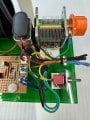
also please show your construction. in general, high frequency circuits are sensitive, so one need to pay attention to details. layout, shielding, parasitic capacitance etc. can be factors and thus important. it is a good idea to keep connections short.
 

MisterBill2

Joined Jan 23, 2018
27,187
Oscillation is always the result of FEEDBACK toward the input of whatever is providing amplification. The bad news is that that feedback loop is not always obvious. In an experimental arrangement it may even be in what is called the "Ground"section of the wiring.
 
Top