Facebook
 Google
 GitHub
 Linkedin

I'm designing a fairly simple circuit to provide LED lighting for my home's staircase whenever a motion sensor is tripped.
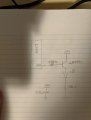
The motion sensor part of the circuit I have a good handle on (I'm using a 16F88 to accept the signal from the sensors, then to turn on the LED strips in kind), the LED side of the circuit is what I'm curious on. And on the schematic to clarify what the "x8" means, I'll have 8 LEDs in series for each strip, with a total of ~10 strips. Each strip would get its own 2N4401 for LED activation.
The schematic is attached. A few questions I have on it:
Is it going to be reliable long-term, or will I have an issue with LEDs burning out after a short while?
Is it viable for me to replace the resistor for the LED brightness with a rheostat to adjust their brightness on the fly, or is there a better way of being able to do so?
The capacitor is to provide a dimming effect when the LEDs lose power. Is this going to be safe/viable for a dimming effect, or is there a different way to provide a dimming effect that would be more efficient?
The motion sensor part of the circuit I have a good handle on (I'm using a 16F88 to accept the signal from the sensors, then to turn on the LED strips in kind), the LED side of the circuit is what I'm curious on. And on the schematic to clarify what the "x8" means, I'll have 8 LEDs in series for each strip, with a total of ~10 strips. Each strip would get its own 2N4401 for LED activation.
The schematic is attached. A few questions I have on it:
Is it going to be reliable long-term, or will I have an issue with LEDs burning out after a short while?
Is it viable for me to replace the resistor for the LED brightness with a rheostat to adjust their brightness on the fly, or is there a better way of being able to do so?
The capacitor is to provide a dimming effect when the LEDs lose power. Is this going to be safe/viable for a dimming effect, or is there a different way to provide a dimming effect that would be more efficient?
Attachments
-
 54.5 KB Views: 29