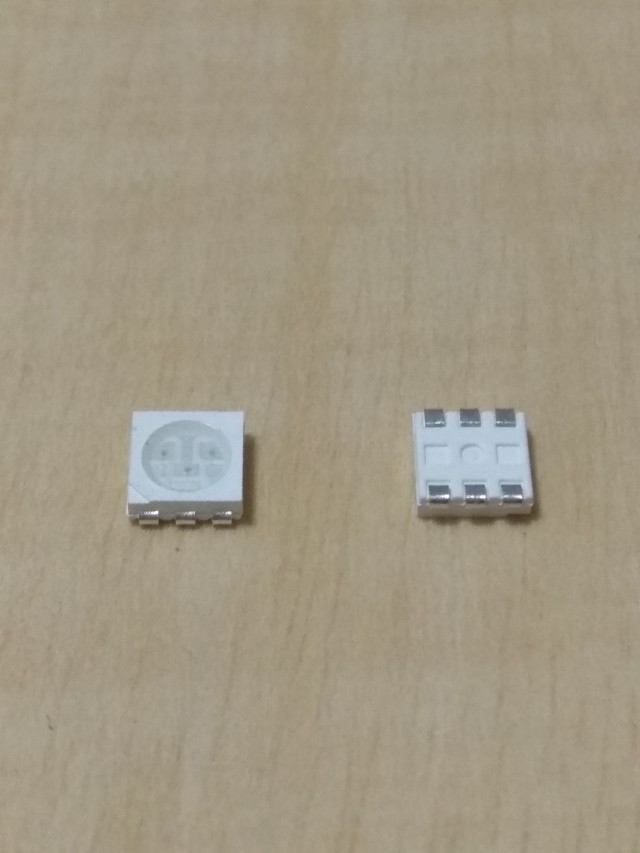
For SMD 5050 led, does it need 6 solder pads or can I create a long solder pad for the top 3 leg & 2nd long solder pad for the bottom 3 leg ?
Thank you in advance for your advice.
Use a single pad for each lead.. (so 6 pads)
Absolutely necessary if thats an RGB led or you need each of the 3 diodes to be independent of the other but even if not you should get more consistent soldering/less potential issues with 6 pads vs 3..
Use a single pad for each lead.. (so 6 pads)
Absolutely necessary if thats an RGB led or you need each of the 3 diodes to be independent of the other but even if not you should get more consistent soldering/less potential issues with 6 pads vs 3..
Schematic? We have no idea of the configuration of this device, so no one can answer the question.
Okay, it appears that there are three anodes and three cathodes. Make a single pad for all three, but use mask to create the three cutouts for each the anode and cathode. Whichever node is connected to the substrate is the heatsink side, so that pad should reflect that and be made larger, although it depends on the part dissipation.
(a) if the package has 3 isolated diodes, you can connect them any way you want.
(b) if you are soldering by hand, the pad layout won't matter much.
(c) if you are designing a PCB for reflow soldering, then the pads should be separate, so the solder will pull the part into the center when you reflow the board. Of course you can still connect them any way you need to, with traces from the pads.
(d) connecting LED's in parallel without resistors is not good practice, they won't share current well.
(c) if you are designing a PCB for reflow soldering, then the pads should be separate, so the solder will pull the part into the center when you reflow the board. Of course you can still connect them any way you need to, with traces from the pads.
Just guessing here, but it sounds like three independent diodes. Soldering SMD's with large pads run more heat and run the heat longer, meaning your diodes are exposed to more thermal stress. Having three individual pads runs cooler simply by virtue of a smaller thermal mass.
Now, as an engineer (you, not me) you can design your circuit using a common anode or a common cathode but you can't do both. Why not? Because one diode will draw all the power and burn out. Then the next two will compete for the power and burn out, finally the third will go. Like dominos. If you've ever set up dominos you know that one mistake can knock down the whole pile. And that's how diodes will fail. So if you DO go with a single pad you can do so ONLY ON ONE SIDE. In other words, the smallest number of pads you can get away with is 4 pads. One common (anode or cathode) and three isolated pads. That way each diode can have its own resistor and operate purely on its own circuit. It's OK to have one common anode or cathode but the other side must be independent from the others.
Like I said, I'm just guessing at what you have. You don't have a spec sheet and neither do any of us. So we can't know for sure and we can't tell for sure. It's POSSIBLE that one of the LED's may be oriented opposite of the other two. This might be intended for wiring the diodes in series. I'll draw a picture and post it shortly.
[edit] I do this EVERY time, forget to calculate with the forward voltage considered. The numbers below are now correct. Since resistors come in preset values use something close, slightly over if necessary. 9 volts with 1KΩ would result in 7mA. Close enough to tell what's what on your chip. Then once you have a known (or close) current you can measure across the LED to get a good idea exactly what the forward voltage of the LED is. Manufacturers vary, and within a run Vf (forward voltage) can vary. I did a test yesterday and discovered that some of my LED's varied as much as 9 mV. NOT a big deal, but there IS variance.
{original post}
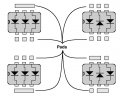
OK, here's the promised drawing. Notice four examples of how you can construct your pads, based off of just how this LED is wired. I'd recommend you test each segment for polarity and color using 10 mA of current. Figure since you said the LED is red, figure on a forward voltage of 2 volts (close enough) and use a 5 volt source (or 6 volts) with the appropriate resistor. At 10 mA, and 5 volts you'd want a 300 Ω resistor. At 6 volts use a 400 Ω resistor. If you use 9 volts, use 700Ω. That'll be 9 mA but you won't notice a difference. Make very clear notes on a sheet of paper exactly what you found. Then, depending on if they're all the same or one is switched around, you'll better understand how to construct your pads.
Looking at your picture it appears as though they are all wired the way I drew the left set of LED's. What's not clear is if they might be common cathode. To test to see if they're common cathode, connect your test circuit to one of the three pins on one side and test each pin individually on the other side. If you hold negative on pin #6 (for instance) and each LED can be lit by touching positive 10 mA to pin 1, then pin 2, then pin 3; then that means you have a common cathode.
The way to determine anode and cathode is the cathode is the negative end. Just think of the cathode as "Can't"thode (the negative end). In other words, you can't put a positive on the canthode. You should be able to discern if it's common anode or cathode from the sellers page. They SHOULD have told you. Not saying they would always tell you 100% of the time.
Looking at your picture it appears as though they are all wired the way I drew the left set of LED's. What's not clear is if they might be common cathode. To test to see if they're common cathode, connect your test circuit to one of the three pins on one side and test each pin individually on the other side. If you hold negative on pin #6 (for instance) and each LED can be lit by touching positive 10 mA to pin 1, then pin 2, then pin 3; then that means you have a common cathode Good luck.
hi Tony,
Yes, they are wired like the left set of LED you drawn. But they are neither common cathode nor common anode. Tested with a multimeter, it is just 3 separate LED.
I have an existing PCB using a 3528 LED. Intend to recreate the PCB to use the bigger 5050 LED.
Beside creating 6 solder pads for the 5050.
Question 1 - do I need a resistor for each LED within 5050 ?
Question 2 - Can I link up all 3 solder pad for anode ? Then link up all 3 solder pad for cathode. ?
Looking forward to learn from you. Thank you very much.
Answer 1 - yes, this is highly recommended
Answer 2 - you can but in that case only red LED will be able to work. if red LED burns or fails open, green and blue will turn on.
it shows that leds of different color have different forward voltage (red one is lowest hence Answer 2).
V-I curve for all forward biased semiconductors (diodes, base emitter junctions of transistors etc.) varies. unfortunately results vary enough that even same products from same batch will not be matched. as a result even slight voltage change will cause huge change in current which prevents connecting such products in parallel. this is why such products are considered current controlled and that is why each should have own resistor.
some cheap ass led flashlights do have leds in parallel but this is not good. when batteries are new, all LEDs may look equally bright to human eye (but that is poor test, specially when you are blinded by bright light source). in reality some LEDs draw much more current than others. when batteries go low, you will see even without shades that LEDs are not equally bright. it is much better to connect them in series and use proper LED driver. This way battery lasts longer, all LEDs work evenly etc.
I'm not a fan of this answer. It's assuming a multi-color LED. If it IS a multi-color LED then the answer is correct, but the solution is not recommended.
If we assume all three elements are the same color then generally speaking their current draw is going to be the same. I said "Generally speaking" because it's an assumed model. The reality is that (as panic mode said) each element is going to have a slightly different current draw. If you supply sufficient current for all three elements through a single resistor then the current will take the path of least resistance, meaning it will want to go to one element and cause it to burn out. When it burns out there's now the same current but fewer elements using that current, which means the next lowest element will take all that current and then burn out. Finally, the last element will burn out because there's just way too much current flowing through it. And this will happen in a flash. It will be over for all three elements quicker than you could react to shut it off.
You CAN tie all three elements together on EITHER the cathode OR the anode. Not both. If you tie all cathodes together then you need a resistor on each anode. That way the current path for each element is controlled, and the risk of losing all three elements is virtually eliminated. Provided you limit their current to the recommended draw. The same would be true that you can tie all three anodes together with a resistor on each cathode. Let me ask you this: Do you know how to calculate the current requirements for an LED?
I am not EE engineer. Just have an interest in electronic & IT, trying to learn electronic via tinkering & building electronic kits. Taught myself how to solder through hole devices years ago. Surface mount devices had reached a point where it is cheap & widely available. Making it feasible to keep an inventory at home.
Using SMD, I had no choice but to make a PCB. Usually I pass the schematic to a PCB Fab house, to make the PCB. For my next PCB, I want to draw out the PCB layout and get the PCB Fab house to make exactly as per my layout.
Still learning the Do & Don't of PCB making using a Fab house.
Answer 1 - yes, this is highly recommended
Answer 2 - you can but in that case only red LED will be able to work. if red LED burns or fails open, green and blue will turn on.
it shows that leds of different color have different forward voltage (red one is lowest hence Answer 2).
V-I curve for all forward biased semiconductors (diodes, base emitter junctions of transistors etc.) varies. unfortunately results vary enough that even same products from same batch will not be matched. as a result even slight voltage change will cause huge change in current which prevents connecting such products in parallel. this is why such products are considered current controlled and that is why each should have own resistor.
some cheap ass led flashlights do have leds in parallel but this is not good. when batteries are new, all LEDs may look equally bright to human eye (but that is poor test, specially when you are blinded by bright light source). in reality some LEDs draw much more current than others. when batteries go low, you will see even without shades that LEDs are not equally bright. it is much better to connect them in series and use proper LED driver. This way battery lasts longer, all LEDs work evenly etc.
You CAN tie all three elements together on EITHER the cathode OR the anode. Not both. If you tie all cathodes together then you need a resistor on each anode. That way the current path for each element is controlled, and the risk of losing all three elements is virtually eliminated. Provided you limit their current to the recommended draw. The same would be true that you can tie all three anodes together with a resistor on each cathode.
Noted your advice.
I will do the following on my next PCB, in order to use the 5050 LED
1. create 6 solder pads for the 5050 led
2. Put a resistor in front of each anode
3. Tie the 3 cathode solder pad together.
what are you using this for? illumination?
what is the source voltage you plan on using?
if using higher voltage (say 12V) it would be more efficient to connect them in series.
I missed that point. Had to read all the way back to post #5. I have to agree, red LED's are not much in the way of producing light. Maybe that's why you got a thousand of them so cheap, there's not a lot of use for them.
I have a dash cam in my truck. It has GPS and can show speed and where I've been. But it doesn't show brake lights or turn signals. So I bought some super bright LED's and planned to hang two in front of the camera, out of focus and high in the picture frame. When I turn right the GREEN LED will flash with the right blinker; the RED LED with the left signal. So in the video there's recorded evidence of blinking turn signals. And if I turn on the 4 way flashers both LED's blink, showing evidence of having the 4 way's on. But the red I have is a clear SUPER BRIGHT. It can be seen in daylight. It can prove just a little distracting at night, but at least I have a video record of whether I signaled or not. So far I haven't had to prove anything. Yet. But when the time comes, if I'm not at fault - I have a video record of it. (if I am at fault nobody needs to know there was a camera watching).
Panic Mode and I both think a red LED isn't going to provide much illumination. Maybe you can wire one up and light it up for us. Take a picture in regular light to see if it's effective. Just for comparison, take a picture in dimly lit light. Dark won't give us much to compare to because the camera will compensate for the lack of light and provide more exposure.

 Facebook
 Google
 GitHub
 Linkedin