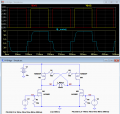
Here's the LTspice simulation of a simple low-speed MOSFET H-bridge.
By cross-coupling the P-MOSFET gates to the output, it requires no other transistors.
(Edit: It also does not suffer from the large feed-through current-spike that the bridge in the referenced circuit in Post #15 has, when both transistors on one side of the bridge are momentarily ON during the time the bridge changes state.)
It should be apparent, but the two inputs must never be ON together, or the supply voltage will be shorted to ground.
Note that the N-MOSFETs must be logic-level types that can be fully turned on by the Arduino output voltage.
Those are just some MOSFET models in the simulator.
There are many MOSFETs that would work for you.
Where are you located, and where would you buy MOSFETs?
Their on-resistance is rated for Vgs=5V, so it would be better to find one rated Vgs-3V (if that's your Arduino output voltage).
But it likely will work okay if the motor current is only 1.1A.
That device is an N-MOSFET, which will work for the bottom MOSFETs.
You need a P-MOSFET for the two upper MOSFETs.
Those can be standard type (do not need to be logic-level).
Thanks. I tested the voltage output of a pin on my Arduino and it was 5v so I believe that would mean that the RFP30N06LE mosfet would work for the n channel mosfets. For the p channel mosfets, would the IRF9540 mosfet work? Also, how do you figure out what type of transistor to use?
It depends upon the application.
For switching applications the main parameters of interest are:
Voltage rating
On-resistance (to avoid requiring a heatsink the I²R dissipation should be no more than about a watt (I is the load current and R is the on-resistance).
Whether you need a logic-level rated device (Vgs of 5V or less to fully turn on), or a standard rated device (Vgs of 10V to fully turn on).
For high-speed switching, the value of the gate charge (capacitance) becomes important since you have to rapidly charge and discharge that charge value to achieve fast switching transition times.
And, of course, price is also usually a consideration.
Those are rather arbitrary.
I wanted them to slow down any possible spikes from the motor, but not slow down the transistor operation too much.
10kΩ seemed a good compromise for R1 and R2.
And 10kΩ is a common value resistor to use to keep a MOSFET gate at ground potential with no input.

 Facebook
 Google
 GitHub
 Linkedin