pythagorean cup circuit

MrChips

Joined Oct 2, 2009
34,814
No. The voltage divider is not part of the charging system.

The purpose of the voltage divider is to monitor the battery voltage only. It is used to create a voltage in a suitable range for the voltage detection circuitry. For example, if your battery threshold is going to be 3V, a 50% voltage divider, for example R1 = R2 = 100KΩ will create a voltage of 1.5V. This will be halfway between the 3V supply voltage of the CMOS logic gate and hence will be approximately the correct CMOS gate switching threshold.
 

Thread Starter

lennyp

Joined Aug 23, 2019
11
No. The voltage divider is not part of the charging system.

The purpose of the voltage divider is to monitor the battery voltage only. It is used to create a voltage in a suitable range for the voltage detection circuitry. For example, if your battery threshold is going to be 3V, a 50% voltage divider, for example R1 = R2 = 100KΩ will create a voltage of 1.5V. This will be halfway between the 3V supply voltage of the CMOS logic gate and hence will be approximately the correct CMOS gate switching threshold.
wouldn't dropping below 3V lower the 1.5V also and therefore drop below the gate switching voltage?
 

carloc

Joined Oct 8, 2018
13
I believe that the very first point to realise is that any kind of threshold circuit will invariably need a (tiny) power to operate even when not triggered, i.e. while the capacitors are charging.

On the other hand, even if you not yet managed to measure it, there actually is some current from the cell. This is proven by the capacitors voltage reaching 3V or so.

So let's put this things together, we have to use a fraction of cell current to power the trigger circuit, accepting that capators will take longer to reach 3V.

Say you change 3V into 5F i.e. 15C in 10h or 36000s, this is approx 400uA average, low but definitely not zero. We could think to devote some 10uA to the trigger circuit.

This would give possibility to design something working.
 

MrChips

Joined Oct 2, 2009
34,814
wouldn't dropping below 3V lower the 1.5V also and therefore drop below the gate switching voltage?
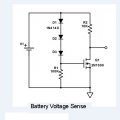
You are correct. I have been thinking about this and have come up with the following simple circuit.

The output will be the battery voltage until a threshold voltage is exceeded at which stage the MOSFET will turn on and the output will be 0V. You can adjust the trigger level by changing the number of diodes in series.

With 2 diodes, the threshold is 2.3V.
With 3 diodes, the threshold is 2.9V.


Battery Voltage Sense.jpg
 

MrChips

Joined Oct 2, 2009
34,814
wouldn't the mosfet turn off when the voltage drops below the threshold voltage?
much similar to your first suggestion?
i am now building a circuit as descibed here: https://www.eevblog.com/forum/beginners/pythagorean-cup-circuit/
Yes, the MOSFET will turn off. This is not the total solution. This part of the circuit is to trigger another circuit.

I would prefer an output that goes high when the threshold is exceeded. I need to think about this one more deeply.
 
Top