pythagorean cup circuit

Thread Starter

lennyp

Joined Aug 23, 2019
11
Hello everyone!

I am not so good with analog circuits but i have a problem which requires one :(

I am using a solar panel to charge a capacitor and i need some kind of circuit that
turns on a load (small dc motor in my case) when the voltage of the the capacitor
reaches ~3V and turns the load off when the voltage is too low for the motor.
in principle something very similar to a pythagorean cup: https://en.wikipedia.org/wiki/Pythagorean_cup

the solar panel is very weak (i cannot measure any short circuit current with my DMM)
but monitoring the voltage of the capacitor confirms that it actually works (slowly rising voltage).

any help/ideas/hints would be greatly appreciated!
 

Alec_t

Joined Sep 17, 2013
15,118
Welcome to AAC!
What current does the motor draw and how long do you need it to run for? If the panel current is so low that you can't measure it I doubt the panel is suitable for powering a motor, other than in very short bursts.
Will the motor start reliably at 3V?
 

MrChips

Joined Oct 2, 2009
34,809
Lots of folks present great ideas here on AAC!

Unfortunately, it is frustrating to present useful guidance when they do not present the purpose of the idea.

What are you trying to do from the view of the big picture?
 

Thread Starter

lennyp

Joined Aug 23, 2019
11
Welcome to AAC!
What current does the motor draw and how long do you need it to run for? If the panel current is so low that you can't measure it I doubt the panel is suitable for powering a motor, other than in very short bursts.
Will the motor start reliably at 3V?
that's exactly the point why i want to do what i described in my first post

Lots of folks present great ideas here on AAC!

Unfortunately, it is frustrating to present useful guidance when they do not present the purpose of the idea.

What are you trying to do from the view of the big picture?
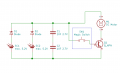
please see the attached schematic

And while at it is an external power supply avilable to power the "logic"?

Up to what voltage can the capacitor charge?
please see attached schematic for clarification.
it is two capacitors in series with each being rated for 2.7V

there is no other power supply available, the idea is to make it self contained.
 

Attachments

Alec_t

Joined Sep 17, 2013
15,118
Whether or not capacitors are involved, to determine if the project is viable you need to know how much energy the solar cell can provide in, say, one day and how much energy the motor requires in that period.
So, what current does the motor draw and how long do you want it to run for?

Edit:
Let's do some sums to put things in perspective.
The two caps in your schematic have a combined capacitance of 5F.
You want to start the motor when they charge to 3V and stop the motor when the voltage drops to, say, 1V. So the charge held goes from 3V x 5F = 15 C down to 1V x 5F = 5 C.
If the motor current were a uniform 200mA (it won't be in practice) it could therefore run for (15-5)C/0.2A = 50 seconds.
If the solar cell could provide, say, only 20mA then the cap re-charge time would be 10 x 50 seconds = 8.3 minutes.
 
Last edited:

Thread Starter

lennyp

Joined Aug 23, 2019
11
i really appreciate your help, but now i realize what MrChips meant with "big picture"
sorry if there were some confusions here...

the whole story is:
i want to use the motor to wind up a mechanical watch, so probably 20 revolutions per day would be more than enough.
it does not really matter how long it takes to charge the capacitors or for how long the motor will run as long
as it does run.

the whole point of this project was to give new purpose to some parts i had lying around.
the motor is an old micro servo where the driver chip failed, so its basically a dc motor with a gearbox.
at first i tried running the motor directly from the panels (which obviously didn't work) and then had the
idea to use capacitors to "buffer" the energy from the solar panels.
when i charge the capacitors to ~5V the motor runs smoothly for a long time (relative to the amount that is really needed),
and starts to go really slow at about ~1V.
the solar panels will generate around 3-3.5V at the place where i want to put the whole contraption.
with this in mind my first post should make more sense now.

i need the motor to draw no current until the solar panels charge the capacitors above a certain threshold where they
can run the motor for some time.
 

MrChips

Joined Oct 2, 2009
34,809
Without giving it serious thought, here are some solutions I would investigate.

1) Use a 555-timer circuit that turns on for X seconds when a threshold of Y volts is exceeded.

2) Use an MCU (microcontroller unit) to turn on the motor for X seconds once daily if a threshold of Y volts is exceeded.
 

Alec_t

Joined Sep 17, 2013
15,118
i want to use the motor to wind up a mechanical watch, so probably 20 revolutions per day would be more than enough.
In that case you don't want to over-wind the watch. Doesn't that change the cut-off requirement from being 'when the voltage drops to 1V' to 'when the watch is fully wound' instead?
 

Thread Starter

lennyp

Joined Aug 23, 2019
11
1) Use a 555-timer circuit that turns on for X seconds when a threshold of Y volts is exceeded.
how would you build the threshold detection?
i would like to keep the circuit as simple as possible, using a micro controller seems a bit overkill to me, and also
arises concerns over the power efficiency of the circuit. since the solar panels are low power i am afraid that
they won't be able to charge the capacitors over the winter months using MCUsi have at hand.

In that case you don't want to over-wind the watch. Doesn't that change the cut-off requirement from being 'when the voltage drops to 1V' to 'when the watch is fully wound' instead?
there is a clutch mechanism that prevents over-winding.
 

MrChips

Joined Oct 2, 2009
34,809
Threshold detection can be as simple as a voltage divider or a voltage divider with amplification.
The latter can be implemented in different ways, a transistor amplifier or op-amp, analog comparator, or a simple 1-bit ADC (aka a digital logic gate).
 

Analog Ground

Joined Apr 24, 2019
460
I love this application!. How about this circuit powering a variation of a "Useless Box" with the box opening when the capacitors are fully charged, then a hand comes out and waves "Hi!" then closes when the caps are discharged. I am thinking a very low power microcontroller in sleep mode which wakes up when it's comparator senses a full charge. For the mechanically inclined, have the hand wave both hello and goodbye.
 

Thread Starter

lennyp

Joined Aug 23, 2019
11
Threshold detection can be as simple as a voltage divider or a voltage divider with amplification.
The latter can be implemented in different ways, a transistor amplifier or op-amp, analog comparator, or a simple 1-bit ADC (aka a digital logic gate).
where/how would you build the voltge divider? can you elaborate this a bit more, maybe with a schematic?
how would one build a 1-bit ADC and integrate into this?
i do have an lm311 lying around but as i said my knowledge for analog circuits is very limited so maybe you have
some more pointers for me?

the solar panels may somewhat limit the charging current otherwise https://www.google.com/search?q=charge+contorl+circuit+5F+supercapacitor
i also tried using google. but with these search parameters i cannot find anything related to my problem.
maybe you can post a link with an example more closely related to my problem?
 

Alec_t

Joined Sep 17, 2013
15,118
there is a clutch mechanism that prevents over-winding.
On the basis of my figures in post #6, the motor run time of 50 secs per charge/discharge cycle is much greater than the time a micro-servo would take to do 20 revs, which I'd estimate at about 4 secs. So the clutch would be slipping for most of the time. Methinks a cut-off timer and/or a 'once per day' cut-off would be an advantage, as well as the 1V cut-off.
 

MrChips

Joined Oct 2, 2009
34,809
No problem.

A voltage divider is simply two resistors in series across the voltage source. This will divide the input voltage to a suitable range using the formula:

Vout = Vin x R2 / (R1 + R2)


MrChips

Joined Oct 2, 2009
34,809
For a digital output, you can use the LM311 analog comparator but there are alternatives.

Of starters, you can experiment with a simple CMOS inverter gate such as CD4049 which is a basic 1-bit ADC (analog-to-digital converter). The switching threshold of the gate will be one-half the supply voltage.

CD4049 supply operating range is 3-18V
SN74HC04 supply operating range is 2-6V

SN74HC14 is a Schmitt-trigger inverter which will give faster rise and fall times.
 

Thread Starter

lennyp

Joined Aug 23, 2019
11
No problem.

A voltage divider is simply two resistors in series across the voltage source. This will divide the input voltage to a suitable range using the formula:

Vout = Vin x R2 / (R1 + R2)

this would not work in my case, since there would be no way for the solar panels to charge the capacitor then.

On the basis of my figures in post #6, the motor run time of 50 secs per charge/discharge cycle is much greater than the time a micro-servo would take to do 20 revs, which I'd estimate at about 4 secs. So the clutch would be slipping for most of the time. Methinks a cut-off timer and/or a 'once per day' cut-off would be an advantage, as well as the 1V cut-off.
how would a circuit like that look like?

For a digital output, you can use the LM311 analog comparator but there are alternatives.

Of starters, you can experiment with a simple CMOS inverter gate such as CD4049 which is a basic 1-bit ADC (analog-to-digital converter). The switching threshold of the gate will be one-half the supply voltage.

CD4049 supply operating range is 3-18V
SN74HC04 supply operating range is 2-6V

SN74HC14 is a Schmitt-trigger inverter which will give faster rise and fall times.
i looked at these parts but i don't quite understand how to incorporate these into my circuit.
maybe you can give an example by expanding on this:
 
Top