Guidance Required for Debugging Hardware Implementation of Sprott Chaotic Attractor Circuit

Thread Starter

Maitreya07

Joined Jun 4, 2026
4
I am currently working on the hardware implementation of a Sprott chaotic attractor circuit using analog computation techniques. While the circuit performs correctly in LTspice simulations and produces the expected chaotic attractor trajectories, I have been unable to obtain the expected behavior from the physical hardware implementation. I would greatly appreciate your guidance in identifying the possible causes of the problem.

Project Overview
The circuit is based on the Sprott chaotic system realized using analog integrators, summing amplifiers, and nonlinear multiplication blocks. The implementation uses LT1057 operational amplifiers and an AD633 analog multiplier.

In simulation:

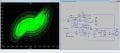
  • The state variables Vx, Vy, and Vz evolve chaotically.
  • Phase portraits such as Vx vs Vy and Vy vs Vz produce the expected butterfly-like chaotic attractor.
  • The system remains bounded and exhibits sustained chaotic oscillations.
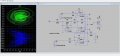
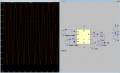
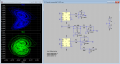
I have attached the simulation screenshots showing the expected attractor trajectories.

Hardware Implementation
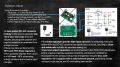
Since I did not have access to a dedicated ±15 V laboratory power supply, I had to generate the required supplies using additional circuitry:

1. Dual Supply Generation
The chaotic circuit requires:

  • +15 V
  • -15 V
To obtain these rails, I used:

  • A DC-DC boost converter module for generating a higher voltage.
  • Additional circuitry to derive the negative rail (-1V).
2. Reference Voltage Generation
The circuit also requires a fixed -1 V reference.

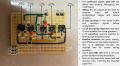
Since a precision negative reference source was not available, I implemented a separate circuit using:

  • LT431 adjustable reference
  • Operational amplifier buffering stage
  • Trimmer potentiometer for adjustment
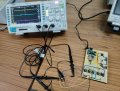
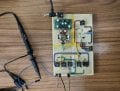
This circuit is shown on the upper-right section of the hardware board.

Measurements Performed
The outputs corresponding to:

  • Vx
  • Vy
  • Vz
were probed using a digital oscilloscope.

The expectation was:

  • Oscillatory signals on all three state variables
  • Chaotic waveforms
  • XY plots forming the attractor shape
However, the observed behavior was:

  • Nearly constant DC voltages on some nodes
  • Significant noise on the outputs
  • No visible chaotic oscillation
  • No attractor formation in XY mode
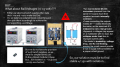
The oscilloscope traces mainly showed noise spikes and almost stationary voltage levels instead of the expected evolving state variables.
I want to implement it on a PCB so that no mistakes are there.

What I Would Like Guidance On
I would be grateful for advice on:

  1. A systematic debugging procedure for chaotic analog circuits.
  2. Which node should be checked first to verify proper operation.
  3. How to verify whether each integrator stage is functioning correctly.
  4. Methods to confirm the AD633 multiplier is producing the correct output.
  5. Whether the custom ±15 V supply arrangement is likely to be the primary issue.
  6. Whether a PCB implementation is necessary or if this should work reliably on a prototyping board.
  7. Any recommended measurements that could help isolate the fault.
I have attached:

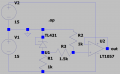
  • LTspice simulation schematics
  • Simulation results showing the expected attractor
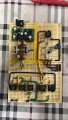
  • Photographs of the completed hardware setup
  • Oscilloscope measurements
I have also watched a few videos where they have done these type of circuit boards in pcbs :
links:
(here he has done lorentz chaotic circuit)
links:
(here he has done lorentz chaotic circuit)

Any guidance regarding likely failure points or recommended debugging steps would be extremely helpful. Please Help me out.
 

Attachments

Irving

Joined Jan 30, 2016
5,138
Welcome to AAC.
Nicely documented, though the Sprott Chaotic Attractor is a new 'thing' to me.... I've come across chaotic behaviour before, but by accident rather than design! Other than pretty pictures... what's it for and why?

I can't see anything wrong with the +/- 15v rails, have you measured them accurately, and also the current being drawn from both?

I suspect, unless there's a flaw in your wiring, you've met the issue that simulations are based on perfect devices, but the real world says otherwise... though intuitively maybe a chaotic system would cope with that? I note that the multiplier isn't in your simulations so that would be my first area to investigate - why didn't you include it? Note the simulation needs a small -ve DC offset - or a capacitor in the output W to remove the DC offset. Maybe this is throwing your circuit out? We cant see your multiplier element in the schematic so can't validate it.
+
1780587584919.png
Files attached in case you don't have them..

BTW your -1v could have been derived more directly from the -ve rail.
1780584813281.png
 

Attachments

Last edited:

Thread Starter

Maitreya07

Joined Jun 4, 2026
4
Thank you very much sir, for replying.
And yes i have not used the ad633 in Ltspice since some issues were coming up with their files, so went on with an ideal scenario.

Sir apart from these i had checked the voltages +-15v and -1v was just coming fine and to be specific it was not complete 15 one rail had 14.89 and another 15.1 but the -1v was perfect.

Thank you, once again for providing the .asy and .sub files i am including it and then showing the results to you.
 

panic mode

Joined Oct 10, 2011
5,013
you did not post LTSpice files, what you shared are screenshots. ;)
you did not post info on the power supply (schematics, part numbers), only pictures, etc.
you did not post picture of the bottom side of the PCB.

methodical approach is to test one stage at a time....the good news is you have OpAmps socketed. this means you can pull the ICs, then do the tests piecemeal...

step 1. simply measure if you are getting +/-15V. if you do, power supply is working. step 1 done.

step 2. samething... check if -1V rail is really -1V. design is ok to get low impedance -1V from not regulated supply. but since you do have regulated supply, using just trimpot and capacitor would do just fine, specially since the only load is a 100k resistor.

step 3. your entire project is power supplies and two subcircuits. one is gain -1 amplifier and the other is integrator.

the gain -1 amplifiers are U9 and U8. for some reason they use different resistor values but they are same circuits (you can change R5 and R6 to 100k to make them same).
they are easy to test, instead of "X" connected to R7, connect some fixed voltage and measure voltage at outputs of those two ICs.
as a fixed voltage source, i would recommend 10k trimmer potentiometer. connect ends to +15V and -15V while wiper is your adjustable fixed voltage for tests.

make sure U7 is not inserted into its socket, then connect and then set this to some nice round voltage such as 5V and connect it to left side of R7.
U9 will invert that voltage so you will get -5V at its output. then U8 will do the same again and you will get +5V at its output.
you can adjust trimpot to 0V and both U9 and U8 will show 0V. and if you bring it to -5V, U9 will output +5V and U8 will output -5V.
it does not matter what voltage you set by trimmer, you will see the same at U8 and opposite at U9. so if you do not have trimpot at hand you can use batteries (1.5V, 9V, whatever..). and yes, you can also use 2.5V from your TL431 or -1V rail....

the last part is integrators. again, you have two identical integrators: U7 and U10. so both can be tested the same way. the only problem is that time constant is so small. hence need for scope...
so if you use some fixed voltage as input and touch the integrator input only briefly, your scope should show jump in opposite direction (if input is positive, output will jump into negative direction).
and as soon as contact is gone, output will rapidly decay to 0V.

so you can temporarily use larger values for R and C to something like 1M and 10uf and with this change you can do test using just DMM (or better yet analog one if you have it).
 
Last edited:

Irving

Joined Jan 30, 2016
5,138
i had checked the voltages +-15v and -1v was just coming fine and to be specific it was not complete 15 one rail had 14.89 and another 15.1 but the -1v was perfect.
Those regulators are, I believe, 2% tolerance; anything from 14.7 - 15.3 would be in specification, .so no issues there.
 

Thread Starter

Maitreya07

Joined Jun 4, 2026
4
Yes, it is working with the ad633 files you gave and the circuit was much cleaner than before.
Welcome to AAC.
Nicely documented, though the Sprott Chaotic Attractor is a new 'thing' to me.... I've come across chaotic behaviour before, but by accident rather than design! Other than pretty pictures... what's it for and why?

I can't see anything wrong with the +/- 15v rails, have you measured them accurately, and also the current being drawn from both?

I suspect, unless there's a flaw in your wiring, you've met the issue that simulations are based on perfect devices, but the real world says otherwise... though intuitively maybe a chaotic system would cope with that? I note that the multiplier isn't in your simulations so that would be my first area to investigate - why didn't you include it? Note the simulation needs a small -ve DC offset - or a capacitor in the output W to remove the DC offset. Maybe this is throwing your circuit out? We cant see your multiplier element in the schematic so can't validate it.
+
View attachment 368025
Files attached in case you don't have them..

BTW your -1v could have been derived more directly from the -ve rail.
View attachment 368019
Sir, if possible, can you please provide similar files for the TL081 opamp? I wish to see if they work in place of the LT1057.
 

Irving

Joined Jan 30, 2016
5,138
Sir, if possible, can you please provide similar files for the TL081 opamp? I wish to see if they work in place of the LT1057.
I could, but better you:
Download this file: http://bordodynov.ltwiki.org/lib.zip
Unzip to a temp directory
Close LTSpice, if runnng
Copy the resulting LIB folder over your %USERNAME%/AppData/Local/LTSpice/lib folder (when asked, skip files of the same name)
Start LTSpice

Then you'll have a whole load of new devices to play with (Use TL082)
 
Last edited:

Futurist

Joined Apr 8, 2025
774
I am currently working on the hardware implementation of a Sprott chaotic attractor circuit using analog computation techniques. While the circuit performs correctly in LTspice simulations and produces the expected chaotic attractor trajectories, I have been unable to obtain the expected behavior from the physical hardware implementation. I would greatly appreciate your guidance in identifying the possible causes of the problem.

Project Overview
The circuit is based on the Sprott chaotic system realized using analog integrators, summing amplifiers, and nonlinear multiplication blocks. The implementation uses LT1057 operational amplifiers and an AD633 analog multiplier.

In simulation:

  • The state variables Vx, Vy, and Vz evolve chaotically.
  • Phase portraits such as Vx vs Vy and Vy vs Vz produce the expected butterfly-like chaotic attractor.
  • The system remains bounded and exhibits sustained chaotic oscillations.
I have attached the simulation screenshots showing the expected attractor trajectories.

Hardware Implementation
Since I did not have access to a dedicated ±15 V laboratory power supply, I had to generate the required supplies using additional circuitry:

1. Dual Supply Generation
The chaotic circuit requires:

  • +15 V
  • -15 V
To obtain these rails, I used:

  • A DC-DC boost converter module for generating a higher voltage.
  • Additional circuitry to derive the negative rail (-1V).
2. Reference Voltage Generation
The circuit also requires a fixed -1 V reference.

Since a precision negative reference source was not available, I implemented a separate circuit using:

  • LT431 adjustable reference
  • Operational amplifier buffering stage
  • Trimmer potentiometer for adjustment
This circuit is shown on the upper-right section of the hardware board.

Measurements Performed
The outputs corresponding to:

  • Vx
  • Vy
  • Vz
were probed using a digital oscilloscope.

The expectation was:

  • Oscillatory signals on all three state variables
  • Chaotic waveforms
  • XY plots forming the attractor shape
However, the observed behavior was:

  • Nearly constant DC voltages on some nodes
  • Significant noise on the outputs
  • No visible chaotic oscillation
  • No attractor formation in XY mode
The oscilloscope traces mainly showed noise spikes and almost stationary voltage levels instead of the expected evolving state variables.
I want to implement it on a PCB so that no mistakes are there.

What I Would Like Guidance On
I would be grateful for advice on:

  1. A systematic debugging procedure for chaotic analog circuits.
  2. Which node should be checked first to verify proper operation.
  3. How to verify whether each integrator stage is functioning correctly.
  4. Methods to confirm the AD633 multiplier is producing the correct output.
  5. Whether the custom ±15 V supply arrangement is likely to be the primary issue.
  6. Whether a PCB implementation is necessary or if this should work reliably on a prototyping board.
  7. Any recommended measurements that could help isolate the fault.
I have attached:

  • LTspice simulation schematics
  • Simulation results showing the expected attractor
  • Photographs of the completed hardware setup
  • Oscilloscope measurements
I have also watched a few videos where they have done these type of circuit boards in pcbs :
links:
(here he has done lorentz chaotic circuit)
links:
(here he has done lorentz chaotic circuit)

Any guidance regarding likely failure points or recommended debugging steps would be extremely helpful. Please Help me out.
I'm curious, you speak of "simulating" a chaotic circuit using analog computation, but why simulate it when you can simply build it?

How does your simulation of the analog computation based oscillator behave, compared to the simulation of an actual Sprott oscillator?
 
Top