PWM - Average current

Thread Starter

Gorden

Joined Oct 30, 2019
27
I agree with this - the only thing is if you want to have the initial pull in charge, you would then have to use a capacitor discharge circuit. Using PWM allows for a digital control of the current from 100% to get the initial pull, then drops to whatever is required.

But I do understand you point.

 

shortbus

Joined Sep 30, 2009
10,050
While all of this reduced voltage works when used on a relay coil, I'm not so sure it will work on a solenoid valve. The relay only needs to overcome the small spring on the movable armature, a valve needs to overcome the hydraulic or air forces on the valve, which could be much more.

What changes do you expect by reducing current on the valve coil? A properly designed or specified valve for the voltages used is made to work at full voltage and current in continuous use. In my machine shop I have a 5HP air compressor, with a solenoid valve on the air outlet, working at 120VAC. When ever the lights are on the valve is actuated. It has been working for over 25 years now and hasn't failed. And it isn't cooled by the air passing through it, because most of the time the compressor isn't turned on or full of air. The valve doesn't burn out because it is made to work with the voltage that is used on it.
 

Tonyr1084

Joined Sep 24, 2015
9,744
Put the cap across the resistor. The lack of charge on the cap at startup will draw the current needed, but as it charges the resistor will take over the task of limiting the current. Then when powered down the resistor will drain the cap getting it ready for the next on cycle.

Keep in mind - I'm a BASIC electronics expert. I said "Basic".
 

Tonyr1084

Joined Sep 24, 2015
9,744
@shortbus Solenoid valves - lawn sprinkler types for example - use the solenoid to open a small equalizing passage to equalize the pressure on both sides of the diaphragm. A small spring can hold back the water pressure easily because on both sides of the diaphragm are equalized. The solenoid vents the pressure from the one side allowing the high pressure on the other side to push the valve open. Maybe I have that backwards, but that's the basic operation of most solenoid valves. Now - I have a couple SV's in the garage that came out of dishwashers and a water / ice maker water valves from a fridge. Not exactly sure how those operate. Probably something similar.
 

crutschow

Joined Mar 14, 2008
38,506
As the frequency is reduced, the coil ripple is greater, although fitting a 1000uF capacitor across the supply (after the 1R) smooths this out completely.
That smooths the ripple you see through the resistor but has no effect on the solenoid ripple current.
 

shortbus

Joined Sep 30, 2009
10,050
Solenoid valves - lawn sprinkler types for example - use the solenoid to open a small equalizing passage to equalize the pressure on both sides of the diaphragm.
Never had a water sprinkler valve apart. But if that's how they work it's not how all of the solenoid valves work. Since the TS hasn't posted the type of valve, I still stand by my choose the right one for the job at hand, that is from my experience.
 

Tonyr1084

Joined Sep 24, 2015
9,744
@ ALL - Hope you had a good Halloween.

@shortbus I think I'm understanding that @Gorden isn't trying to control the amount of (fluid or air) so much as he's trying to reduce the amount of current being used by the valve itself. My take-away is that he wants full current at initial activation then some reduced level of current after the valve has been opened. The lower current continues to hold the valve open. That's what I get from all the posts so far.

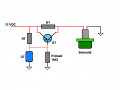
Digital control (or programmed control) of the current is certainly one way to approach the issue. But I'm thinking there must be a way to achieve the same thing with passive components. Or maybe a transistor controlled by an RC circuit that upon initial energizing - the transistor conducts full current, but after the TimeOut the transistor shuts down and sends power to the coil via a current reducing resistor. No need for µC's or programming. Just a simple set of passive components to do the job.

I made an oscillator out of an extra DD Flip Flop using only the set and reset. The problem I encountered was that the oscillator would not start. But as soon as I probed it with my O-scope it began oscillating. So I used a PNP transistor and an RC to pull one of the two (set or reset) to ground momentarily, triggering the FF to oscillate. I'm thinking something very similar could be used to conduct full current until the RC times out, then current only flows through an appropriate sized resistor. (Ohms and Watts)
 

Tonyr1084

Joined Sep 24, 2015
9,744
Since @Gorden is thinking about PWM - I'm assuming the valve is being controlled by 12 VDC. In a DC circuit a transistor / timer would (I think) work well. IF the coil is 12 VAC - that may require a different approach. Not sure about that one.
 

Tonyr1084

Joined Sep 24, 2015
9,744
Here's my thinking: At initial power-up Q? (PNP type) conducts because CT (Timing Cap to be determined) is at zero volts. The solenoid gets full power through Q? (Q? to be determined). CT charges through RT (Timing Resistor; value to be determined). When CT is sufficiently charged Q? stops conducting leaving the current for the solenoid to be carried by R?. When shut down, R bleed (1MΩ or other value) bleeds CT down so that at next power cycle the system is ready to function as described. Any current flowing through RT and R bleed will be minimal.
solenoid.png
 

Alec_t

Joined Sep 17, 2013
15,119
I want to use a small SMPS mains converter, that is rated less than the 450mA the solenoid will require at 100%
Depending on the SMPS that may or may not work. Even if the solenoid operates only briefly at 100% the SMPS will be in an overload state and may respond by shutting down to protect itself.
 

Thread Starter

Gorden

Joined Oct 30, 2019
27
That smooths the ripple you see through the resistor but has no effect on the solenoid ripple current.
But it would average out the current that the power supply see's as the current pulses are then supplied by the capacitor itself (I think..)
 

Thread Starter

Gorden

Joined Oct 30, 2019
27
Depending on the SMPS that may or may not work. Even if the solenoid operates only briefly at 100% the SMPS will be in an overload state and may respond by shutting down to protect itself.
Yes - The peaks drawn by the solenoid must be less than the rating of the SMPS, hopefully the smoothing capacitor will supply most of the peak current during the very short initial pulse and the shorter PWM pulses.
 

Thread Starter

Gorden

Joined Oct 30, 2019
27
Hello Crutschow, sorry for the delay.
I have tested between 50-100ms without any problems.

The only issue i now have is switching noise on the supply line, as the solenoid turns on and off i am getting a volt of drop when turned of and then the same above positive when turned off.

The other issue is the frequency - i have simulated and tested, lower than 1Khz you start to see lots of ripple, above 5Khz i can't really notice any significant effect, i have gone all the way to 25Khz. So it's not clear to me how to choose - i am just using anything between 1-5Khz.
 

crutschow

Joined Mar 14, 2008
38,506
i have gone all the way to 25Khz. So it's not clear to me how to choose - i am just using anything between 1-5Khz.
The higher the frequency, the higher the switching losses, but that's probably not a problem at these frequencies.
Sometimes the frequency is kept above 20kHz to keep it out of the audible range, if that's a consideration.
 
Top