Push pull amplifier biasing

Thread Starter

demir-ali

Joined Jul 13, 2024
321
True, the linear region is small due to the exponential behavior of Vbe vs Ic. And ss the name suggests the differential amplifier "reacts" to a voltage difference between two bases.
\[ \frac{I_{E1}}{I_{E2}} = e^{\frac{V_{BE1}- V_{BE2}}{26mV}} \]
But I'm sure books mention about it too.
I will look for it again
 

Jony130

Joined Feb 17, 2009
5,598
But all you have to remember is that for asymmetrical output (as in your case) the diff stage voltage gain will approach Av_max = (gm * Rc)/2.
In your case, the gain is much less due to the R4 resistor's influence on the Q2 gain. Because now vpi2 is no longer equal to the emitter voltage but rpi together with R4 forms a voltage divider.
Thus, vpi2 = ve * rpi/(rpi + R4), and this is why the voltage gain will drop. And this is what you see in the simulation.
 

Thread Starter

demir-ali

Joined Jul 13, 2024
321
But all you have to remember is that for asymmetrical output (as in your case) the diff stage voltage gain will approach Av_max = (gm * Rc)/2.
In your case, the gain is much less due to the R4 resistor's influence on the Q2 gain. Because now vpi2 is no longer equal to the emitter voltage but rpi together with R4 forms a voltage divider.
Thus, vpi2 = ve * rpi/(rpi + R4), and this is why the voltage gain will drop. And this is what you see in the simulation.
Also , with single ended setup, I can't take advantage of CMR I guess.
 
Last edited:

Thread Starter

demir-ali

Joined Jul 13, 2024
321
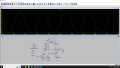
When I connect noise source plus biasing , It does not work as we wanted to do but the solo noise is prevented mostly. Can you check it ?
 

Attachments

MrAl

Joined Jun 17, 2014
13,707
Hi , I was trying to improve my last design in the direction of using power mosfets at output which have lower Bf values.
I add my .asc file and the circuit image. I be happy if you review and lead me.
If you followed my drawing you would have seen that the diodes work in close conjunction with the base emitter diode voltage drops. If you have 2 BE voltage drops then you need 2 diode drops, hence 2 diodes. In this new circuit you have 3 BE voltage drops so you need (ideally) 3 diode voltage drops yet you seem to have 4.
This is one of the reasons I posted that diagram showing the connections from the diodes to the transistors a little bit tighter, even though it was just by means of some virtual wiring.
 

Thread Starter

demir-ali

Joined Jul 13, 2024
321
If you followed my drawing you would have seen that the diodes work in close conjunction with the base emitter diode voltage drops. If you have 2 BE voltage drops then you need 2 diode drops, hence 2 diodes. In this new circuit you have 3 BE voltage drops so you need (ideally) 3 diode voltage drops yet you seem to have 4.
This is one of the reasons I posted that diagram showing the connections from the diodes to the transistors a little bit tighter, even though it was just by means of some virtual wiring.
Yes , after posting I removed 1 diode and it worked well with small c.distortion. So , is this a good design?
 

MrAl

Joined Jun 17, 2014
13,707
Yes , after posting I removed 1 diode and it worked well with small c.distortion. So , is this a good design?
Well hey what can I say, if it works, it works :)

There are better biasing methods though for the output transistors. Maybe look some of them up.
The problem with diodes alone is that they do not track the base emitter diodes that well over temperature. Better than nothing though.
Check your currents to see if the diodes are doing a good job. The emitter currents have to be non-zero always, yet not too high when the opposite transistor is conducting.
 

MisterBill2

Joined Jan 23, 2018
27,547
Well hey what can I say, if it works, it works :)

There are better biasing methods though for the output transistors. Maybe look some of them up.
The problem with diodes alone is that they do not track the base emitter diodes that well over temperature. Better than nothing though.
Check your currents to see if the diodes are doing a good job. The emitter currents have to be non-zero always, yet not too high when the opposite transistor is conducting.
There do exist diodes made for that purpose, and when mounted to the heat sink close to the transistors they work"fairly well." But I don't know if they are still available. It seems that they do have a tendency towards failure. My MARANTZ 2235 is an example of that.
 

MrAl

Joined Jun 17, 2014
13,707
There do exist diodes made for that purpose, and when mounted to the heat sink close to the transistors they work"fairly well." But I don't know if they are still available. It seems that they do have a tendency towards failure. My MARANTZ 2235 is an example of that.
I had a Radio Shack audio amplifier like that one time too a long time ago and one of the diodes blew out and I had to replace it. I am sure I used a different diode part number but it still worked OK. Never checked the currents though, but it still sounded good so I didn't bother checking anything else at the time.

The type of bias I was thinking of might be the kind with the one transistor instead of diodes. That might work better.
 

Thread Starter

demir-ali

Joined Jul 13, 2024
321
Hi , I've studied these subjects. What would you suggest me to have a look at ? I am having fun spending my time over project development.
Could you tell me some example projects or circuits please ?
Or what would you research next in the path of learning electronics ?
 

MisterBill2

Joined Jan 23, 2018
27,547
Considering that the amplifiers that used the diodes are bipolar transistor amplifiers, 1960's and 1970' s technologies, visiting a major electronic semiconductor's website and looking at application notes for audio amplifiers may provide a more current insight into audio amplifier current technology.
 

Thread Starter

demir-ali

Joined Jul 13, 2024
321
Considering that the amplifiers that used the diodes are bipolar transistor amplifiers, 1960's and 1970' s technologies, visiting a major electronic semiconductor's website and looking at application notes for audio amplifiers may provide a more current insight into audio amplifier current technology.
I am not totally interested at audio amplifiers but the first subject we learn was these in electronics class I do not know anything else yet
 

MisterBill2

Joined Jan 23, 2018
27,547
Audio amplifiers are a good choice for an electronics class, and a great way to get into more complex circuits. Amplifiers are a large part of electronics in general so what you learn at this point will be useful in the future. Even those boring details will be useful.
 

MrAl

Joined Jun 17, 2014
13,707
Hi , I've studied these subjects. What would you suggest me to have a look at ? I am having fun spending my time over project development.
Could you tell me some example projects or circuits please ?
Or what would you research next in the path of learning electronics ?
Hello again,

Here's quick list. You have to think about what you are most interested in.
Note I do not know what you have learned in the past so I list things here you may already know. If you know Nodal analysis that's great, but if not you might want to start with that. It's one of the keys to understanding many circuits. If you are not that into the math that's ok then skip that for now.

The most modern audio amplifiers.
AC power circuits, single phase, three phase, power factor, sine wave inverters.
Rectifier circuits.
General diode circuits.
Filters, capacitors, inductors.
Op amps: filters, amplifiers.
Transistor amplifiers.
Voltage regulators, linear, switching.
Phase shift oscillators.
Root Locus.
Microcontollers (wide variety of projects).
Nodal Analysis.
 

Thread Starter

demir-ali

Joined Jul 13, 2024
321
Hello again,

Here's quick list. You have to think about what you are most interested in.
Note I do not know what you have learned in the past so I list things here you may already know. If you know Nodal analysis that's great, but if not you might want to start with that. It's one of the keys to understanding many circuits. If you are not that into the math that's ok then skip that for now.

The most modern audio amplifiers.
AC power circuits, single phase, three phase, power factor, sine wave inverters.
Rectifier circuits.
General diode circuits.
Filters, capacitors, inductors.
Op amps: filters, amplifiers.
Transistor amplifiers.
Voltage regulators, linear, switching.
Phase shift oscillators.
Root Locus.
Microcontollers (wide variety of projects).
Nodal Analysis.
Hi , as I am EEE student , I already studied many of things u listed here. I am good ad KCL KVL and nodal analysis.
I've designed very simple power supply using regulator , stepdown transformer and rectifier diodes.
In my last project , I've also used diodes for signal switching as T/R switch , also used opas for amplifying and active filtering.
As you can see from my last topics including this thread I also studied transistor amplifiers.
At this poing Im also interested at designing pcb but I do not have any project to design a pcb.
I have the idea of completing my ultrasonic sensor project and design a pcb wich includes a mcu to make it able to send data , but since only 2 weeks remaining before my semester starts , I am a bit away from this idea.
Next semester I have classes about electrical machines , signals and systems , electronics2 which consist of mostly amplifiers , and electromagnetics2.
I guess I will look for transistor oscilators and sallenkey topology for now. May be power supply circuits using semiconductors.
Also I am happy about I have someone to talk about these here.
 
Top