Push pull amplifier biasing

crutschow

Joined Mar 14, 2008
38,513
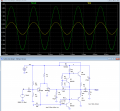
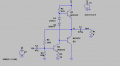
Below is my favorite, relatively simple, audio amplifier:
It uses DC and AC negative feedback from the output to a differential input stage (Q1 and Q1) to stabilize the output DC bias at 1/2 the supply voltage, set the amp gain, and reduce distortion.
The feedback value is determined by R4, R5, and C2.

1724341782907.png
 

Attachments

Last edited:

Thread Starter

demir-ali

Joined Jul 13, 2024
321
Below is my favorite, relatively simple, audio amplifier:
It uses negative DC and AC feedback from the output to a differential input stage (Q1 and Q1) to stabilize the output DC bias at 1/2 the supply voltage, set the amp gain, and reduce distortion.

View attachment 329829
Seems well but it is complex for me to analyse for now. I want to practice previous example, then study differantial pairs and amplifiers. I have no experience with differantial pairs.
I wonder why it is a better setup with Q3 and how to calculate the gain and the affect of feedback ? Excuse me if I am missing something.
 

crutschow

Joined Mar 14, 2008
38,513
I have no experience with differantial pairs.
Basically, a differential pair is biased and operating normally when the two input voltages are very near equal, thus the output is determined by any small difference (differential) between the two input voltages.
why it is a better setup with Q3
Q3 is a Vbe multiplier circuit which allows setting of the output transistors bias current by adjusting the values of R6 and R7..
You want the output bias current high enough to eliminate crossover distortion, but low enough so it doesn't generate significant bias power in the output transistors.
how to calculate the gain and the affect of feedback
The AC feedback is determined by the attenuation ratio of R4 and R5 that gives an AC feedback voltage at Q2's base equal to the input voltage at Q1's base.
For the R4 and R5 values shown, the feedback attenuation is about 0.28, giving a gain of about 3.6 (i.e. the output AC voltage has to be 3.6 times the input for the two differential voltages to be equal).

Due to C2, the DC feedback gain is 1, thus the output DC bias point equals the bias voltage at Q1's base of 1/2 the supply voltage.
 

Thread Starter

demir-ali

Joined Jul 13, 2024
321
Hi , I slightly got your circuit by seperated parts but it is still hard to look at the big picture for me.
I also understood the feedback in your circuit but I am very new with these topologies.
Also what does Q3 make better the circuit below ? I know a active load is better than a resistor but here why is that ?
1724348255702.png
 

MrChips

Joined Oct 2, 2009
34,817
Output transistors Q1 and Q2 are emitter followers. They do not provide voltage gain. They provide current gain and very low output impedance.

Q3 is the driver stage. It is a common emitter amplifier. It provides both current and voltage gain. It also presents a high input impedance.
 

Thread Starter

demir-ali

Joined Jul 13, 2024
321
Output transistors Q1 and Q2 are emitter followers. They do not provide voltage gain. They provide current gain and very low output impedance.

Q3 is the driver stage. It is a common emitter amplifier. It provides both current and voltage gain. It also presents a high input impedance.
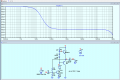
How can I calculate the gain in this one ? I can change it by changing values but not by calculating.
When I apply V/I = R over diodes and take it as Rc, RC/RE corrects the gain. But , how should I calculate ?
1724349213390.png
 

Audioguru again

Joined Oct 21, 2019
6,826
I made an error for your little low power output transistors. The maximum allowed curent for the BC547C anf BC557C transistors is only 100mA. Your simulations are trying to get 2V peak into 8 ohms= 250mA.
The simulation program does not care if you overload the transistors to cause destruction.

2N3904 and 2N3906 transistors have a maximum allowed output current of 200mA but they have the American EBC pinout.
Your BC547 and BC557 have the European CBE pinout.
 

Thread Starter

demir-ali

Joined Jul 13, 2024
321
I made an error for your little low power output transistors. The maximum allowed curent for the BC547C anf BC557C transistors is only 100mA. Your simulations are trying to get 2V peak into 8 ohms= 250mA.
The simulation program does not care if you overload the transistors to cause destruction.

2N3904 and 2N3906 transistors have a maximum allowed output current of 200mA but they have the American EBC pinout.
Your BC547 and BC557 have the European CBE pinout.
I knew about it but since it is simulation did not care. My problem is about calculating the gain. I also be happy If you can suggest me some circuit models or example to study.
 

ericgibbs

Joined Jan 29, 2010
21,442
Hi demir,
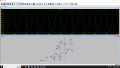
This simulation compares the Va/2 Nodes, with and without the connection to the Vj Node.
I have reduced the Vin to 10mVppk in order to not limit the output voltage swing.

Try running the asc file, show your calculations for the expected gain of the Q3 stage.

What are your conclusions on the effect of the Node vj feedback?
E
EG57_ 2019.png
 

Attachments

Thread Starter

demir-ali

Joined Jul 13, 2024
321
Hi demir,
This simulation compares the Va/2 Nodes, with and without the connection to the Vj Node.
I have reduced the Vin to 10mVppk in order to not limit the output voltage swing.

Try running the asc file, show your calculations for the expected gain of the Q3 stage.

What are your conclusions on the effect of the Node vj feedback?
E
View attachment 329875
Seems like feedback decreasing dc point and increasing ac swing a little bit. But in this case , as it is hard to calculate Rout at Q3 , how could I calculate or how should I approximate the gain ?
 

MrChips

Joined Oct 2, 2009
34,817
I did same thing but in DC analysis.
So the way of calculating gain is changing values in the simulation ?
Sometimes calculating the gain or frequency response and phase shift of a circuit is very complex.
It is easier to let the simulation determine these things for you.
 

Thread Starter

demir-ali

Joined Jul 13, 2024
321
Sometimes calculating the gain or frequency response and phase shift of a circuit is very complex.
It is easier to let the simulation determine these things for you.
I mean , if I would know approximate value of Rout , I can set Re. As It is not constant I am confused.
 

MrChips

Joined Oct 2, 2009
34,817
Yes I know , I mean is this the True method of doing this ?
I doubt that there is any "True" method of doing this. All semiconductor circuit calculations require modeling and approximations.
For example, even modeling of a simple PN junction in a diode requires knowledge of the reverse saturation current and its temperature dependence.
 
Top