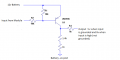
Pulsed ground signal into positive output

Thread Starter

soulessshadow

Joined Jan 12, 2025
10
Apologizes for my lack of knowledge I only know enough to get myself into trouble.

I've tried searching for the answer the closest I found was this thread - https://forum.allaboutcircuits.com/threads/converting-negative-signal-into-positive-signal.8030/

I tried making up the suggested circuit from there and measured the output it was 0v until I grounded the input onto the -ve terminal and then the output measure 12v I thought oh great that was easy....ha but once I took the input wire off the battery the output stayed at 12v and it seemed to instanly fry the transistor. Im definitely dont have enough knowledge to go about fixing it myself so any help would be amazing.

I've attached what I had hooked up. I hope it makes sense
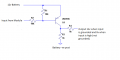
interface.PNG Also will add I'm looking for the output to be a 5v square wave signal to drive an ignition coil trigger.

Thank you
 

Thread Starter

soulessshadow

Joined Jan 12, 2025
10
Yeah so I definitely messed up. Fixed the output position on the board and now it seems to be working. I'm only using a multimeter to check but if I hold the input grounded voltage goes up then basically back down to 0v if I just tap the input on and off the ground the voltage jumps up then down only seeing around 1.5 to 1.8v max. Is this just a case of the multimeter being to slow to see the full voltage? Or is something else wrong for it not to show a steady voltage out when grounded?


Also whats the best way to have the output maximum be 5v ? Limit it to 5v on the input side with a bec? Or something else?

Thanks
 

Sensacell

Joined Jun 19, 2012
3,767
Just replace the single 1K resistor on the collector terminal with a voltage divider.
If the input is 12V:

Lower resistor = 1k

Upper resistor= 1.4K

This will give you 5V across the 1K.
 

Thread Starter

soulessshadow

Joined Jan 12, 2025
10
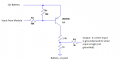
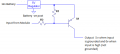
Its not always 12v exactly could be whatever the alternator is putting out. But if I was to do this which of these would be the correct placement ? I know maybe it should be clear but I just want to make sure I'm understanding correctlyinterface_v2.png
Or
interface_v2.1.png
Given that the Voltage may vary between 10.5v-14.7v from cranking to engine running would I be better off to regulate the voltage from the battery down to 5v?

Thank you
 

sghioto

Joined Dec 31, 2017
8,633
Given that the Voltage may vary between 10.5v-14.7v from cranking to engine running would I be better off to regulate the voltage from the battery down to 5v?
I would try this circuit.
Component values dependent on the load current required.
"Also I'm looking for the output to be a 5v square wave signal to drive an ignition coil trigger".

1736879054164.png
 

Thread Starter

soulessshadow

Joined Jan 12, 2025
10
I have no idea I could measure it once I have it working. But the 5v signal is only the control to start energizing the coil and then on the low side it fires it. Coil has its own 12v source and ground. The ignitor is built into the coil so just triggering that. That's usually a few hundred mA at most. But short answer is no I dont
 

Thread Starter

soulessshadow

Joined Jan 12, 2025
10
Okay I measured the resistance and I got 2.34Mohm. the module only sends a negative trigger signal so no voltage as far as I know?
I built the circuit as suggested with a 10k resistor for r1 and r2. I then hooked it all up and was able to produce a spark from the coil every time I quickly tapped the input onto the battery -ve post. So it seemed to work great like that. Thank you for the suggestion
 

sghioto

Joined Dec 31, 2017
8,633
Have you actually tried it using the module?
I'm concerned about the transistor not being rated high enough if you think the igniter draws several hundred ma.
 

Thread Starter

soulessshadow

Joined Jan 12, 2025
10
Yeah i was just going off what external igniters usually draw. I haven't found any specs for this exact coil. Just a few mentions of 3 wire coils like these it being a logic only circuit and less then 20mA
 
I would try this circuit.
Component values dependent on the load current required.
"Also I'm looking for the output to be a 5v square wave signal to drive an ignition coil trigger".

View attachment 340369
I hate to be a downer here,but beware load dump voltages in automotive applications. These are a very secondary concern but if you find that your regulator blows up occasionally, consider the possibility.
Load dump in 12V systems are usually modeled as 60V spikes. Short but not sweet.
 
That is a concern but only happens if the battery connection is suddenly broken while the alternator is spinning.
Murphy's law applies always ;)The most likely thing to happen is the thing you thought impossible - Just one paraphrasing of many of the universal law.

If this project is going into long term use or deployed widely, load dump may be an issue worth dealing with. Either way, it is worth knowing that it can happen.
 

Thread Starter

soulessshadow

Joined Jan 12, 2025
10
What would you add to the circuit to protect it from the possibility? Given that it's a race car application and has a kill switch so that scenario of the battery being disconnected while the engine running is a likely possibility
 

AnalogKid

Joined Aug 1, 2013
12,043
In the post #6 lower schematic, consider increasing the lower 1K resistor (Reference Designators!) to 10K, and adding a 5.1 V zener diode in parallel with it. This will give you a stable-enough output voltage without the complexity and clutter of an IC regulator, AND clamp both positive and negative transients on the output. To keep the available output current at approx. the same level as before, decrease the 1.4 K resistor to 1 K ohm.

Is the control signal coming in from the Module a 12 V signal, a 5 V signal, a switch that goes open-circuit, other - ?

ak

Reference Designators - !
 
Last edited:
Top