pulsed input constant output circuit

Thread Starter

liteace

Joined Mar 7, 2012
242
Hello ALL,, what is the official name for a pulsed input > constant output circuit, anyone know if there's a prebuilt cheap china kit I can buy or is it easy to knock one together with a few components

Ive got a pulsed input thats flashing a alarm (when triggered) light, I want the pulsed signal to be a constant signal to switch on a relay, this is all on a 12v system, is this poss?

Thanks
 

dl324

Joined Mar 30, 2015
18,220
What is the frequency of the pulsed signal? How long do you want the relay to be energized after the alarm pulse stops? What is the relay coil resistance?
 

Thread Starter

liteace

Joined Mar 7, 2012
242
The period of the pulses varies

I can measure the frequency, it;s like old 1990's horn, beep.....beep......beep.... car alarm or turn signal,

relay coil resistance = 200Ω

As soon as the pulsed input stops the relay needs to switch off immediately
 
Last edited:

Externet

Joined Nov 29, 2005
2,624
Is the amplitude of the pulse what determines the constant output ? Or is it the duration of the pulse determining it ? Or how frequent ?, if there is one pulse every hour, is it supposed to yield a constant output until the next hour pulse appears ?
A latching relay can produce a constant output when triggered by a pulsing signal of any flavor until is manually disabled.
 

BobTPH

Joined Jun 5, 2013
11,463
How much current can the pulse provide. How much does the relay take? How long between pulses?

It may be that all you need is a diode and capacitor.
 

Thread Starter

liteace

Joined Mar 7, 2012
242
How much current can the pulse provide. How much does the relay take? How long between pulses?

It may be that all you need is a diode and capacitor.
Current from pulse = aprox 3.5 amps
Relay consumes about 12 Ma
About the same as a vehicle turn signal
 

ronsimpson

Joined Oct 7, 2019
4,647
There is a thing call a relay. Under that there are versions that include a timer. (time delay relay) Under that there several options.

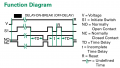
From the data sheet on a "Time Delay Relays - Delay-on-Break". The relay will comes on right away but goes off after a delay. In this case 2.5 seconds.

In the picture, V is the power to keep the relay working. It should connect to some source all the time.
S1 is the input. "trigger". For the first pulse the output "NO" responds in 0.01 seconds. It stays on 2.5 seconds beyond when S1 goes off.
Look at the next two (or more) pulses on S1. As long as pulses happen closer together than 2.5 seconds the output will remain on.
1761408123354.png
 

crutschow

Joined Mar 14, 2008
38,318
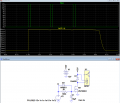
Below is the LTspice sim of a circuit using a small MOSFET to keep a standard relay on between pulses:
The yellow trace shows the relay coil current.

1761414617592.png
 

BobTPH

Joined Jun 5, 2013
11,463
With a large enough capacitor, you might not need the power supply and transistor. The capacitor has to be large enough to supply the 12mA for the max time between pulses while remaining above the hold voltage for the relay.

This is why I asked about the current that the pulse can supply. If it can really supply 3.5A, the capacitor will charge almost instantly on each pulse.
 

ronsimpson

Joined Oct 7, 2019
4,647
With a large enough capacitor, you might not need the power supply and transistor.
You will need to store enough energy to keep the relay on for one time period. It is possible. Large capacitors are a problem. (Reliability and life expectancy, temperature) Worth thinking about.
 

BobTPH

Joined Jun 5, 2013
11,463
How large does the capacitor have to be?
Depends on the max time between pulses, which you still have not told us. Also, we need to know which of these is incorrect:

12V
200Ω
12mA

As pointed out, a 200Ω coil powered by 12V will draw 60 mA.

And we need to know the minimum holding voltage for the relay.

Edited to add: If it has to hold for a full second, the capacitor only method is probably not practical.
 
Last edited:
Top