pulsed input constant output circuit

Hello ALL,, what is the official name for a pulsed input > constant output circuit, anyone know if there's a prebuilt cheap china kit I can buy or is it easy to knock one together with a few components

Ive got a pulsed input thats flashing a alarm (when triggered) light, I want the pulsed signal to be a constant signal to switch on a relay, this is all on a 12v system, is this poss?

Thanks
Hello,
Thank you for the question, I hope I can answer it well.

A pulsed signal can be toned down to DC level with a low pass filter (LPF)
I think a simple LC circuit will do (assuming a bessel-shaped frequency response is okay)
This is highly similar to how switching converters operate, albeit for this case
there is no feedback or control circuit to regulate the frequency.

However, I think you're planning to feed this DC voltage to a relay which draws significant current.
In doing so, you might need to use a buffer in between the relay and LC circuit
to provide ample loading current to the relay.

I hope I was able to help in some way and will try to answer any further questions or inquiries.
Thank you very much for spending time reading my reply.
Best regards,
Justin
 

BobTPH

Joined Jun 5, 2013
11,521
A car's turn signal is designed to
A car's turn signal is designed to flash
between 60 and 120 times per minute, or one to two times per second.
So, assuming 50% duty cycle that is 1/4 to 1/2 a second.

dV / dt = I / C

For a 12000 uF cap at 12 mA

dV / dt = 0.012 / 0.012 = 1 V / sec

So that should be sufficient.

A 1200 uF would lose 10V per second, or 2.5V in 1/4 sec, which would work if the hold voltage is under 9.5V.

It sounds quite doable, depending on the exact requirements. If the current is 60 mA it gets more questionable.
 
Last edited:

crutschow

Joined Mar 14, 2008
38,520
The relay is a Omron G8NW-27HR, here's the datasheet:
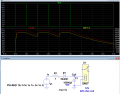
Below is the LTspice sim of a circuit using a diode, a resistor, and a large capacitor to drive a relay with the same coil resistance as the one you referenced.
A 10,000µF capacitor should be more than sufficient to hold the relay energized for 12V pulses occurring at a typical turn-signal frequency.
R1 limits the peak charging current through the diode.
The yellow trace is the relay coil current

The relay will de-energize a maximum of about 5 seconds after the end of the last pulse.
If you need a faster release, you can experiment with smaller capacitors, to see the minimum value you need.

1761598787550.png
 
Last edited:

ronsimpson

Joined Oct 7, 2019
4,695
I looked up some solid-state relays with input current in the 7.5 to 10mA range. My thought is to make the capacitor 1/5 the size.

Next idea is to use a current source not a simple resistor on the SS relay. That will allow the cap to be discharged further down.

Just a thought.
 

Thread Starter

liteace

Joined Mar 7, 2012
242
Below is the LTspice sim of a circuit using a diode, a resistor, and a large capacitor to drive a relay with the same coil resistance as the one you referenced.
A 10,000µF capacitor should be more than sufficient to hold the relay energized for 12V pulses occurring at a typical turn-signal frequency.
R1 limits the peak charging current through the diode.
The yellow trace is the relay coil current

The relay will de-energize a maximum of about 5 seconds after the end of the last pulse.
If you need a faster release, you can experiment with smaller capacitors, to see the minimum value you need.

View attachment 357778

Thanks, that looks good, I'll have a play with the cap/s as would like the relay to switch off a bit quicker than 5 sec's, would an extra load, say a resistor across the relay coil de-energize the cap a bit quicker or is it easier to change the cap to lower value?
 

crutschow

Joined Mar 14, 2008
38,520
would like the relay to switch off a bit quicker than 5 sec's, would an extra load, say a resistor across the relay coil de-energize the cap a bit quicker or is it easier to change the cap to lower value?
An added resistor across the coil would have the same effect as using a smaller capacitor.
It just adds an additional part.
 
Last edited:
Top