Pulsed Transformer Coil Maximum Current

Thread Starter

jannerfish

Joined Jan 21, 2016
22
What current can I safely pulse,

@ 50 kHz
12V
50% duty cycle,

through a,

30 awg
0.36 Ohm coil?

This is part of a 12V to 16V DC-DC converter. Can attach proposed circuit if interested.
 

Papabravo

Joined Feb 24, 2006
22,058
What current can I safely pulse,

@ 50 kHz
12V
50% duty cycle,

through a,

30 awg
0.36 Ohm coil?

This is part of a 12V to 16V DC-DC converter. Can attach proposed circuit if interested.
Give me a definition of safe. e.g.
  1. Won't make the coil warm
  2. Won't melt the coil form
  3. Won't make the 30 ga. wire glow
  4. Won't start a fire
  5. Won't impale you with shrapnel
Give me something to go on.

The power you are talking about is a maximum 100 watts. That is

\( \cfrac{(6 \text{ V.})^2}{0.36 \text{Ω}}\;=\;100 \text{ watts} \)

Typical temperature rise charts show the maximum current for various type of insulation. High grade Kapton insulation will allow for more temperature rise but 2-4 amps is typical for AWG 30 wire. For your power levels I would try something beefier.
 

BobTPH

Joined Jun 5, 2013
11,463
Not answerable. If you buy a coil its datasheet will tell you the max current. It is generally limited by core saturation.

And the current is typically continuous with some ripple, not pulsed. It it driven by pulses, but the current simply rises and falls with each period. You need to simulate or do thhe rather complicated analysis.
 

Papabravo

Joined Feb 24, 2006
22,058
Not answerable. If you buy a coil its datasheet will tell you the max current. It is generally limited by core saturation.

And the current is typically continuous with some ripple, not pulsed. It it driven by pulses, but the current simply rises and falls with each period. You need to simulate or do thhe rather complicated analysis.
@BobTPH I don't think the TS mentioned a core, but that does not mean that his particular coil lacks one, and that has a major impact on the potential answers as you have correctly pointed out.
 

BobTPH

Joined Jun 5, 2013
11,463
I suppose you could make a DC to DC converter with an air core inductor operating at 50 KHz, but it seems unlikely.
 

Papabravo

Joined Feb 24, 2006
22,058
The use of "transformer coil" in the thread title introduces a level of ambiguity that is difficult to resolve. There are many types of DC-DC converters that use a transformer and many that do not. A "coil" can be wound on many different types of material. Some are ferromagnetic and others are not. I was not assuming an air coil necessarily, but I was not excluding it eithr since it remains unspecified.
 

MisterBill2

Joined Jan 23, 2018
27,172
I am guessing that the TS is primarily concerned about the heating effect of the current thru the resistance. And further, I am guessing that it is not an alternating current that reverses every half cycle, but rather half the time flowing and the other half the time not flowing. But at 50KHZ there will not be much cooling time, but certainly only half as much heating time, but at a higher power level. Unfortunately what we do not know is anything about how the heat will be transferred away from the wire. One option would be to calculate the temperature rise based on the power input, which by one calculation is given as 100 watts.

So we could solve the equation Q= mS(delta T) for the temperature rise, giving (deltaT)=100W/ (mass of copper)x(specific heat of copper)
But since we have no hint about how the heat would be removed, or what the other parts of the transformer will be, it seems that we are not able to even make much of a guess at this point.
It would be really quite handy if somebody had a good textbook on transformer design.
 

Thread Starter

jannerfish

Joined Jan 21, 2016
22
Give me a definition of safe. e.g.
  1. Won't make the coil warm
  2. Won't melt the coil form
  3. Won't make the 30 ga. wire glow
  4. Won't start a fire
  5. Won't impale you with shrapnel
Give me something to go on.

The power you are talking about is a maximum 100 watts. That is

\( \cfrac{(6 \text{ V.})^2}{0.36 \text{Ω}}\;=\;100 \text{ watts} \)

Typical temperature rise charts show the maximum current for various type of insulation. High grade Kapton insulation will allow for more temperature rise but 2-4 amps is typical for AWG 30 wire. For your power levels I would try something beefier.

Thanks for your reply (and everyone else's). Well, by safe I mean that it will continue to work.

A typical datasheet for a transformer coil, the Murata 78253/55C for instance, simply says:

Peak current Ipk 400mA

They don't elaborate on what happens if Ipk is exceeded. So, what I mean by safe is just that it will continue to operate without getting too warm. If you touch a board mounted DCDC convertor that's been operating a while, it is warm - no more than that. I guess that is what I mean.

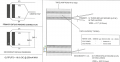
Attached is the coil I intend to use (coil is home spun on a former jig)

coil windings.png


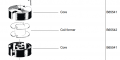
And an excerpt from the datasheet for the coil former and ferrite core, (available at digikey) https://www.digikey.co.uk/en/products/detail/epcos-tdk-electronics/B65541W0000R030/3913795

coil bobbin.png
 

Thread Starter

jannerfish

Joined Jan 21, 2016
22
The MOSFETs in the circuit will sink current from the coils.

Primary coil resistance, Rcoil = 0.36.

Using mosfets with Rds << Rcoil, eg. 2 - 3 mOhm Rds, means each side of primary will be pulled to ~0V as circuit oscillates.
Pulsed input to primary 0 - 12V.
Current through coil and mosfet is then 12 V / (0.36 + 0.003) = 33 A (pulsed).

Alternatively, by including the highlighted leg of circuit, and selecting a mosfet with Rds ~ Rcoil, the 12V between centre tap and ground is equally divided between coil and fet. Then a pulsed input of +6V, -6V (wrt to coil centre tap) is achieved. The +6V is brief (Tconst = 100pF x 330R = 33ns) but this should still 'collect' on the output capacitors, C6, C7, is that correct? (Tconst need altering?)
Then the current through coil and mosfet is 12V / (0.36 + 0.36) = 17 A (pulsed)

On one hand this is half the current and so more desirable. But will this smaller current affect my ability to load ~250mA @16V onto the outputs?
 

Attachments

MisterBill2

Joined Jan 23, 2018
27,172
If it says the peak current is 400mA that is the max current you can use and expect it to work. As I stated before, heating is not the limiting factor in coils with a ferrimagnetic core.
Certainly heating is not an issue UNTIL THE INSULATION BETWEEN TURNS FAILS. at that point heat becomes the issue.
 

BobTPH

Joined Jun 5, 2013
11,463
Certainly heating is not an issue UNTIL THE INSULATION BETWEEN TURNS FAILS. at that point heat becomes the issue.
You miss my point entirely. What I am trying to say is that even if it does not overheat at a higher current, that does not mean it is working correctly.
 

MisterBill2

Joined Jan 23, 2018
27,172
It is certainly true that going beyond the current that produces the magnetization past the intended limit will add to dissipation while not providing any benefit. And it will probably produce some overheating. So it will be useful to know what the actual peak currents are.
 
Top