Proper Storage for Logic and other ESD Sensitive IC's

Wendy

Joined Mar 24, 2008
23,797
Just curious, have you read the link I put in post #15, ElectroStatic Discharge? We are repeating every bit of information I put in that article.

The foam is not as good as an enclosure. Personally I am willing to accept the risk, but you have to understand that from the gitgo. You are right in how it works, but the plain truth is it can be overwhelmed with a static charge if it is big enough. A Faraday cage can not be overwhelmed. Foam has another advantage, mechanical protection of the pins.

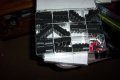
Static tubes also offer protection for the pins. They are a big awkward, but are a common way to store chips, especially from vendors. The full tube shown was received from Mouser that way. Static tubes are basically Faraday cages, which means they are safe. I cut them down and use thumb tacks to keep the chips in them when I need to customize them.

I have a packrat gene. I don't throw away empty bags or other containers, I save them.

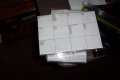
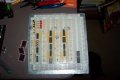
I have attached the pictures I promised. I also show how I keep these parts. I understand it is not as safe as a bag, but am willing to compromise to allow tight storage. I also included a shot of my latest project, a digital clock I'm showing how to build for the AAC book. The article in is the Feedback and Suggestions forum (totally off topic).

Weather also plays a big part in ESD, and this is in the article. A humid day actually makes the air conductive, and right now we've been running over 6 weeks over over 100°F+. I hate Dallas in the summer.

You have probably noticed I'm not using a ESD safe workstation for this project. I've had one chip (worth about 54¢) blow already. In this case my personal comfort counts too.

Concrete is an ESD conductive material, if you are in bare feet or are wearing socks that are nice and sweaty it too works in your favor.

But I am making excuses. I know better, and am willing to live with it. I also know the right way to do it. I have an ESD mat and ground strap for parts that are too expensive to risk. All it takes is once, and it is easy to lapse with protections. Winter, with its cold air, is a high risk time of year. As you warm cold air the relative humidity goes way down. The drier the air, the more ESD hazard.

Basically it is a trade off. The stuff I do at work is for the military. It is a given that someone's life could be at risk if I goof off there, so I take it very seriously. For hobbiest use I am a lot more relaxed. If I am teaching, as in right now, I try to make sure people understand the whys and wherefores.

A quick note about pictures. A digital camera and/or flat bed scanner are valuable chunks of equipment for this site, as pictures are always worth more than words. Usually I would shrink the sizes and display them in the thread, but I was going for quick and dirty. These are very high resolution pictures.

Since I use these parts to aid my writing I have about 7 of these kit boxes. To my disgust Walmart has decided not to keep them anymore, so I am stuck for a while. For my resistors, capacitors, and coils I tend to go with baggies (I also have a impulse sealer, which allows me to make custom bags). Another project I have published for a complete (and I do mean complete) set of ¼W 5% resistors is in this article, Project: Resistor Parts Storage.

.
 

Attachments

Last edited:

magnet18

Joined Dec 22, 2010
1,227
I keep all my ic's in the static tubes they come in, I have them all lined up on a shelf above my desk and I wrote on them with sharpie to make it easier to identify and to keep things organized (heh, right...).

and yes, the black foam is horrible for corrosion, especially if you live somewhere humid like I do. (silica gel is your friend)
if you lived somewhere like New Mexico or Arizona, corrosion is less of a problem, but your ESD risk shoots up.
Personally, I would prefer corrosion.
 

Wendy

Joined Mar 24, 2008
23,797
To date the stuff I've bought hasn't been a problem. I keep it indoors though, and I am buying it new from my local vendor, Tanner's Electronics.

Electronics storage is one of those gnarly problems everyone has to fight. I'm just showing my solutions, there are plenty of others.

I wonder if an Altoids can is ESD safe? Tight fit, metal enclosure, but painted.
 
I keep all my ic's in the static tubes they
and yes, the black foam is horrible for corrosion, especially if you live somewhere humid like I do. (silica gel is your friend)
.
Dang. I just spent a few hours sticking several hundred linear and logic ICs on sheets of that black conductive foam sold by Jameco electronics, AND I live in a humid climate.

How much time are we talking about, before corrosion becomes a problem with this foam ? Would that be weeks, months or years ?

I'm now thinking of buying a whole bunch of static IC tubes to solve this looming problem once and for all.
 

Wendy

Joined Mar 24, 2008
23,797
I'll haven't seen the problem myself. It was mentioned there is a difference between newer foam and older stuff, I can only hope. I started my first kit box with foam in mid 2008, no problem yet.
 
Sounds like my IC collection should be free of rust over the coming years then.

The conductive foam I purchased is literally just days old, and coming from a reputable supplier like Jameco, should be of good quality. I'll be sure and check the pins now and then, and toss in a few silica gel packs for good measure.
 

Thread Starter

Stuntman

Joined Mar 28, 2011
222
Very good. I have certainly read your post Bill. In fact, I ran across and read that entire article during my research before posting here. Very informative

Given the questionable history of the parts, I think ESD foam in the metal drawers is a good compromise of convenience, protection, and cost. I noticed all-spec has two types of black esd foam: polyethelene and polyurethane. Hopefully I can track down which is best for storage.

My plan is to ground the shelving cabinets all inside another steel locker/cabinet, then run a ground wire from the cabinet to my house earth ground using the 10MΩ you suggest (any particular power rating for the resistor you would suggest?). At some point I would like to to run its own ground, but does this seem reasonable until then? Or is grounding to the house's earth ground more harm that good (old house, seemingly ok wiring). I'd hate to worry about lightning, a power surge, or even a faulty appliance frying all my electronics!

Second. I am assuming these unlined plastic drawers are just fine for resistors, pots, caps, and inductors. I imagine the zip-lock baggies are ESD generative, therefore concern for damage is fairly low? What about diodes and SMD resistors and caps (although most of mine are still in tape and reel)?

Thanks for all the info. I feel like I have a much better grasp on ESD precautions now.
 

Wendy

Joined Mar 24, 2008
23,797
The 10MΩ resistor wattage is nonexistent, anything 10MΩ will work. The resistors slow down the surge current to a low value. If a ESD event is occurring it drops the currents down to values the chips might survive. It is the nanosecond surge of several hundred amps caused by the extreme voltages ESD generates that is one of the problems.

If you ground your storage shelves keep in mind it is worthless if you yourself aren't grounded when you get a part. Worse, you could zap the other parts in the shelf if you get lax once.

A common trick working on computers is to touch the case on the computer to discharge yourself before going for any electronics. It is not foolproof, but in theory it works.
 

Thread Starter

Stuntman

Joined Mar 28, 2011
222
Are you suggesting it would be best to leave the cabinet "floating"? I suppose my line of thinking is that I would have a good chance of grounding myself out either opening the steel grounded door, or the drawer handle, getting rid of any charge I may have accumulated.

As primary protection, however, all the parts are planned to be either wrapped in foil, or in ESD foam, so if the shelves do conduct something, it should either bypass the parts via a faraday cage, or raise all pins together via the protective foam. Is there a better way you can think of? I am exceptionally curious because at least for the time being, my parts cabinet will probably be sitting on carpet.

Or

Am I looking at this the wrong way and I should put my parts in plastic (read: non conductive) drawers so they are all somewhat isolated, then rely on the ESD workstation to drain any charge away when I get there.

Still curious if ESD needs to be considered for passive components, or if they are safe loose in plastic drawers.

Thanks
 

Wendy

Joined Mar 24, 2008
23,797
The cabinets don't really matter, you are the static generator. If you go into the cabinets loaded with static electricity it doesn't matter if they are grounded or not.

I wouldn't try using the cabinets for ESD storage either, but that is me. If you do use it as a ESD safe container then your body needs to be grounded.

Plastic will store an ESD charge on its surface. That is why I keep harping on about an ESD safe container. You can use plastic just fine as long as the chips are protected with something else.
 

magnet18

Joined Dec 22, 2010
1,227
Dang. I just spent a few hours sticking several hundred linear and logic ICs on sheets of that black conductive foam sold by Jameco electronics, AND I live in a humid climate.

How much time are we talking about, before corrosion becomes a problem with this foam ? Would that be weeks, months or years ?

I'm now thinking of buying a whole bunch of static IC tubes to solve this looming problem once and for all.
not sure exactly, but I got a bunch from a friend and they were all corroded, probably many, many years.
 

Thread Starter

Stuntman

Joined Mar 28, 2011
222
The cabinets don't really matter, you are the static generator. If you go into the cabinets loaded with static electricity it doesn't matter if they are grounded or not.

But this charge will only damage the parts if it puts a potential across the pins (ie, current flows). If I were to "isolate" the parts bin (say use plastic drawers), if I were to touch parts (in their foil or foam), any charge I had on me should simply be facing an open circuit right? And having them in foil or foam would means this potential would distribute itself across the chip.

Conversely, if I ground the cabinets, I feel that this current could be dissipated away through the 10MΩ ground connection but again, should do so without damage given the foam or foil will keep the leads of each part at the same potential.

Is this true, and which is best? I also am throwing around the idea of simply leaving the cabinets as they are (not grounded, to avoid any possible complications of grounding through the mains circuitry), and installing a wrist strap run to ground solely for getting parts out of the bins.


I wouldn't try using the cabinets for ESD storage either, but that is me. If you do use it as a ESD safe container then your body needs to be grounded.

Not sure what you mean here. Are you saying you wouldn't use the steel, the plastic, or neither.

Plastic will store an ESD charge on its surface. That is why I keep harping on about an ESD safe container. You can use plastic just fine as long as the chips are protected with something else.

And regardless of the steel, plastic, grounded, or not grounded, I plan on having the parts in either foil, or the leads sunk in foam. Seem reasonable?
Still curious about the ESD protection of passive components, any input?
 

Wendy

Joined Mar 24, 2008
23,797
It is in the article. There are very few components that may require it, but in general resistors, capacitors, and coils do not require ESD protection. There are some exceptions for specialized MOS capacitors, but I've never seen one myself.

Diodes, such as zener diodes and power rectifiers, are also more robust than most semiconductors. There are specialized high frequency diodes that are extremely sensitive, but they tend to be the exception. They also tend to be extremely expensive. I remember my last job we had some diodes that could be zapped with as little as 3V.

New LEDs are also static sensitive. Older LEDs were more rugged, but they don't make them anymore, so you would be wise to treat LEDs in general with caution.
 

#12

Joined Nov 30, 2010
18,224
My first look at this thread. I used graphite spray for door locks to un-static my plastic drawers. It was Jig-a-loo brand quick-dry graphite lubricant from Home Depot, but I think other brands will work.

Procedure: Immaculately clean the plastic. Spray it. Let it dry. Wash with detergent to remove any oils. Measure 5 to 8 megs per inch. This was my first try. I expect you could get less resistance with a thicker coat.

Hope this is helpful to somebody.
 

Wendy

Joined Mar 24, 2008
23,797
Quote:
Originally Posted by Bill_Marsden
Quote:
Originally Posted by Stuntman
Hey Bill,

I appreciate your input on the ESD storage. I put a few points a couple posts back within a quote that I don't believe you saw. I would like your input on my current plan. I want to make sure I'm making the best choice between metal or plastic, and grounded or not grounded.

Thanks for all the info.


I keep saying the same thing, it doesn't matter. It breaks down into 2 parts

1. You must be ESD grounded when you take the part out of their ESD package.

2. Your part must be in proper packaging when not at an ESD workstation.

Meet these two requirements and nothing else matters.

I get the feeling you have your heart set on using the metal shelves as the ESD storage container. You said it yourself, they are painted. They will never be totally conductive, so you would need something to isolate these parts from the rest of the world ESD wise.

If the parts are in ESD containers it does not matter what the rest is, be it plastic or metal, or metal shelves.


So let's go this route. Let's say I install a wrist strap in the parts cabinet so I can ground myself before grabbing parts. This takes care of point #1. And it doesn't sound like there is any way around this.

So for #2. Yes, the metal would be more convenient if plastic is not a better option for some reason (?). Would I be better off grounding the metal containers, or leaving them floating? And yes, I have established that I will wrap parts in aluminum foil, or put them in ESD foam before they go into the bins. Do I need to worry if DIP leads stick all the way through the foam and can contact the drawer material?

Does all this seem an okay approach to ESD protection?
In regards to #1... the wrist strap would ground me, not the cabinet. This is what you say is necessary for my setup right?

As for #2... A foil wrapping, OR ESD foam on the pins count as ESD protection in your scenario?

And finally, do you think the metal or plastic is better for this, and from your last post, I don't need to ground them (given the previously mentioned setup) right?

Thanks again
I've said this many times already. It doesn't matter if your storage method, be it shelves or kit boxes, are grounded. It does matter that your parts are ESD protected in protective packages. Aluminum foil (any foil) qualifies. So does static foam, but static foam is not as good as an ESD bag or aluminum foil. Static foam will protect the IC pins when wrapped in aluminum foil, I don't think that has been mentioned. I have also been known to put two chips bottom to bottom (where the pins are going through each other) for the same effect, then wrapping them in aluminum foil.

It matters that you have a ESD workstation. I have defined this in great detail in the ESD article. When you break the seal of the ESD protective package it should be at the ESD workstation.

You are asking the same questions over and over. My answers aren't going to change.

It breaks down into 2 parts

1. You must be ESD grounded
(translation:at an ESD workstation wearing your wriststrap) when you take the part out of their ESD package.

2. Your part must be in proper packaging when not at an ESD workstation.

Meet these two requirements and nothing else matters.
 
Last edited:

FrugalGuy

Joined Jul 25, 2015
1
I’m just settling my up a bench and so this thread has been interesting. After reading the static article and every word of the thread, I believe this would work. If I’m wrong, I’d love to hear it:

Buy cheap static generative storage boxes from Harbor Freight. Spray them with adhesive and apply a layer of Al foil to the bottom, sides, and top of the plastic container. None of this foil is inside of the container, but does cover all outside surfaces.

Keep the boxes on cheap plastic, metal, or wooden shelves with no consideration for grounding either the shelves or the boxes.

Black foam or any other foam wrapped in Al foil is inside the box compartments, with chips inserted.

Have a properly grounded ESD mat and wrist strap available at the workbench. You are not wearing the strap at this point.

Shuffle across the carpet from the workbench to the shelves. Reach in and pick up a foil-coated box. Shuffle back to the workbench.

Set the box on the ESD mat. Take a moment to put on and attach the wrist strap, then pull up a chair and sit at the bench.

Place your hands on the mat, then on the box. Keeping the box firmly on the mat, open the box and remove a foam-cushioned chip, placing the foam on the mat.

Close the box and set it aside off the mat, out of your way. Keep the chip in the foam on the mat until you need to remove it to work with it.

Ensure you are strapped and have touched the mat before lifting the foamed chip from the mat or otherwise working with it.

When you need to return the box or retrieve another, first get up, then unstrap, then pick up the box and feel free to shuffle back to the shelves.

Just be sure to follow the ritual of strapping in, sitting down, and touching the mat for a moment before touching anything sensitive again.

Does that work?
 

MrChips

Joined Oct 2, 2009
34,889
Basically, make sure the mat is grounded and you are wearing an antistatic wristband.

Do not remove any ICs from their antistatic containers until they are on the antistatic mat.
 
Top