Facebook
 Google
 GitHub
 Linkedin

Just curious, have you read the link I put in post #15, ElectroStatic Discharge? We are repeating every bit of information I put in that article.
The foam is not as good as an enclosure. Personally I am willing to accept the risk, but you have to understand that from the gitgo. You are right in how it works, but the plain truth is it can be overwhelmed with a static charge if it is big enough. A Faraday cage can not be overwhelmed. Foam has another advantage, mechanical protection of the pins.
Static tubes also offer protection for the pins. They are a big awkward, but are a common way to store chips, especially from vendors. The full tube shown was received from Mouser that way. Static tubes are basically Faraday cages, which means they are safe. I cut them down and use thumb tacks to keep the chips in them when I need to customize them.
I have a packrat gene. I don't throw away empty bags or other containers, I save them.
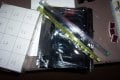
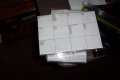
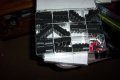
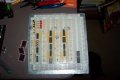
I have attached the pictures I promised. I also show how I keep these parts. I understand it is not as safe as a bag, but am willing to compromise to allow tight storage. I also included a shot of my latest project, a digital clock I'm showing how to build for the AAC book. The article in is the Feedback and Suggestions forum (totally off topic).
Weather also plays a big part in ESD, and this is in the article. A humid day actually makes the air conductive, and right now we've been running over 6 weeks over over 100°F+. I hate Dallas in the summer.
You have probably noticed I'm not using a ESD safe workstation for this project. I've had one chip (worth about 54¢) blow already. In this case my personal comfort counts too.
Concrete is an ESD conductive material, if you are in bare feet or are wearing socks that are nice and sweaty it too works in your favor.
But I am making excuses. I know better, and am willing to live with it. I also know the right way to do it. I have an ESD mat and ground strap for parts that are too expensive to risk. All it takes is once, and it is easy to lapse with protections. Winter, with its cold air, is a high risk time of year. As you warm cold air the relative humidity goes way down. The drier the air, the more ESD hazard.
Basically it is a trade off. The stuff I do at work is for the military. It is a given that someone's life could be at risk if I goof off there, so I take it very seriously. For hobbiest use I am a lot more relaxed. If I am teaching, as in right now, I try to make sure people understand the whys and wherefores.
A quick note about pictures. A digital camera and/or flat bed scanner are valuable chunks of equipment for this site, as pictures are always worth more than words. Usually I would shrink the sizes and display them in the thread, but I was going for quick and dirty. These are very high resolution pictures.
Since I use these parts to aid my writing I have about 7 of these kit boxes. To my disgust Walmart has decided not to keep them anymore, so I am stuck for a while. For my resistors, capacitors, and coils I tend to go with baggies (I also have a impulse sealer, which allows me to make custom bags). Another project I have published for a complete (and I do mean complete) set of ¼W 5% resistors is in this article, Project: Resistor Parts Storage.
.
The foam is not as good as an enclosure. Personally I am willing to accept the risk, but you have to understand that from the gitgo. You are right in how it works, but the plain truth is it can be overwhelmed with a static charge if it is big enough. A Faraday cage can not be overwhelmed. Foam has another advantage, mechanical protection of the pins.
Static tubes also offer protection for the pins. They are a big awkward, but are a common way to store chips, especially from vendors. The full tube shown was received from Mouser that way. Static tubes are basically Faraday cages, which means they are safe. I cut them down and use thumb tacks to keep the chips in them when I need to customize them.
I have a packrat gene. I don't throw away empty bags or other containers, I save them.
I have attached the pictures I promised. I also show how I keep these parts. I understand it is not as safe as a bag, but am willing to compromise to allow tight storage. I also included a shot of my latest project, a digital clock I'm showing how to build for the AAC book. The article in is the Feedback and Suggestions forum (totally off topic).
Weather also plays a big part in ESD, and this is in the article. A humid day actually makes the air conductive, and right now we've been running over 6 weeks over over 100°F+. I hate Dallas in the summer.
You have probably noticed I'm not using a ESD safe workstation for this project. I've had one chip (worth about 54¢) blow already. In this case my personal comfort counts too.
Concrete is an ESD conductive material, if you are in bare feet or are wearing socks that are nice and sweaty it too works in your favor.
But I am making excuses. I know better, and am willing to live with it. I also know the right way to do it. I have an ESD mat and ground strap for parts that are too expensive to risk. All it takes is once, and it is easy to lapse with protections. Winter, with its cold air, is a high risk time of year. As you warm cold air the relative humidity goes way down. The drier the air, the more ESD hazard.
Basically it is a trade off. The stuff I do at work is for the military. It is a given that someone's life could be at risk if I goof off there, so I take it very seriously. For hobbiest use I am a lot more relaxed. If I am teaching, as in right now, I try to make sure people understand the whys and wherefores.
A quick note about pictures. A digital camera and/or flat bed scanner are valuable chunks of equipment for this site, as pictures are always worth more than words. Usually I would shrink the sizes and display them in the thread, but I was going for quick and dirty. These are very high resolution pictures.
Since I use these parts to aid my writing I have about 7 of these kit boxes. To my disgust Walmart has decided not to keep them anymore, so I am stuck for a while. For my resistors, capacitors, and coils I tend to go with baggies (I also have a impulse sealer, which allows me to make custom bags). Another project I have published for a complete (and I do mean complete) set of ¼W 5% resistors is in this article, Project: Resistor Parts Storage.
.
Attachments
-
 261.7 KB Views: 66
 -
 169.7 KB Views: 60
 -
 264.5 KB Views: 65
 -
 261.6 KB Views: 67
Last edited: