Problem with Joulethief

Thread Starter

psoke0

Joined Mar 31, 2017
205
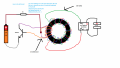
Hi guys me again . i really need your informations here . im stuck with this. i did this circuit before and i dont know if i did the same but its like it was the same and it was working before but not now. i just cant get the voltage i want. its allways gives low or non . it was giving me about 170 + volts before but 30 or 40 now .i have some questions in the pictures to hopefully understand what is wrong here is the pictures i made i hope u guys will be able to help me

Joulthief.png
Joulthief3.png
Joulthief4.png
 

DickCappels

Joined Aug 21, 2008
10,661
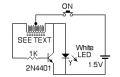
This circuit is usually a reliable oscillator but performance can vary a lot. The way the circuit is shown in your diagram current into the circuit is limited by the 1k resistor. Its hard to get much output with only a few milliwatts of drive.

I suggest the following modification:

• Remove the 1k resistor and connect the battery directly to the junction of the collector and base winding.

• Place the 1k resistor in series with the transistor base.​

Now you are more likely to get the kind of voltage you are looking for. I suggest a large bleeder across the capacitor.

upload_2018-4-8_22-48-24.png
Ignore the LED -this schematic should give you a picture of where the 1k resistor belongs and the phase relationship between the base and collector windings.

Let's take a look at the components, the transformer being the heart of the circuit, let's start there.

The 2N2222 base-emitter junction will break down -that is clamp the voltage when the base is at about -4.5 with respect to the emitter. This will limit the peak-to-peak excursion of the base winding and that will in turn restrict the max peak-to-peak in the collector winding, except that the base and collector windings are not perfectly coupled, so you may see narrow spikes going much higher.

Depending upon the exact 2N2222 you are using you will probably see a collector breakdown voltage of between 50 and 60 volts above the emitter. That may be limiting the voltage on the collector, though transistors can often be operated beyond their breakdown voltages provided there is little or no current flowing.

The most frequent reason for these oscillators not starting is the phase of the base can collector windings is incorrect. Try reversing one of them.

Sometimes a small capacitor (.001 uf or so) across the 1K resistor can help, particularly in case of poor coupling between the collector and base windings.

It has also been reported that using a large output capacitor (2.2 uf in your drawing) sometimes loads down the initial flyback pulse thus preventing sustained oscillation.

Since you have a separate secondary winding one way to increase the output voltage is to increase the number of turns in the secondary.

You have a full wave bridge rectifier. Make sure that it is fast enough. If you can't measure the oscillation frequency it is best to assume that it is several tens of kilohertz or higher. With a blocking oscillator the waveform looks a lot like a flyback pulse (because it is!) so you can do well with only one diode rather than a full wave bridge. That way you could use an ultrafast diode (UF4004, for example). Using the old 1N4000X rectifiers is unlikely to yield good results.
 

-live wire-

Joined Dec 22, 2017
959
Psoke,

A joule theif is a good, simple circuit for beginners, but if you really want to get stable voltages higher than your input, there are better options.

The first thing to keep in mind: Pout < Pin. Higher voltages means to draw the same current on the output you will need to draw more current on the input. You will be limited to a few mAs on the input with that resistor. 1.5V*1.5mA = 2.25 mW. So even the tiny current needed to measure the voltage may cause it to drop. As others have said, ditch the resistor.

And if you can, use a more powerful power supply. That means more batteries in series and/or parralel, or an AC/DC adapter if you don't care about it being portable. You can only (safely) draw about an amp from your aa battery. So 1.5V*1A = 1.5W. That's nothing. If you want to make something that can supply some serious power, go with a battery like this. It is very overkill, but if you want high power, it is a good option.
http://www.batteryspace.com/nimhbattery144v4500mahreplacementbatteryforirobotscooba5900.aspx.
It can supply over 24A at 14.4V! That is over 300W. If you are willing to spend some money, and want it to be portable, a pack like this will be very helpful. It will allow you to get the desired high voltages on the output you want. Obviously be very careful around such voltages and take proper precautions.

Or if you don't need it to be portable and don't want to have to charge it, you can go with a cheap atx power supply like this:
https://www.amazon.com/Apevia-ATX-R...3211266&sr=8-6&keywords=500w+atx+power+supply
It can supply HUGE amounts of power and has some important protections built in.

Of course, you can just use what you have lying around if you do not want to invest too much. Pro tip: old computer adapters make good power supplies and can often supply a few amps at 20-30V.

In terms of the whole circuit, this is what I recommend. First make a square wave oscillator with a 555 timer, some mosfets, or whatever you want. You can search "simple mosfet square wave oscillator" or "555 timer variable frequency PWM oscillator". Just have a potentiometer that allows you to adjust the frequency. Then, connect it to an H-bridge (all n-channel, use dedicated drivers). If you are using higher power, go with IGBTS and not mosfets. You should connect an inverted output from your oscilator to one set of transistors, the non-inverted output to the other set. Just add some caps to get a sine wave, and you now can easily feed it into one or more transformers. Just use properly rated components with the required heatsinks and you now get a stable, much higher voltage on the output.

Live Wire
 

Thread Starter

psoke0

Joined Mar 31, 2017
205
guys thank you for respond the resistor you guys talking about is just that i changed its place recently because it wasnt working when it was conencted to the base of the transistor. but im not looking for really much power i just need it to make about 170+ voltages on cap with 4,2 v battery . i put 1,5 v battery option in drawing because i thought that joulethief may not be working good with higher input voltages. so i will run it with 4,2 v anyway :) iwas just wondering can the windings be wrong or not. and as live wire said i thought about making driver circuit like pwm for joulethief core but its will take too much space also what im trying to do is put all the circuitry inside 2 by 2 cm aeria :) with small 4,2 v lithium polymer battery so that its will fit inside . i did this circuit before and it was working i just dont remember the winding part. because everything is the same exept that part cuz i dont remember if i did it this way or not.
 

Colin55

Joined Aug 27, 2015
519
"to get more volts out of it you can add more turns to the secondary (output) winding."

Adding more turns to the secondary will not simply increase the voltage.
It has to be an overwind. as the zener of the transistor will limit the output voltage.
 

DickCappels

Joined Aug 21, 2008
10,661
There might be some benefit to reviewing the diagram in post #1, which shows a base winding, a collector winding, and an output winding.
 

Thread Starter

psoke0

Joined Mar 31, 2017
205
"to get more volts out of it you can add more turns to the secondary (output) winding."

Adding more turns to the secondary will not simply increase the voltage.
It has to be an overwind. as the zener of the transistor will limit the output voltage.
can you please tell me what is overwind is i cannot find anything about that in google :( i dont understand it
 

Colin55

Joined Aug 27, 2015
519
The 470 turns in the first diagram is called an overwind or tertiary winding.

It allows a very high voltage to be produced that is not passed to the transistor as the transistor can only withstand 25 to 45 volts.
 
Top