Problem with guitar amplifier: distortions in the higher notes.

MisterBill2

Joined Jan 23, 2018
27,652
About 1980, when Hall Effect IC devices were quite new, and after discussions with both guitar players and a sales-rep from a big semiconductor company, I decided to develop a non-inductive guitar pickup. The sales rep saw it as a whole new market into a different industry, and I saw it as a way to greatly reduce production costs and improve the frequency response, which was not at all even close to flat.
The first effort was a single hall device glued to a magnetized steel bar and taped into position on a steel-stringed acoustic guitar. The amplifier was a tube-type utility amplifier with a maximum of about 5 watts output. The hall device power was 5 volts from a regulated power supply known to have a hum-free output.
With an air-gap of about 3/16 inch, I picked the string, and the note came through quite well, but not as loud as the "white noise" from the hall device. The noise covered most of the frequency spectrum, becoming stronger as the frequency increased.
Probably I should have experimented with different supply voltages and stronger magnetic fields, but it was clear at the time that this type of device was not going to impact the musical world yet.
Perhaps today there are much quieter hall devices, but at that time the major emphasis was on using them in the switching mode. That is probably why we still use the wire-wound magnetic pickups with 5000 turns of #36 copper wire.
 

Ya’akov

Joined Jan 27, 2019
10,258
About 1980, when Hall Effect IC devices were quite new, and after discussions with both guitar players and a sales-rep from a big semiconductor company, I decided to develop a non-inductive guitar pickup. The sales rep saw it as a whole new market into a different industry, and I saw it as a way to greatly reduce production costs and improve the frequency response, which was not at all even close to flat.
The first effort was a single hall device glued to a magnetized steel bar and taped into position on a steel-stringed acoustic guitar. The amplifier was a tube-type utility amplifier with a maximum of about 5 watts output. The hall device power was 5 volts from a regulated power supply known to have a hum-free output.
With an air-gap of about 3/16 inch, I picked the string, and the note came through quite well, but not as loud as the "white noise" from the hall device. The noise covered most of the frequency spectrum, becoming stronger as the frequency increased.
Probably I should have experimented with different supply voltages and stronger magnetic fields, but it was clear at the time that this type of device was not going to impact the musical world yet.
Perhaps today there are much quieter hall devices, but at that time the major emphasis was on using them in the switching mode. That is probably why we still use the wire-wound magnetic pickups with 5000 turns of #36 copper wire.
FYI: https://www.aes.org/e-lib/browse.cfm?elib=2960 and also https://www.freepatentsonline.com/4182213.html (1980 Patent). You may have dodged a legal battle bullet if it had worked.
 

LowQCab

Joined Nov 6, 2012
5,101
Piezo-Electric-Pickups are readily available, and work quite well,
and have excellent, "too-good" Frequency-Response,
however, Electric-Guitar-Players generally want to hear "Classic-Tones"
from their Guitars so they are not very popular.
.
.
.
 

MisterBill2

Joined Jan 23, 2018
27,652
Piezo-Electric-Pickups are readily available, and work quite well,
and have excellent, "too-good" Frequency-Response,
however, Electric-Guitar-Players generally want to hear "Classic-Tones"
from their Guitars so they are not very popular.
.
.
.
I did assist in the development of piezo pickups for the "Herald" guitar company, many years back. That was interesting although not financially rewarding. Those pickup installations were under the bridge and so rather permanent.
And it might be that my dating of the hall pickup experimenting is off a few years.
 

Thread Starter

boromyr

Joined Nov 26, 2023
24
The problem is not caused by the power supply voltage or the op-amp, which is not clipping, as I have seen from the oscilloscope and headphones, but by the signal intensity emitted by the guitar, which increases progressively with the number of frets. With the multimeter, I measured the voltage emitted by the D string at open and at the 21st fret: when played open with force, it reaches about 68mV, at the 21st fret it reaches 130mV without applying too much force. This lack of linearity is probably irrelevant in an amplifier powered by the mains that can handle peaks, but in my case it is different with a battery power supply. When a signal peak arrives, the power supply voltage can drop, and if it drops below 8V, the amplifier cannot maintain the output power without distortion. I tested the amplifier with a sinusoidal signal emitter through an Android app at ~80% volume and varying the frequency, the distortion occurs quite linearly in the spectrum only when I exaggerate with the gain. Everything works consistently with a constant source.

The solution at this point would be: how can I level the input signal intensity or decrease the gain dynamically with the output signal?
 

Alec_t

Joined Sep 17, 2013
15,119
From your description it sounds as though a low-pass filter, with a knee just below the point where the frequencies get boosted, might tame the distortion?
 

Thread Starter

boromyr

Joined Nov 26, 2023
24
Unfortunately, not, because the signal peak occurs on different strings and at different frequencies. What I should implement is something that resembles a "volume normalizer" that is present in various audio software. I should limit the signal when it exceeds a certain threshold, so that every guitar key sounds at the same volume without causing distortions. Diodes in soft-clipping? Variable gain amplifier?
 

kiroma

Joined Apr 30, 2014
80
Unfortunately, not, because the signal peak occurs on different strings and at different frequencies. What I should implement is something that resembles a "volume normalizer" that is present in various audio software. I should limit the signal when it exceeds a certain threshold, so that every guitar key sounds at the same volume without causing distortions. Diodes in soft-clipping? Variable gain amplifier?
What Alec_t said is just what you are seeking.
The low-pass filter is the volume normalizer for higher frets, which emit higher volumes the higher the note.
 

Thread Starter

boromyr

Joined Nov 26, 2023
24
If it were just one string it might work, but if you cut a frequency in fret 21 of one string, you're also cutting the frequencies of the next string 5 frets earlier, finally string 1, the highest, no longer sounds. The variable low pass filter is already present in electric guitars, and does not solve the problem.
 

kiroma

Joined Apr 30, 2014
80
I thought a bit more about it and maybe saying this will help you understand.
Imagine you're having 20 dB/decade of increasing volume at a certain point.
Now imagine you put a -20 dB/decade at that same point.
What happens? You've normalized the volume.
 

Audioguru again

Joined Oct 21, 2019
6,826
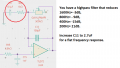
In my post #7 I showed that the preamp has a highpass filter that cuts 1600Hz and all lower frequencies at -6dB per octave.
Then when the level is turned up to hear the mid and low frequencies, the higher frequencies are clipping.
 

Attachments

MisterBill2

Joined Jan 23, 2018
27,652
There are over a hundred volume compressor designs available, some of then claim to allow less than one dB of increase for many dB of input change.
MY solution would be mains power to the amplifier from a suitable wall wart supply, or just totally abandon the small amp and use a slightly larger one able to handle the dynamic range adequately. Dynamic Range is never gracefully compressed.
 

BobTPH

Joined Jun 5, 2013
11,555
Have you tried what @Audioguru again suggested? That capacitor is definitely too small. After you make the change it should distort at all frequencies. Then, when you turn the gain down it should be okay.
 

Thread Starter

boromyr

Joined Nov 26, 2023
24
Yes, I tried increasing it and indeed the bass can be heard at a higher volume now, so I'll leave it at 2.2μF. Unfortunately, no effect on power supply clipping. I then inserted an AGC circuit found on the internet to normalize the volume, and now I can play without voltage drops, as the keys now have a more consistent volume compared to before.

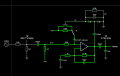
1702233549399.png
This is the circuit in the simulator, which in reality I did not connect the diode's anode to ground. The volume drops to 0 when I connect it to the ground of my board. Any ideas on why?
 

Thread Starter

boromyr

Joined Nov 26, 2023
24
In the simulation, the JFET is an N-channel even though it's not very visible.

This is the link of the simulation.

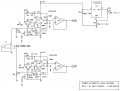
Original circuit, single power supply. Also in the simulation, the power supply goes from 0 to 12V.

1702296827437.jpeg
 
Top