Problem with DFRobot EMG sensor.

Thread Starter

moimoi2k5

Joined Dec 7, 2025
9
Hi, I'm an automation student and I'm a beginner in electronics, I was trying to build a relatively simple circuit using an arduino and a EMG sensor to get analog values whenever a muscle was flexed.
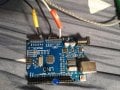
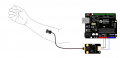
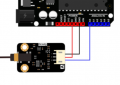
I was following the powering circuit provided by the sensor's manufacturer but the sensor started burning and I don't know why. I saw a youtube video of the same circuit working perfectly fine.
Can someone tell me if I did something wrong or why this could happen?
I will atach a link from the manufacturer.
https://wiki.dfrobot.com/Analog_EMG_Sensor_by_OYMotion_SKU_SEN0240
 

meth

Joined May 21, 2016
299
Without even opening the datasheet, on 100% of the sensors I have encountered, blue is GND and black is signal output.

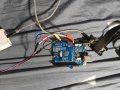
Edit: Amazingly, it is not the case with this sensor :D but I still think you messed up the pins. I cant determine which wire is going where from here:

1765351198906.png
 
Last edited:

Thread Starter

moimoi2k5

Joined Dec 7, 2025
9
Without even opening the datasheet, on 100% of the sensors I have encountered, blue is GND and black is signal output.

Edit: Amazingly, it is not the case with this sensor :D but I still think you messed up the pins. I cant determine which wire is going where from here:
View attachment 360297
z7311871295957_25ff2ab16a5101468803797b8c30282b.jpg
1765598867019.pngz7311871295957_25ff2ab16a5101468803797b8c30282b.jpg1765598867019.png
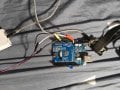
I've colored the wires and circled the connection points on the Arduino.
 

sghioto

Joined Dec 31, 2017
8,634
The connections look correct as seen in the photo now but could you have wired the red and black wires in reverse the first time it was hooked up?
That would seem to be the only way it would start "burning" unless it was defective from the start.
 

meth

Joined May 21, 2016
299
The connections look correct as seen in the photo now but could you have wired the red and black wires in reverse the first time it was hooked up?
That would seem to be the only way it would start "burning" unless it was defective from the start.
+1 , you either got defective piece (not likely), or you wired or accidentally touched something that you should have not. Maybe you placed the module on conductive surface and created a short? Cause these things often dont have any protection - it comes with the price.
 

Thread Starter

moimoi2k5

Joined Dec 7, 2025
9
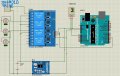
Thank you for your suggestions. Additionally, I'm planning to design a glove using EMG sensors. When an electromyographic signal is detected, a motor will inflate the glove with air, and when the hand is released, the glove will expand. I've designed the circuit diagram in Proteus, but there are still some inaccuracies. Could you please point them out?
Thank you very much !
z7434234414365_9bc823f741fa8c5b025b9b6740421606.jpg
 

sghioto

Joined Dec 31, 2017
8,634
but there are still some inaccuracies. Could you please point them out?
First thing I noticed is the solenoid and motors are connected to the NC contacts on the relay module, shouldn't they be connected to the NO contacts?
What is the output voltage on the Buck converter?
What type of 9 volt battery is BAT1?
 

Thread Starter

moimoi2k5

Joined Dec 7, 2025
9
First thing I noticed is the solenoid and motors are connected to the NC contacts on the relay module, shouldn't they be connected to the NO contacts?
What is the output voltage on the Buck converter?
What type of 9 volt battery is BAT1?
I will connect the solenoid and motors to the NO contacts.
The input voltage from 4-35V, output voltage from 1.25-30V.
Can you suggest me what type of battery I should put in there ?
 

sghioto

Joined Dec 31, 2017
8,634
The battery voltage will be the same as what the solenoid and motors require from looking at the schematic.
Depending on the current demand probably a lipo type.
 

Thread Starter

moimoi2k5

Joined Dec 7, 2025
9
The battery voltage will be the same as what the solenoid and motors require from looking at the schematic.
Depending on the current demand probably a lipo type.
Based on the image above, you can see the output pins of the buck converter are connected to the Arduino and relay, right?
And are there any errors in the connections between pins IN1, IN2, and IN3 of relay to the Arduino?
 

Sensacell

Joined Jun 19, 2012
3,773
I caution you to consider that your input circuit (EMG unit) is sensitive to microvolt signals, while motors and solenoids can generate lots of electrical noise.
 

Ya’akov

Joined Jan 27, 2019
10,226
PP3 ("9V") batteries are a terrible power source. They are among the very most expensive ways to power things, and have pathetic capacity. The table below shows various common cells and costs/capacities. Of course, size and weight will bear on your choice for a given project, and there are other factors (such as shelf life) that can influence a choice as well. The table only lists primary cells. For most projects today, a secondary (rechargeable) sell such as LiPo pouch cell, an 18650, or in some cases NiMH packs of the kind used in RC models makes more sense than disposable options.

Note that as a general rule, AA cells are the best option (not accounting for size constraints)

The PP3 (9V) is the only battery listed. To compare directly in terms of price and energy (mWh), multiply the 1.5V cells by 6 and the 3V cells by 2.

Form factorChemistryV (nom)Avg capacity (mAh)Avg energy (mWh)Unit price (USD)Cost / mAh (¢)Cost / mWh (¢)
AAAlkaline (Zn/MnO₂)1.5270040500.290.0110.007
AALithium (Li/FeS₂)1.5300045002.740.0910.061
AAAAlkaline (Zn/MnO₂)1.5120018000.310.0260.017
AAALithium (Li/FeS₂)1.5125018752.610.2090.139
CAlkaline (Zn/MnO₂)1.58000120001.250.0160.010
DAlkaline (Zn/MnO₂)1.512000180002.560.0210.014
9VAlkaline (Zn/MnO₂)9.05504950 (825/cell)2.620.4770.053
CR2032Lithium (Li/MnO₂)3.02256751.000.4440.148
CR123ALithium (Li/MnO₂)3.0155046502.490.1610.054
 
Top