Facebook
 Google
 GitHub
 Linkedin

Hello ladies and gentleman!
I am designing a circuit in which a passive infrared motion detector (PIR) is triggering a bistable 555 timer. Trick is that the PIR sensor needs some time (roughly 1 minute) to calibrate itself, during this it outputs a few signals that triggers the bistable but this is not good for me. Bistable should only be triggered by detected motion. My solution was to build in another 555 that works as a delaying device. After the delaying time runs out it operates a relay that is feeding power to the bistable. I created two similar set ups, but none of them is perfect, that's why I'm asking for your help. In the pictures below, the PIR sensor's driving circuit is not shown just the sensor itself. I try to describe what's happening here:
The left 555 is the delaying device. When power is applied C2 starts to charge up through R4. During this the trigger (pin2) of the delay 555 is held high, so the output of the same 555 is low and works as a sink for LED D2 that emits green light, furthermore electricity is flowing through Q2 transistor which activates the relay and the normally open contact gets closed that way the bistable is not receiving power. After about 2 mins C2 saturates and level drops low at delaying 555's trigger and it's output goes high at pin 3 which deactivates LED D2 and transistor Q2. At the same time the relay turns off, hence closing the normally closed contact and enabling power supply for the bistable 555. This time if you move your hand in front of the PIR it activates the output of the bistable and in turn the LED D1 starts to emit red light. WOHOO! But there is a problem. When the battery is connected to the circuit the red LED D1 blinks for the fracture of a sec, because the mechanical relay needs that time to pull in and break the normally closed contact, while the electrons traveling with light speed reach the bistable's pin8. Basically, problem is that the relay is slower than light speed. I thought of using a solid-state relay, that has no moving parts and in theory is able to break the contact with light speed, but I don't have a solid-state as they are very expensive. Do you think it could work with a solid-state?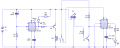
My other circuit is pretty much the same, difference is that while C12 is charging the trigger of the delaying 555 is held low and the relay is not operated, because the same 555's output is high (only D4 is lit). When time runs out trigger of the delaying device is pulled high and the output goes low, hence firing Q8 which in turn activates the relay. The problem in this case is that the relay is turned off for the short calibration phase and after it remains pulled in hence supplying power for the bistable. This stage can be long (days) and the relay eats up too much electricity this way. I think the whole project should be redesigned but I'm out of ideas. In short the upper one turns on the red LED when it should not (only for the fracture of a sec, but it is unacceptable nonetheless), the lower one eats up too much electricity. If you have any ideas on how to delay the PIR'S output reaching the bistable for the calibration phase in a power saving manner I would greatly apprecaite your help! Cheers!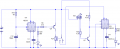
I am designing a circuit in which a passive infrared motion detector (PIR) is triggering a bistable 555 timer. Trick is that the PIR sensor needs some time (roughly 1 minute) to calibrate itself, during this it outputs a few signals that triggers the bistable but this is not good for me. Bistable should only be triggered by detected motion. My solution was to build in another 555 that works as a delaying device. After the delaying time runs out it operates a relay that is feeding power to the bistable. I created two similar set ups, but none of them is perfect, that's why I'm asking for your help. In the pictures below, the PIR sensor's driving circuit is not shown just the sensor itself. I try to describe what's happening here:
The left 555 is the delaying device. When power is applied C2 starts to charge up through R4. During this the trigger (pin2) of the delay 555 is held high, so the output of the same 555 is low and works as a sink for LED D2 that emits green light, furthermore electricity is flowing through Q2 transistor which activates the relay and the normally open contact gets closed that way the bistable is not receiving power. After about 2 mins C2 saturates and level drops low at delaying 555's trigger and it's output goes high at pin 3 which deactivates LED D2 and transistor Q2. At the same time the relay turns off, hence closing the normally closed contact and enabling power supply for the bistable 555. This time if you move your hand in front of the PIR it activates the output of the bistable and in turn the LED D1 starts to emit red light. WOHOO! But there is a problem. When the battery is connected to the circuit the red LED D1 blinks for the fracture of a sec, because the mechanical relay needs that time to pull in and break the normally closed contact, while the electrons traveling with light speed reach the bistable's pin8. Basically, problem is that the relay is slower than light speed. I thought of using a solid-state relay, that has no moving parts and in theory is able to break the contact with light speed, but I don't have a solid-state as they are very expensive. Do you think it could work with a solid-state?
My other circuit is pretty much the same, difference is that while C12 is charging the trigger of the delaying 555 is held low and the relay is not operated, because the same 555's output is high (only D4 is lit). When time runs out trigger of the delaying device is pulled high and the output goes low, hence firing Q8 which in turn activates the relay. The problem in this case is that the relay is turned off for the short calibration phase and after it remains pulled in hence supplying power for the bistable. This stage can be long (days) and the relay eats up too much electricity this way. I think the whole project should be redesigned but I'm out of ideas. In short the upper one turns on the red LED when it should not (only for the fracture of a sec, but it is unacceptable nonetheless), the lower one eats up too much electricity. If you have any ideas on how to delay the PIR'S output reaching the bistable for the calibration phase in a power saving manner I would greatly apprecaite your help! Cheers!