Powering Abandoned House

Thread Starter

free-bee

Joined Sep 4, 2017
14
Is that Earth-Neutral bonding? I wasn’t sure if that was a step I should have taken or not. It’s something we did when I took electrical motor controls classes in college, but we were working directly with an actual transformer when we did it. By grounding one side of the coil, we’d be making our own neutral, which is why I wasn’t certain about it in this application; the inverter would presumably have that taken care of internally (I know, I know, don’t assume that they did it right).
 

Reloadron

Joined Jan 15, 2015
7,891
I've dealt with this problem at a number of sites, and my advice is to use an sine-wave inverter to generate AC. 12V is quite limiting, on a number of fronts. It's an AC world really.
That has my vote especially if you will only have light loads. You still need to maintain a good battery supply for the inverter. Make sure the existing wiring is in good shape.

Ron
 

Ian0

Joined Aug 7, 2020
13,132
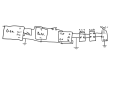
This is the correct bonding (as also mentioned by @boostbuck )
IMG_1115.pngCareful with the choice of MCB. If the inverter doesn't have the capacity to exceed the trip current (say, double the rated current) they are in the "chocolate teapot" category.
 

Ian0

Joined Aug 7, 2020
13,132
Where can I get my copy of @Ian0EDA and does it run on Apple devices?
Its LibreOffice draw. You might note that the nice straight earth symbol is the one I added, the rest is the TS’s drawing from Post 19.
Better than my usual standard, which is drawn by fountain-pen and photographed by my iPad.
 

Thread Starter

free-bee

Joined Sep 4, 2017
14
So essentially, the answer to my question in post 21 is a “yes.” Should I leave the grounds of the two halves of the system separate or could I directly tie them together, which is what I was planning?

As for the drawing, I used clip studio paint lol, drawn on iPad.
 

Ian0

Joined Aug 7, 2020
13,132
Is that Earth-Neutral bonding? I wasn’t sure if that was a step I should have taken or not. It’s something we did when I took electrical motor controls classes in college, but we were working directly with an actual transformer when we did it. By grounding one side of the coil, we’d be making our own neutral, which is why I wasn’t certain about it in this application; the inverter would presumably have that taken care of internally (I know, I know, don’t assume that they did it right).
Small inverters driving a single load can be wired as IT, but that is not acceptable when it is possible to connect more than one load, so small inverters will be supplied with the neutral isolated.
If you intend to connect more than one load, then you must make it TN-S, otherwise the earthing won't provide any safety.
Earthing the battery negative isn't so important. It's more common to have the battery floating (in which case it needs double-pole fusing)
 

geekoftheweek

Joined Oct 6, 2013
1,429
In all reality unless you are getting more than a 1800 watt constant inverter any circuit breakers are pretty much pointless. The inverter will most likely fault before the breaker trips.
 

Ian0

Joined Aug 7, 2020
13,132
In all reality unless you are getting more than a 1800 watt constant inverter any circuit breakers are pretty much pointless. The inverter will most likely fault before the breaker trips.
And when that happens, everything stops. An effective circuit breaker would isolate the faulty circuit.
 

geekoftheweek

Joined Oct 6, 2013
1,429
And when that happens, everything stops. An effective circuit breaker would isolate the faulty circuit.
True, but considering 1800 watts would be 15A your typical breaker probably wouldn't be fast enough to beat the overload of the inverter.

If you are using stand alone breakers (DIN rail or whatever) then yes it would be possible to use something smaller, but if you are using 12/2 wire then what would really be the point of that?
 

Thread Starter

free-bee

Joined Sep 4, 2017
14
My line of thinking is that even though the house has 12/2 and 15 amp breakers, the load may be spread across multiple circuits. I would be feeding the inverter into the main 200(?) amp breakers to supply the whole box, which could easily overload the inverter circuit. That in itself isn’t really too big of a concern as long as I don’t go with the cheapest of the cheap. It’s more of a “this shouldn’t exceed x amps, but if it does, then something is wrong.” I actually want it to trip lower than the typical 15 amps—say only 5-10.

I’m wanting the RCCB to double as the main shutoff and build it as part of the generator itself because the generator may get moved to a new location for a completely different purpose. I may have trouble finding a lower-rated RCCB and have to find a normal mini breaker, but the RCCB should still be able to function as the main disconnect and GFI.
 

Thread Starter

free-bee

Joined Sep 4, 2017
14
I did some looking around and the smallest RCCB overload trip current I found was 10 amps. So now I’m thinking use it as the main cutoff and feed it into two 5 amp mini breakers and use those to feed both sides of the breaker box; one breaker per side/phase. Only thing is I have no real reason to do this other than to maybe satisfy an OCD. So this leads me to think perhaps have a receptical or two (or just something else entirely) installed on the generator itself and use the second 5 amp breaker for it. I also should find an over current device for the inverter input side and/or alternator output.
 

Ian0

Joined Aug 7, 2020
13,132
You are getting confused about how an RCCB works.
It trips when the difference between the live and neutral currents exceeds the value of ΔI.
ΔI is either 10mA, 30mA or 100mA. The amount of current that the switch can pass doesn't matter - the more the better. An RCCB does NOT trip on over-current, it trips of LEAKAGE current.
A device that trips on both LEAKAGE and OVERCURRENT is called an RCBO.
 

Thread Starter

free-bee

Joined Sep 4, 2017
14
These literally have overcurrent protection listed as a feature and flat out say what that current is. This particular model has 10/16/20/25/32/40/50/63 amp variants while the leakage current (sensitivity) is 30mA across the spectrum. Here’s a link:
RCCB 10A
 
Top