Powering Abandoned House

Thread Starter

free-bee

Joined Sep 4, 2017
14
The tl;dr for the backstory:
We have an abandoned house (trailer) on our property that hasn’t been lived in for 10 years. We tried to give it away twice, but both times, it fell through…and then a tree fell through it, so we’ve accepted that the house will likely sit there until it rots away. Then more recently, I decided to fix it back up a little bit to use as like a hangout spot. There’s more to this, but the rest of what you need to know deals with the electrical side of things, and that is that there is no electric running to it. The pole has even been taken down and relocated.

While I decided to fix it back up a little bit, I don’t plan to put it back into excellent condition. I want to get the tree chopped up and the debris cleared and then the outside paneling fixed up enough to stop the weather (namely rain and snow) from getting in. I initially didn’t plan to do much more than that (bring in a water tank and gutters to make a rainwater collection system), but now I’m thinking of building a new electrical system. I have ideas already, but I’m wanting some input from others before I settle on something.

An obvious problem has to do with the tree that’s laying across the house. It probably severed an electrical connection when it crashed down. Luckily for me, it would have affected just a single room. To deal with it for now, I’ll just hunt down the breaker and flip it off and also make sure it’s the only circuit that got damaged. And this is where I need opinions—installing a power source.

I was thinking bring in a lead acid battery and connect it to the breaker box and let the current wiring system supply 12 volts of power to the receptacles in the house (lights and plugs). This leaves an issue of sending DC power over about 200 feet of 12/2, so anything on the other end (the load) may only get about 10 volts, according to an online calculator. I want to use LED lighting, so the voltage difference may not be a big deal. But at the same time, the loss still exists and it creates heat.

My second idea is nearly the same thing, but with an inverter (12 V) included to convert the DC into AC. This should decrease power loss and heat, but it’s an extra part to add and anything that runs off of DC would need to have yet another part added on at the load end.

My final thought is to just buy a generator, but I’d rather not because I plan to use the location for filming purposes and don’t want the extra noise. I’m not completely against the idea, but the first two options are preferred. And though I’m comfortable with it, I don’t really want to work with high voltage anyway. Again, the house has been abandoned for 10 years and there’s a tree through it currently.
 

geekoftheweek

Joined Oct 6, 2013
1,429
With 12 volts and 12/2 wire you won't create any real heat unless you really load the circuit. The losses associated with a long run don't normally create a temperature change if that is what your line of thinking is.
 

boostbuck

Joined Oct 5, 2017
1,043
I've dealt with this problem at a number of sites, and my advice is to use an sine-wave inverter to generate AC. 12V is quite limiting, on a number of fronts. It's an AC world really.
 

Thread Starter

free-bee

Joined Sep 4, 2017
14
(Using this site on mobile is awkward lol)
@geekoftheweek aye, that was one concern about it. When I think about it more, I come up with more potential issues I’d have to overcome. Namely, I’d have to figure out how to get the 12 (10) volts down to about 5 at the load end. Not really an issue on the lighting front (which is itself a third concern, but I’ll get to that), but it’s a concern on the socket side. I may need to charge some batteries and/or phones at some point or another and having low-voltage DC sent directly to the outlets is starting to sound kinda dumb tbh. It sounded like an easy problem at first, but the solution would require some extra rigging, and I’m lazy and don’t wanna go through that.

@boostbuck are you thinking 12 DC to 120 AC? I got to thinking that 12 AC wouldn’t be too good because I’d have to do extra work on the load end. Specifically, I’d need a rectifier circuit for anything USB (what I initially thought about).

12 DC may still be a viable option. I’d have to do some digging online to see if anything exists that’s ready to go for my application. But with that said, 120 AC seems the most convenient. Practically everything I’d need to power already comes with a charging block, so that would be the least amount of work on my part. Perhaps I should take a moment to check the condition of the wiring as-is since that’s one of the major factors behind the HV/LV options. That’ll take a couple days because of my work schedule.
 

LowQCab

Joined Nov 6, 2012
5,101
I would suggest that You don't connect anything to the existing Wiring,
unless You want to get rid of the thing by burning it to the ground.

Use "UF"-rated-Cable, ( rated for direct-burial in the ground ).
When using "12-2-with-ground" Cable You can comfortably draw about 10-Amps per ~100-feet.
Every additional ~100-feet should cut the acceptable Current in half to ~5-Amps, and then to ~2.5-Amps.
Don't go over 300-feet without calling in an Professional-Electrician.

12-ga. UF-Cable is usually around ~$1.oo per foot, ( USA )

Bury the Cable as deep as practical.
If it will be driven over, put a 10-foot section of 2" PVC Pipe over the Cable before burying it.

Connect the Cable to your Circuit-Breaker-Panel with a 15-Amp Circuit-Breaker,
or, install a heavy-duty plug on the end of the Cable and plug it into an exterior-Outlet on your house.

A Generator is sounding like the best plan.
.
.
.
 

geekoftheweek

Joined Oct 6, 2013
1,429
Namely, I’d have to figure out how to get the 12 (10) volts down to about 5 at the load end... I may need to charge some batteries and/or phones at some point or another and having low-voltage DC sent directly to the outlets is starting to sound kinda dumb tbh. It sounded like an easy problem at first, but the solution would require some extra rigging, and I’m lazy and don’t wanna go through that.
There are several DC - DC converters that will work to get you down to 5V. Unfortunately cost may be an issue if you need large amounts of power. Most chargers that you plug into your vehicle are switch mode power supplies and should work fine with the reduced voltage. Again the cost issue, unless you already have a handful laying around.

Yea it does kind of sound dumb in a way, but if you don't want the noise of the generator or the headaches of running out power or whatever then it is possible.

Just make sure whatever course you decide to isolate any damage from the tree. Even 12V can start a fire pretty quickly with a direct short.
 

boostbuck

Joined Oct 5, 2017
1,043
Either a 12VDC to 120VAC so that all your lights and other services are standard (eg your phone chargers). Or stick entirely with 12V and wire it as a vehicle - there are plenty of 12V systems for RV and outdoors to provide lighting and phone chargers etc.

My preference is to use 120VAC.
 

Thread Starter

free-bee

Joined Sep 4, 2017
14
I would suggest that You don't connect anything to the existing Wiring,
unless You want to get rid of the thing by burning it to the ground.

Use "UF"-rated-Cable, ( rated for direct-burial in the ground ).
When using "12-2-with-ground" Cable You can comfortably draw about 10-Amps per ~100-feet.
Every additional ~100-feet should cut the acceptable Current in half to ~5-Amps, and then to ~2.5-Amps.
Don't go over 300-feet without calling in an Professional-Electrician.

12-ga. UF-Cable is usually around ~$1.oo per foot, ( USA )

Bury the Cable as deep as practical.
If it will be driven over, put a 10-foot section of 2" PVC Pipe over the Cable before burying it.

Connect the Cable to your Circuit-Breaker-Panel with a 15-Amp Circuit-Breaker,
or, install a heavy-duty plug on the end of the Cable and plug it into an exterior-Outlet on your house.

A Generator is sounding like the best plan.
.
.
.
Absolutely none of the wiring will be outside if I go with battery or battery-inverter. If it hasn’t been already, I’m going to remove the cables going to the main cutoff in the breaker box (mainly because that’s where the new source would go). I don’t really have a plan for how to set up a generator, should I go that route. That’s something I’ll have to do research on, but I do agree that it’s starting to sound like the best option. If the power goes out at our actual house, I could move the generator so we’d still be able to run some electronics or a couple of electric heaters, if applicable (in this case, the generator would be isolated from the house’s wiring).

Another option that came to me was to pull one of the existing wires and buy some wire staples and boxes to create a custom circuit. No more power than I expect to draw, this should be fine. I’d have to do some research and calculating just to be sure. If we assume about one amp per LED light…5 amps should be plenty enough. Err, well, that’s assuming 12 volts, so it’d definitely be enough for 120


There are several DC - DC converters that will work to get you down to 5V. Unfortunately cost may be an issue if you need large amounts of power. Most chargers that you plug into your vehicle are switch mode power supplies and should work fine with the reduced voltage. Again the cost issue, unless you already have a handful laying around.

Yea it does kind of sound dumb in a way, but if you don't want the noise of the generator or the headaches of running out power or whatever then it is possible.

Just make sure whatever course you decide to isolate any damage from the tree. Even 12V can start a fire pretty quickly with a direct short.
It’s less about if they exist and more of in what form they exist. What I really could use for the 12 VDC setup is almost guaranteed to not exist—a socket that takes power from the posts and put it to USB ports with a DC-DC converter in the middle (built in). Also, I’m ahead of you with isolating the damaged circuit plan. I need to check that it’s the only one that got damaged too.


Either a 12VDC to 120VAC so that all your lights and other services are standard (eg your phone chargers). Or stick entirely with 12V and wire it as a vehicle - there are plenty of 12V systems for RV and outdoors to provide lighting and phone chargers etc.

My preference is to use 120VAC.
Yeah, I’ve about decided to do 120 VAC. It seems in the end that it would be the most convenient. It would also allow me to more readily expand my setup in the future if I wanted to since I wouldn’t have to take into account any special considerations outside of whether or not the current and/or power usage is too high.
 

Thread Starter

free-bee

Joined Sep 4, 2017
14
(Because I can’t edit my previous message)

I think I have a solution now. The idea is a hybrid system where the battery-inverter setup is the main power source and a generator is used as backup. Essentially, when the battery starts getting low on power, I can turn the generator on to recharge it. At this point, the generator becomes the power source. It would also act as an auxiliary source for if something requires more than the inverter can deliver. Even more research would be needed for me to determine how to set up a switchover system, but that’ll be for another day.
 

geekoftheweek

Joined Oct 6, 2013
1,429
I have the beginnings of a similar system for backup power. I've never lost electricity enough to justify buying a generator or lost it enough to finish my project for that matter. I do have a small engine running an old alternator that I use to charge batteries of equipment in a shed out back. There's no power, it's too far to run cords, and half the year the ground is too soft to drive the car out to jump start things. If you are buying new then a generator may be the better option, but if you have access to some old parts maybe something to think about.
 

Thread Starter

free-bee

Joined Sep 4, 2017
14
I don’t have the mechanical know-how to build a generator, but I have considered it a couple times. The issue would be that by the time I bought the parts (used lawnmower or something with an engine and the generator part itself), I’d be better off just buying a complete one. Plus buying stuff to make the fra-…

Actually…I might could do this. We might have an alternator already that works. Then it’d just be making a frame and adding a small handful of extra components. Well, I still have to find a working engine, but how hard could that be.
 

Ian0

Joined Aug 7, 2020
13,131
If you use an inverter, it will flatten your battery by itself if you leave it running.
Its self-consumption is about 1% full load.

Have you thought about some solar panels to keep the battery charged?
 

boostbuck

Joined Oct 5, 2017
1,043
If you use an inverter, it will flatten your battery by itself if you leave it running.
True, but many inverters drop into a standby mode when AC demand ceases. The one I used had a standby draw of 50mA. The only downside was a momentary pause when a load was applied.
 

Thread Starter

free-bee

Joined Sep 4, 2017
14
I have a schematic in my head. Work should be dead today, or dead enough I can get it drawn out. I need to look online for certain things, but I have a generalized idea of how it all should go together. Hard to explain through text, but I’ll try (I’ll post the schematic once it’s drawn).

The alternator connects to the motor (duh) and a switch connects the battery to the alternator excitation coils. I want the same switch to also act as a kill switch for the motor (solenoid valve on the fuel line?). Battery connects to the inverter through some switching mechanism like a contactor because idt a standard toggle switch would handle the amps (calculations needed). The contactor would be powered via switch. The output end of the inverter goes to a volt-amp-power meter then a 30 amp residual current breaker before going to the breaker box. I think the box already has 15 amp breakers. If not 15, then 20, but I’d strongly doubt that.
 

Ian0

Joined Aug 7, 2020
13,131
I have a schematic in my head. Work should be dead today, or dead enough I can get it drawn out. I need to look online for certain things, but I have a generalized idea of how it all should go together. Hard to explain through text, but I’ll try (I’ll post the schematic once it’s drawn).

The alternator connects to the motor (duh) and a switch connects the battery to the alternator excitation coils. I want the same switch to also act as a kill switch for the motor (solenoid valve on the fuel line?). Battery connects to the inverter through some switching mechanism like a contactor because idt a standard toggle switch would handle the amps (calculations needed). The contactor would be powered via switch. The output end of the inverter goes to a volt-amp-power meter then a 30 amp residual current breaker before going to the breaker box. I think the box already has 15 amp breakers. If not 15, then 20, but I’d strongly doubt that.
Don't you mean a 30 milliAmp RCCB?
Don't forget to connect neutral to earth and connect earth to an earthing rod to make a TN-S earthing system.
You need MCBs that stand a chance of tripping. If they are all less than the current-limited output of the inverter then they are worse than useless - the whole system shuts down because of a fault on one circuit.
 

Thread Starter

free-bee

Joined Sep 4, 2017
14
Don't you mean a 30 milliAmp RCCB?
Don't forget to connect neutral to earth and connect earth to an earthing rod to make a TN-S earthing system.
You need MCBs that stand a chance of tripping. If they are all less than the current-limited output of the inverter then they are worse than useless - the whole system shuts down because of a fault on one circuit.
*looks up the specific one I already own*
Oh, it’s 16 amps. It’s the mini breakers I have that are 30. The residual trip current is 30 mA though. The RCCB and the meter are both DIN rail mounted and I should still have a rail or two from a previous project. As for grounds, I was going to bond them at the breaker box because I think the ground rod still exists. That’s something else I’ll have to check…and also research more on. My NEC book is a little outdated (2011 version) and I’ve been wanting to get the latest edition just to have for reference for if I needed to do something like what I’m wanting to do now.
 

Thread Starter

free-bee

Joined Sep 4, 2017
14
Have you thought about some solar panels to keep the battery charged?
I forgot to reply to this lol. I did for a moment, but there are too many trees surrounding the place. Also, based on what I’ve been seeing about solar panel setups, they’re way out of my budget.


Generators cost next to nothing if you can find one that's been neglected and won't start. And if you can fix it.
That’s the big “if.” The people who live around here, I have next to no doubt that I can buy a brand new engine cheaper than what someone would ask for a 10 year old push mower. I’ll still look around first, but my point remains. I’m also not sure if anyone would have an old generator period.
 

Thread Starter

free-bee

Joined Sep 4, 2017
14
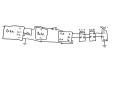
Excuse the nondescript terribleness that is my drawing and writing skills, but it should get the idea across. Note that the breaker box is shown as having L1 and L2 tied together. Left to right is: generator, battery, inverter, volt-amp-power meter, RCCB and breaker box.
IMG_1115.png
The idea behind having the meter placed before the breaker is to have a way to check line power (inverter output) without having to turn on power to the rest of the circuit first. Also, I just realized I forgot to draw a voltmeter across the battery (with a button so that it doesn’t draw power constantly).
 

boostbuck

Joined Oct 5, 2017
1,043
Careful with your grounding - you have not shown E-N bonding on the AC side. Make sure this is before the RCCB, not at the breaker box.
 
Top