Powering a spinning board?

Thread Starter

spinnaker

Joined Oct 29, 2009
7,830
IR is a nice solution.

The receiver can be located at the center.
I sort of like this but I still need to power the LEDs, the IR receiver and any associated hardware so I am not sure it buys me much there..

But it does open possibilities like putting the pic on the non moving board, making time setting and debugging much easier.
 

Thread Starter

spinnaker

Joined Oct 29, 2009
7,830
I sort of like this but I still need to power the LEDs, the IR receiver and any associated hardware so I am not sure it buys me much there..

But it does open possibilities like putting the pic on the non moving board, making time setting and debugging much easier.

After thinking about it I would likely need a mcu on the moving board too. Either that or have 360 i/R sensors. :)
 

RichardO

Joined May 4, 2013
2,270
When I did a "whirligig" ( whirlygig ) many years ago I used slip rings for power and an IR link up through the hollow shaft.

The data had an embedded clock. A narrow pulse was a 0 and a wide pulse was a 1. Data recovery was done with a one-shot set for 50% of the bit rate. The data went into serial to parallel shift register. When the time between clocks was more than a bit time, the data was transferred from the shift register to a latch.
 

RichardO

Joined May 4, 2013
2,270
I forgot to say that there was an IR LED on the spinning portion and a phototransistor on the base. The pulse from the phototransistor was used to sync the data to the spinning rate. The pulse was also used to servo the rotation speed.
 

Thread Starter

spinnaker

Joined Oct 29, 2009
7,830
Seems too slow to me. That would be a 5Hz flicker rate.

I think that is the max rated rpm. It of course could be pushed further. Would be nice to find an inexpensive one rated for higher rpm.

I just started looking.

Did you buy or build your slip ring?
 

RichardO

Joined May 4, 2013
2,270
I think that is the max rated rpm. It of course could be pushed further. Would be nice to find an inexpensive one rated for higher rpm.

I just started looking.

Did you buy or build your slip ring?
I built my own. I will take a picture for you. Unfortunately, the whirligig no longer works. I don't remember having any pictures of it working. :(
 

strantor

Joined Oct 3, 2010
6,875
You could use the same technique used for wireless charging of cell phones, as described here.

Two wire coils a couple of inches in diameter mounted concentric with the shaft, the transmitting coil mounted to the baseplate and the receiving coil mounted on your propellor disc, the two coils separated by about 1/4".

Forget anything piezoelectric; not powerful enough.
I like this one better than my idea.

I think a third option used is a coil in the spinning thing and a magnet on the base, making a sort of a generator, probably quite inefficient.
This will induce drag on the spinning thing. No big deal, but you would have to design based on that.

I was picturing a stationary gear on the base and a little permanent magnet hobby motor mounted to the rotating thing, with a gear on its shaft meshing with the stationary gear. So when the thing spins, the motor spins, and becomes a generator. This would also induce drag. Plus it little slip rings in it. ... oh, there's an idea. Harvest those little slip rings.

But I think the best idea posted thus far is the wireless charger idea.
 

Thread Starter

spinnaker

Joined Oct 29, 2009
7,830
But I think the best idea posted thus far is the wireless charger idea.
I like the idea too but I wonder if I could have enough available surface area. I would think I would need a fairly wide area and I wanted to keep the spinning board fairly small.

Also the tolerances between the fixed and spinning board could have some challenges to set that all up.

I am leaning toward the slip ring. They make 6 wire slip rings. It would allow me to power the LEDS and a chip plus have room left over for communication lines. One or two shift registers and some LEDs on the spinning board is pretty much all I would need. Everything else could be on the fixed board.


The only issue is they are rated too 300 rpm but I have read they can be pushed much higher with the expectation of a diminished life. But they are cheap enough.

I am trying now to wrap my head around how I would spin the the board at the same time affix the slip ring.

I am thinking motor on one side of the board and slip ring on the other.
 

be80be

Joined Jul 5, 2008
2,395
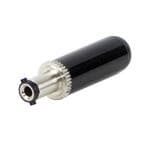
I know I'll get knocked down for this one but these work great and last a long time.

You get one that has 2 or more outer bands and will fit over the motor shaft.

You fix the socket to the spinning part and fix this part on the motor you don't use the inter peice you remove it.
I grinded it out with dremel tool.

Makes a great slip ring.


cmartinez

Joined Jan 17, 2007
8,770
I know I'll get knocked down for this one but these work great and last a long time.

You get one that has 2 or more outer bands and will fit over the motor shaft.

You fix the socket to the spinning part and fix this part on the motor you don't use the inter peice you remove it.
I grinded it out with dremel tool.

Makes a great slip ring.

I won't bash you for that idea... promise...

Only issue I find with it is durability... and maybe a little friction
 

Thread Starter

spinnaker

Joined Oct 29, 2009
7,830
I know I'll get knocked down for this one but these work great and last a long time.

You get one that has 2 or more outer bands and will fit over the motor shaft.

You fix the socket to the spinning part and fix this part on the motor you don't use the inter peice you remove it.
I grinded it out with dremel tool.

Makes a great slip ring.


What is it? A power plug?

I assume I would need both sides?

For a cheap solution at low speed I can see how that would work. But for a high rpm for a propeller clock I don't see how it would hold up.
 

cmartinez

Joined Jan 17, 2007
8,770
What is it? A power plug?

I assume I would need both sides?

For a cheap solution at low speed I can see how that would work. But for a high rpm for a propeller clock I don't see how it would hold up.
How about miniature ball bearings, installed on a hollow plastic shaft, and separated by plastic shims? You could run a multiple conductor cable through the shaft, with each cable making contact with the respective inner ring of each bearing. Then you could install a brush for each outer ring... the bearings being entirely metallic, they should conduct somewhat stable current... using large caps on the spinning circuit should compensate for any unsteady contact inside the bearings
 

Thread Starter

spinnaker

Joined Oct 29, 2009
7,830
How about miniature ball bearings, installed on a hollow plastic shaft, and separated by plastic shims? You could run a multiple conductor cable through the shaft, with each cable making contact with the respective inner ring of each bearing. Then you could install a brush for each outer ring... the bearings being entirely metallic, they should conduct somewhat stable current... using large caps on the spinning circuit should compensate for any unsteady contact inside the bearings

Doubt I could cobble something together that is better than this.

https://www.ebay.com/itm/12-5mm-300...%3A24beaf561600ab6bacebf67ffff66e81%7Ciid%3A1

Only $3.00 each. I will order a few. If one wears out just replace it.
 

DNA Robotics

Joined Jun 13, 2014
670
I saw a patent one time that had current passing through a ball bearing that was insulated from the shaft. The other contact was rubbing on the end of the shaft. I think they use something like that in ladies electric hair curlers that you can rotate.
 

RichardO

Joined May 4, 2013
2,270
Well how did you do it? What did you make it from? Do you have plans?
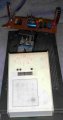
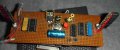
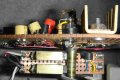
Here are some pictures.
Whirlygig_All.JPG Whirlygig_spinner.JPG Whirlygig_brushes.JPG

The controller is a board with a R6511Q on it. The 6511Q is a 6502 microprocessor with lots of peripherals and I/O. The controller scans the keyboard and LED display to get messages to display. It then sends the graphic image serially to the spinner through an IR link that goes up the hollow shaft.

The shaft is hobby shop brass tubing with heat shrink tubing in between to act as an insulator. The brushes were possibly replacement brushes for a Dremel tool. I put them inside some square hobby tubing. The hub for the spinning part was a collet taken from an old panel mount potentionmeter.

The whole spinning part must be balanced. That is what the alligator clips showing in the picture do.

Note that debugging this thing was tricky. Putting a scope probe on something that is spinning is a real problem. :eek:

I don't have any plans and I doubt that the notes I have would be of much value.
 
Top