Power supply Help

Thread Starter

StephenMG

Joined Feb 7, 2008
10
Hi,

I hope someone can help. I have a power supply with the following output specs.

Voltage: 30 VDC Current 1560 milliamps

I wanted to alter the current to a maximum of 1.5 milliamps. How do I do this?

I think If I solder a resister to one side of the power cord it will drop the current but leave the voltage the same, which is what I want. But I don't know what size resister to use to do this.

Thanks,
StephenMG
 

Thread Starter

StephenMG

Joined Feb 7, 2008
10
Not sure there is a precise answer. Someone with more experience can probably help there. As a first approximation, you can assume that the effective resistance of the power supply is a lot less than the resistor you will be using and can be neglected. E=IR ; therefore to drop 30 volts at 1.5 mA requires a 20K resistor.

When you say "put it in the power cord," I hope you mean the DC line from the power supply, not the AC or DC line into it.

John

Ok, of if I use a 20k ohm resister it will drop the current to 1.5 milliamps but leave the volts at 30 VDC right? Also, what watt resistor should I get. I don't want to over-heat the resister and burn it out.

Yes, John I would solder the resistor to one side of the DC output cord.

Thank you again everyone
 

SgtWookie

Joined Jul 17, 2007
22,230
If the impedance of the power supply is near zero, and you connect a 20K Ohm resistor across the output terminals, you should still read 30V across the resistor, and 1.5mA will be flowing through the resistor.

If you measure less than 30V at the output after connecting the resistor, I'd be very surprised.

You figure power in Watts using Ohm's Law.
P = E x I
P = 30V x 0.0015A
P = 0.045 Watts
That's roughly 1/22 Watts.
 

Ron H

Joined Apr 14, 2005
7,063
Ok, of if I use a 20k ohm resister it will drop the current to 1.5 milliamps but leave the volts at 30 VDC right? Also, what watt resistor should I get. I don't want to over-heat the resister and burn it out.

Yes, John I would solder the resistor to one side of the DC output cord.

Thank you again everyone
It will leave the voltage at 30V until you put a load on it. If you want a supply that will put out a constant 30V for any current less than 1.5mA, it gets way more difficult. Now, if you wanted, say, 25V at a maximum current of 1.5mA, that would be fairly easy.
 

Ron H

Joined Apr 14, 2005
7,063
If the impedance of the power supply is near zero, and you connect a 20K Ohm resistor across the output terminals, you should still read 30V across the resistor, and 1.5mA will be flowing through the resistor.

If you measure less than 30V at the output after connecting the resistor, I'd be very surprised.

You figure power in Watts using Ohm's Law.
P = E x I
P = 30V x 0.0015A
P = 0.045 Watts
That's roughly 1/22 Watts.
The 20k resistor will indeed draw 1.5mA, but it won't limit the current through any other device you connect across the 30V supply.
What are you actually trying to do?
 

Thread Starter

StephenMG

Joined Feb 7, 2008
10
The 20k resistor will indeed draw 1.5mA, but it won't limit the current through any other device you connect across the 30V supply.
What are you actually trying to do?
Hi Ron,

My friend built a device and now needs a power supply for it. He needs the power supply to provide a constant 32 VDC at a maximum current of 1.5 milliamps.

So, I have a 32 VDC power supply that puts out 1560 milliamps and I need to drop the maximum current to 1.5 milliamps.

I figured that if I use 1-20k ohm, 1-300 ohm and 1-33 ohm resistor soldered to one side of the output cord that it would be very close to a maximum current draw of 1.5 milliamps.

Is this correct? or am I all messed up

Thank you guys for helping me so much,
StephenMG
 

Ron H

Joined Apr 14, 2005
7,063
The device will only draw as much current as it needs. The current rating on a power supply is the maximum current it can supply.
 

Thread Starter

StephenMG

Joined Feb 7, 2008
10
The device will only draw as much current as it needs. The current rating on a power supply is the maximum current it can supply.
Ok, that I understand but this device based on a given condition will begin drawing more current and he only wants it to draw a maximum of 1.5 milliamps.
 

Ron H

Joined Apr 14, 2005
7,063
Ok, that I understand but this device based on a given condition will begin drawing more current and he only wants it to draw a maximum of 1.5 milliamps.
Can he live with less than 32V? How about 30V?

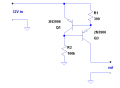
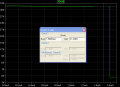
EDIT: Here's a circuit that puts out (according to simulation) about 31.9V with no load, and 31.3V at 1.5mA. the voltage starts to drop like a rock at 1.593mA, and is zero at 1.595mA. The current limit is dependent primarily on the value of R1, and to a lesser degree on R2.
 

Attachments

Top