Power Op Amp

AnalogKid

Joined Aug 1, 2013
12,129
My question was for Wendy, the TS for both this thread and the one I linked. That one has around a dozen different schematics, and most of them would work in this thread's application.

OK, I just re-read the first three words of post #1, where Wendy links th same thread I did. oops. So it looks like this thread is a re-visit and extension of that thread.

ak
 

AnalogKid

Joined Aug 1, 2013
12,129
It’s clear that you are planning to experiment with op-amps (with increased output current using discrete transistors) and measure the THD. I’d be interested in your results; personally I doubt you will achieve better than 1% THD.
Owe Count Rare - many of the world's big audio amps are basically boosted opamp designs. My first encounter with this was the Crown DC-300, a 300 W mono audio amp that was the darling of disco's and other sound reinforcement tasks in the late 70's. It was an opamp plus around a dozen power transistors. My fog-zone memory wants to say it used a uA739, but that is a dual preamp. They might have tied off the unused half, or used it in the input stage; been too long. There are several variations of the DC-300, some all discrete and some with opamps. I've attached one such schematic. U200 might be a UPA75.

Also attached is the service manual for a different amplifier that is a good example of what can be done with an opamp. There is no schematic, but the specs are impressive and the Theory section is excellent.

ak
 

Attachments

Last edited:

Thread Starter

Wendy

Joined Mar 24, 2008
23,798
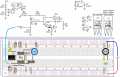
So I finally built and tested this circuit:
0 Power op amp 1 display.png

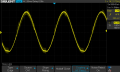
due to excessive noise from my SMPS power supply (which kind of selects my next major project) I chose to use 1 KHz for the test signal. I set the amplifier gain to 10 because my signal generator just isn't that strong I used this to feed it the test signal. I adjusted the signal until it started clipping. I'm sure it comes as no surprise to anyone edit started clipping at 5 volts P-P. What did surprise me what is the relative lack of crossover distortion come I expected a lot more. For my next experiments I will try conventional transistors (such asPN2222's and PN2907's). Anyhow this was the waveforms out:
Out 1.png
 
Last edited:

Audioguru again

Joined Oct 21, 2019
6,826
The old LM358 also has crossover distortion but its gain is much higher at this low frequency of only 142.6Hz and the fairly high level of 5Vp-p covers up the crossover distortion of the entire circuit. At a higher audio frequency the open-loop gain of the opamp will be much less and at a lower output level the crossover distortion will be massive. The LM358 also produces a lot of noise.
 

MisterBill2

Joined Jan 23, 2018
27,514
The most interesting power boosted opamp is one that I see in many ARRL publications in the "filters" section. It uses am LM301 that has it's power terminals tied to the bases of the output transistors, and it claims to be quite low distortion. But is that LM301 even available now, 30+ years later? Really it is an interesting approach.
 

AnalogKid

Joined Aug 1, 2013
12,129
The most interesting power boosted opamp is one that I see in many ARRL publications in the "filters" section. It uses am LM301 that has it's power terminals tied to the bases of the output transistors,
That is shown in posts #10 and #16. It will work with just about any "normal", voltage-feedback, single opamp.

ak
 

Ian0

Joined Aug 7, 2020
13,131
The most interesting power boosted opamp is one that I see in many ARRL publications in the "filters" section. It uses am LM301 that has it's power terminals tied to the bases of the output transistors, and it claims to be quite low distortion. But is that LM301 even available now, 30+ years later? Really it is an interesting approach.
I've seen that circuit several places. The output bias is dependent on the op-amp standing current. I've also seen it with a preset between the op-amp power supply terminals to adjust that bias. I've also seen it (and built it) with MOSFETs.
There are slightly different versions depending on where the op-amp output is connected:
either:
to ground
to ground via a resistor
to the output
to the output via a capacitor
 

AnalogKid

Joined Aug 1, 2013
12,129
Note that this circuit has a *lot* more forward gain than one with outboard emitter followers. This makes the circuit more delicate in terms of layout and/or construction, ground management, power source decoupling, and compensation.

ak
 

MisterBill2

Joined Jan 23, 2018
27,514
That is shown in posts #10 and #16. It will work with just about any "normal", voltage-feedback, single opamp.

ak
NOPE!! Similar concept, though. The one that I am referencing needs only a singe supply and uses 470 ohm resistors base to emitter of the output transistors. A dual voltage design is a lot less convenient. The output transistors are 2N5880 (PNP) and N5881 (NPN).
For the one in post #16, the TDA2030 is not a regular opamp, it is a power amp/driver.
But both have much reduced any crossover distortion effects. (OK, it may not be in the more recent versions, the one I just saw was in section 8 of the 1981 issue of the handbook)
 
Last edited:

MisterBill2

Joined Jan 23, 2018
27,514
Hello,

The LM675 and LM1875 are 20 Watts power op-amps.

Bertus
Both are excellent devices and both demand a careful PCB layout. and I am thinking that they are both single sourced devices and cost quite a bit more. Also, both are a bit more demanding about their heat sinks.
 
Top