Power Op Amp

Thread Starter

Wendy

Joined Mar 24, 2008
23,798
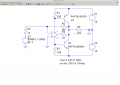
On this thread I speculated on how to boost the output power of a typical opamp. I've had the design kicking around in my head for quite some time, I guess it's time to try it out and see.
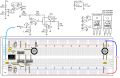
0 Power op amp 1.png

I'll build this sucker and post the results here. Before anyone says anything, I haven't quite finished the drawing
 
Last edited:

crutschow

Joined Mar 14, 2008
38,504
Are Q2, Q2, and Q3 the Darlingtons shown on the right?
That will give you a typical peak output voltage of about 9.5V with a 12V supply and the LM358 op amp.
Is that OK?

220µF at the output will give a low frequency -3dB response of about 72Hz.
You likely want it a little lower than that for audio.
 

Thread Starter

Wendy

Joined Mar 24, 2008
23,798
The thing I'm mostly interested in at this point is crossover distortion as well as high current output. This could also be used for a high current virtual ground.
 
Last edited:

dl324

Joined Mar 30, 2015
18,326
With LM358, you need to add a load to the negative supply to minimize the problem with crossover distortion.

For the power stage, you should use diodes so both output transistors are biased on so they don't cause crossover distortion.

Something similar to this, except using diodes for Q1 and Q2.
1640745823375.png
 

Ian0

Joined Aug 7, 2020
13,131
With LM358, you need to add a load to the negative supply to minimize the problem with crossover distortion.

For the power stage, you should use diodes so both output transistors are biased on so they don't cause crossover distortion.

Something similar to this, except using diodes for Q1 and Q2.
View attachment 256291
That's known as a "diamond buffer". John Broksie has a very good article on them:
https://www.tubecad.com/2012/09/blog0244.htm
The problem is that the base current for the output transistors has to be supplied by R1/R2, which leads to rather a lot of standing current.
I've used the circuit very successfully with MOSFETs. Use the same type of MOSFETs for both driver and output stage. If they are from the same batch, the Vgs(th) voltage will be the same and the offset will be quite small, even before feedback is added.
With Broksie's bootstrap capacitor between the two output transistor bases (gates) it will almost swing rail-to-rail.
 

Ian0

Joined Aug 7, 2020
13,131
A bit dangerous to assume that Vbe3 is exactly 0.6V! Put a preset in series with R2 and adjust. (Don't put a preset in series with R1, because if the wiper loses contact with the track the output stage blows up).
Don't forget that Q3 has to be thermally coupled to Q1/Q2.

If overall efficiency is not paramount, use three diodes in series instead of R1/R2/Q3 and add resistors in series with the emitters of Q1/Q2 to drop 0.3V at the required output bias current.
 

jeffl_2

Joined Sep 17, 2013
78
Yes I like the adjustable part. Nice thing about this Vbe circuit is not only that it tracks thermally, you can "tweak" it for the optimal condition of low output bias current and very low THD. And while we're talking about it an LM358 really has too slow a slew rate for audio, you could use an older part like NE5532 or a newer part like LM4562 or OPA1678 or OP275 for better results, they'll work at 12 volts (this is probably an automotive or motorcycle application) but of course +/-15 volts or higher (depending on opamp rating) would be preferred.
 

Ian0

Joined Aug 7, 2020
13,131
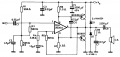
This circuit is also worth a look, but it seems to have completely perplexed SPICE, which doesn't seem to understand that the op-amp's output current is added to its supply current.poweropamp.png
 

AnalogKid

Joined Aug 1, 2013
12,128
This circuit is also worth a look,
I've always liked that approach, but . . .

1. It has its own form of crossover distortion when U2 or U3 kicks in.

2. It is far more susceptible to circuit layout, grounding, and decoupling conditions. The forward gain through the circuit now is the open loop gain of the opamp **times** the gain of the outboard transistor. Both of these numbers vary with frequency and introduce frequency-dependent phase shifts that can reduce the overall circuit's phase margin to zero. At that point, you're just re-invented AM radio. The feedback loop needs some additional phase compensation.

ak
 

MisterBill2

Joined Jan 23, 2018
27,511
This circuit is also worth a look, but it seems to have completely perplexed SPICE, which doesn't seem to understand that the op-amp's output current is added to its supply current.View attachment 256546
There is a similar, but not identical, circuit in the 1980 Radio Amateur's Handbook, published by the ARRL. It uses an LM301 opamp and with the transistors speced it is claimed to deliver at least 5 watts. It is tucked away in a section about audio filters so it takes a bit of searching to find. It uses the NPN above and the PNP below so they are emitter followers instead. Quite stable and low distortion.
 

Ian0

Joined Aug 7, 2020
13,131
I've always liked that approach, but . . .

1. It has its own form of crossover distortion when U2 or U3 kicks in.

2. It is far more susceptible to circuit layout, grounding, and decoupling conditions. The forward gain through the circuit now is the open loop gain of the opamp **times** the gain of the outboard transistor. Both of these numbers vary with frequency and introduce frequency-dependent phase shifts that can reduce the overall circuit's phase margin to zero. At that point, you're just re-invented AM radio. The feedback loop needs some additional phase compensation.

ak
I was hoping to get a Bode plot from SPICE, but SPICE was befuddled by it. I have built it successfully as a headphone amplifier in the days before SPICE was widely available! I have seen R3 replaced by a capacitor which may (or may not) control the gain/phase characteristics at higher frequencies. I've also seen the op-amp output connected directly to 0V.

As the initial requirement was a "rail-splitter", I bet it could be given enough hf roll-off for it to work!

It does have the ability (if it can be kept stable) to give the 741 a rail-to-rail output!
 

MisterBill2

Joined Jan 23, 2018
27,511
The circuit that I have seen has 470 ohm resistors in parallel with the B-E junctions so that crossover distortion is mostly avoided.Because the amp current is always flowing there is much less tendency for crossover distortion. Also, there is quite a bit of negative feedback.
 

Ian0

Joined Aug 7, 2020
13,131
I also saw a version with a preset connected between V+ and V- on the op-amp so that the "supply" current could be increased to bias the power transistors into conduction.
 

MisterBill2

Joined Jan 23, 2018
27,511
NO, not really. The circuit on that link does not use the opamp power supply terminals as drivers for the output transistors. That is the very big difference. And it uses a dual op-amp IC, so it can't use the power terminals as outputs.
The circuit that I referenced has resistors in series with the LM301 output, in addition to externally biasing that output with 1K resistors. It can do that because the LM301 is a low power device..
The circuit with the TDA2030A uses much lower values of shunt resistance, 1.5 ohms, which is probably because it is a power amp IC device drawing a lot more current than the LM301, which is a mid-1970's device, and may not still be available these days. How many ICs have a 50 year life-span? The LM324 comes close, maybe, I think.
 

Hymie

Joined Mar 30, 2018
1,347
It’s clear that you are planning to experiment with op-amps (with increased output current using discrete transistors) and measure the THD. I’d be interested in your results; personally I doubt you will achieve better than 1% THD.

I would recommend you increase the 12V supply voltage, otherwise as crutschow points out your output voltage swing will be limited.

I use 358 op-amps as a general purpose device, but at 10kHz a sinewave appears much like a triangular waveform at the output. With that in mind, you should consider alternative op-amps with a better frequency bandwidth.

Once you have your test set-up configured, besides measuring the THD through the frequency/gain range – you should also vary the output load to assess its effect on THD.
 

ErnieM

Joined Apr 24, 2011
8,415
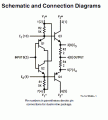
Back in the 80's in the test department we were running thru lots of LH0002 current amps. They are good parts but we would abuse them to death with bad DUT's. They became expensive and then manufactured out of unobtanium so we would use a DIP header and roll our own.

Typically the resistors survived so we would just mount the transistors on the header. I believe we were not picky either, using 2N2222's and 2N 3905's.

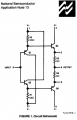
LH0002.gif
 
Top