Power dissipation in operational amplifier

crutschow

Joined Mar 14, 2008
38,526
You are using the Maximum Power Transfer Theorem to make say things that it says nothing about. The theorem ONLY talks about maximizing power transfer to a load. It says absolutely nothing, zero, nada, about power dissipation in the source.
So just exchange the source and load, with the load being the fixed resistor.
So when the output power is maximum, its the same as the source power dissipation under the circumstances of this discussion, which is implied by the Maximum Power Theorem.
But if you want to be pedantic about it, I can't stop you.
Your entire premise is that the power dissipated in this equivalent resistance is the same as the actual power dissipated in the actual opamp internal circuitry. That equivalence is the fallacy.
It is not, and I don't understand why you think it is.
Explain the fallacy, since you haven't so far, other than just waving your arms about the Maximum Power Transfer Theorem and Thevenin equivalents, as if I don't understand those concepts.

Can we agree that the op amp power dissipated (ignoring its bias power) is simply the difference between the supply voltage and the output voltage times the output current?
The maximum for this occurs when the op amp equivalent resistance equals the load resistance and the output voltage equals 1/2 the supply voltage (as shown in my sim).
How is that a fallacy?
 
Last edited:

WBahn

Joined Mar 31, 2012
32,877
So just exchange the source and load, with the load being the fixed resistor.
So when the output power is maximum, its the same as the source power dissipation under the circumstances of this discussion, which is implied by the Maximum Power Theorem.
But if you want to be pedantic about it, I can't stop you.
It is not, and I don't understand why you think it is.
Explain the fallacy, since you haven't so far, other than just waving your arms about the Maximum Power Transfer Theorem and Thevenin equivalents, as if I don't understand those concepts.

Can we agree that the op amp power dissipated (ignoring its bias power) is simply the difference between the supply voltage and the output voltage times the output current?
The maximum for this occurs when the op amp equivalent resistance equals the load resistance and the output voltage equals 1/2 the supply voltage (as shown in my sim).
How is that a fallacy?
Let's just do the math.

Consider a source that is a simple 12 V source with a 6 Ω output resistance.

If the load is 6 Ω, then the output voltage is half of the source voltage and the current is 1 A, resulting in 6 W of power in the load and 6 W of power in the source.

Your claim is that, based on the Maximum Power Transfer Theorem, that this is not only the maximum power that can be delivered to the load, but that this is also the maximum power that will be dissipated by the source.

Replace the load with a 1 Ω resistor.

What is the power delivered to the load resistor? It's well under 6 W, right? That's consistent with the Maximum Power Transfer Theorem, right?

What is the output voltage? It's no where near half of the supply voltage, right?

How much power is being dissipated in the source? How does this compare to the 6 W maximum source dissipation that you claim? Well, that's also perfectly consistent with the Maximum Power Transfer Theorem because that theorem has zero bearing on the power dissipated within the source.

In fact, the maximum power dissipation in the source will occur when the output is shorted to ground, as at that point the both current and the voltage difference between the supply and the output are at a maximum.
 

crutschow

Joined Mar 14, 2008
38,526
Let's just do the math.
Let's not.
It does not pertain to what I said.

But since you seem not to understand that, and keep using examples that are different from what I stated, while replying in a condescending manner to show your superior knowledge, I will have no further comment.
 

Ian0

Joined Aug 7, 2020
13,132
Maximum Power Transfer theorem says that the maximum power is transferred from the source when the source impedance is equal to the load impedance. At that point the output terminal of the source is at half the source voltage.
It follows therefore, that the worst case (i.e. highest dissipation in the source) for a fixed load happens when the source's output terminal is at half the source voltage.
 

Thread Starter

engr_david_ee

Joined Mar 10, 2023
362
In that case, you use the opamp as a voltage follower with an external transistor. Or just use a voltage regulator.

A schematic would put an end to most of this tedious guessing game...
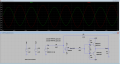
Now I have prepared schematic available in attachment. The maximum load current requirement is 75 mA. I just put load as 1kohm but I the exact load impedance is still not known yet. The load voltage requirement is 0 to -3V adjustable which is set by the DAC not shown in the schematic. The DAC output will be connected in place of input voltage source Vin. The maximum voltage of the DAC is 2.5V. I just a use a sin wave in simulation -2.5 V to +2.5V to get a full swing output but in practice will be from 0V to 2.5V. The OpAmp and a push pull stage using external transistors are shown in the circuit. The gain of the inverted operational amplifier is set by R2/R1 which can be changed by resistor values.

Question: The transistors in the attached circuit are able to drive load with continuous current 75 mA and voltage -3V ?. Back to the original question in this thread about power dissipation. How can I perform thermal analysis in the attached circuit. The output current of the operational amplifier is very small driving the base of the transistors. How to calculate the power dissipation on the transistors given the power supplies are +12V and -12V.
 

Attachments

Thread Starter

engr_david_ee

Joined Mar 10, 2023
362
I am sorry for not providing the schematic before. There have been several comments in this thread already which are very useful for me to understand thermal analysis. I must be very thankful for your contribution.
 

BobTPH

Joined Jun 5, 2013
11,524
We need a link to the sensor datasheet. First you said it needs a steady current of 75mA at -3V. Now you show a circuit supplying a 1KHz sine wave.

The two diodes in your circuit are shorted out. Just connect the output of the opamp between the two diodes.
 

Thread Starter

engr_david_ee

Joined Mar 10, 2023
362
We need a link to the sensor datasheet. First you said it needs a steady current of 75mA at -3V. Now you show a circuit supplying a 1KHz sine wave.

The two diodes in your circuit are shorted out. Just connect the output of the opamp between the two diodes.
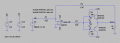
Thanks you noticed. Now I have connected the output of the operational amplifier between two diodes. The input to the circuit is slowly varying. Maybe after 10 second to the new level. Please ignore the sine wave input and consider it constant for a while.
 

Attachments

dl324

Joined Mar 30, 2015
18,336
The load voltage requirement is 0 to -3V adjustable
I just a use a sin wave in simulation -2.5 V to +2.5V to get a full swing output but in practice will be from 0V to 2.5V.
I assume you mean 0 to -2.5V.

For a unipolar voltage, you only need a single transistor on the output of the opamp. You'll need a power transistor if you only have +/-12V supplies.
 
Last edited:

Thread Starter

engr_david_ee

Joined Mar 10, 2023
362
I assume you mean 0 to -2.5V.

For a unipolar voltage, you only need a single transistor on the output of the opamp. You'll need a power transistor if you only have +/-12V supplies.
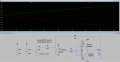
Sorry for confusion. The input is from 0 to +2.5V. The output requirement is 0 to -3.0V. I have corrected in simulation. The output is adjustable from 0 to -3.0V as we change the input from 0 to +2.5V. The load current requirement is the same 75 mA. Kindly have a look again in attached circuit. Is there any component that run into thermal problem ? How can I calculate the power dissipation in the transistors ? I guess the last two transistors are push pull configuration.
 

Attachments

crutschow

Joined Mar 14, 2008
38,526
How can I calculate the power dissipation in the transistors ?
After a transient simulation, hold down the ALT key and left-click on the component, which will then plot the instantaneous power dissipated.
To get the average power over the simulation period, hold down the CTRL key and left-click on the plot power label.
To get an accurate average power with an AC signal, plot an exact full period of the AC.
 

dl324

Joined Mar 30, 2015
18,336
Is there any component that run into thermal problem ?
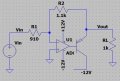
Just the pass transistor. I'd simplify the circuit to this:
sup.jpg
I'd use larger resistors for R1 and R2. No point in loading the DAC and wasting power.

Why do you use so much whitespace in your schematics? And it's a PITA to cut and paste with that grid...
 
Top