Power dissipation in operational amplifier

Thread Starter

engr_david_ee

Joined Mar 10, 2023
361
Hello,

I am using operational amplifier in inverting configuration. Let's have input 100 mV and the output is -500 mV. The gain is 5.

Here is the formula for inverting configuration. The input has to be applied at -IN. The +IN is connected to ground. The value of R1 is 1 k ohm and the value of R2 is 5 k ohm.

Vout = -(R2/R1) Vin

How do we perform thermal analysis ? How can we calculate the junction temperature ?

The datasheet of operational amplifiers have a table for thermal resistances in thermal section. In order to calculate the junction temperature we need to know ambient temperature which can be considered as 40 degC. The thermal resistance which is given in the datasheet. And also the power dissipation. The only thing which is unknown to me is how to calculate the power dissipation ? I am looking for the formula to calculate the power dissipation for inverting input operational amplifier.
 

DickCappels

Joined Aug 21, 2008
10,661
Take the voltage from the V+ pin to the output and multiply by the current going into the V+ pin. This gives you the power drawn from the V+ supply. Do the same with the V- pin and add the two powers together.

Edit: Mind the polarities so you don't end up with negative power dissipation!
 
Last edited:

ericgibbs

Joined Jan 29, 2010
21,406
Hi Bob,
Are you saying Dick is not right?
If the supply currents are measured when the OPA is working in the circuit, any output current comes via the OPA power rails.

E
 

MisterBill2

Joined Jan 23, 2018
27,251
That cannot be right. Some of that current goes out through the output pin to external circuits, no?
The POWER dissipated in a op-amp is not the same as the power passing thru it. Measuring the power in the device requires knowing the voltage drop as well as the current.
The supply current scheme is OK for choosing a heat sink, but to even guess at internal heating is more complex. Heating is caused by the power dissipation, voltage X current, and knowing the voltage drop within the device is a bit more complex. In fact, quite a bit more complex.
 

Thread Starter

engr_david_ee

Joined Mar 10, 2023
361
The datasheet of operational amplifier indicates input bias current and also quiescent current. The third current is the operational amplifier output current which is the load current. The load current has to be within the maximum output current of the operational amplifier. All these are known. My question is how do I put them to calculate the power dissipation. I understand that the power is voltage times current. Which voltage do I need to use in each of the three contributors.
 

Ian0

Joined Aug 7, 2020
13,103
Quiescent current * Power supply voltage (total voltage between V+ and V- pins) = Quiescent power.
Input current will probably be negligible, and you can probably ignore it in power calculations.
Power due to the output current needs slightly more thought:
Look where the output load is connected - and work out which supply pin is delivering the current that is going out to the load.
Then the voltage you use is the difference in voltage between the output pin and that supply pin.
 

Thread Starter

engr_david_ee

Joined Mar 10, 2023
361
Thanks. Now I am getting it.

I can calculate the quiescent power as quiescent current x (12V + 12V). This is because the operational amplifier is powered by +12V and -12V.
The second power factor is due to input bias current which is very small, so this factor can be ignored.

The third is the output power. Consider the load voltage is -0.5V (the input to the inverting amplifier of gain 5 is 100 mV). This -0.5V is the Vout of the operational amplifier and the load current is 50 mA let's say. How can I involve the operational amplifier supplies (+/- 12V) towards calculating the power ?
 

Ian0

Joined Aug 7, 2020
13,103
If the output current is 50mA and the output voltage is -0.5V, then where is the other end of the load connected?
At a guess it will be to 0V, in which case the V- pin will be supplying the load. So the voltage in your equation will be the difference between -0.5V and -12V.

Although it is improbable, you might have connected the load between output and -12V, in which case the load is being supplied from the +12V pin.
 

Ian0

Joined Aug 7, 2020
13,103
Dick's calculation would give 20mA *(Vdd-Vout) + 1mA*(Vout-Vss)
and that gives the same answer as 19mA*(Vdd-Vout) + 1mA quiescent * (Vdd-Vss).
 

Thread Starter

engr_david_ee

Joined Mar 10, 2023
361
Thanks. Now I am getting it.

I can calculate the quiescent power as quiescent current x (12V + 12V). This is because the operational amplifier is powered by +12V and -12V.
The second power factor is due to input bias current which is very small, so this factor can be ignored.

The third is the output power. Consider the load voltage is -0.5V (the input to the inverting amplifier of gain 5 is 100 mV). This -0.5V is the Vout of the operational amplifier and the load current is 50 mA let's say. How can I involve the operational amplifier supplies (+/- 12V) towards calculating the power ?
Then I calculate it as power due to load current is 50/1000 x 11.5 = 0.575 Watt

Now I see that this factor is dominant in power dissipation. I will use this in calculating the junction temperature of the chip.
 

Ian0

Joined Aug 7, 2020
13,103
Then I calculate it as power due to load current is 50/1000 x 11.5 = 0.575 Watt

Now I see that this factor is dominant in power dissipation. I will use this in calculating the junction temperature of the chip.
In most cases you only need consider the power dissipated due to the output current.

Watch out for very optimistic figures in datasheets about how much power an op-amp can dissipate. It is often quoted as if the case can be kept at 25°C.
The most important figure is the °C/W figure. Multiply this by the dissipation and add to the ambient temperature, and try to keep the result below 60°C.
 

crutschow

Joined Mar 14, 2008
38,361
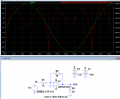
Per the maximum power theorem, the maximum op amp dissipated power for a given output load resistance occurs when the output voltage is 1/2 the supply voltage.
The op amp dissipation is then the output current at an output voltage of 1/2 the supply voltage times the supply voltage.

Below is an LTspice sim showing how the op amp power (red trace) peaks when the output is 1/2 the supply voltages (±6V):

1723904200401.png
 
Last edited:

MrChips

Joined Oct 2, 2009
34,662
I never have to calculate power dissipation and temperature rise of an op amp. You can get an idea by paying attention to the load being driven. If you need to drive a high current then you need an external driver or you are using the wrong op amp. In other words, use a power op amp.
 

Thread Starter

engr_david_ee

Joined Mar 10, 2023
361
Per the maximum power theorem, the maximum op amp dissipated power for a given output load resistance occurs when the output voltage is 1/2 the supply voltage.
The op amp dissipation is then the output current at an output voltage of 1/2 the supply voltage times the supply voltage.

Below is an LTspice sim showing how the op amp power (red trace) peaks when the output is 1/2 the supply voltages (±6V):

View attachment 329437
I don't understand the maximum power is at load voltage equal to halv the supply voltage.

Lower the load voltage higher the power dissipation and higher the load voltage lower the power dissipation, provided the load current remain same.
 

dl324

Joined Mar 30, 2015
18,236
I never worry about power dissipation, and the corresponding temperature rise, in an opamp. The manufacturers have already taken that into consideration and have limited dissipation in the output transistors to avoid issues a thermal gradient on the die would have on performance.
 

Thread Starter

engr_david_ee

Joined Mar 10, 2023
361
I never worry about power dissipation, and the corresponding temperature rise, in an opamp. The manufacturers have already taken that into consideration and have limited dissipation in the output transistors to avoid issues a thermal gradient on the die would have on performance.
A continuous output current at low Vout could lead to the power dissipation of more then 2 Watt. Usually the thermal resistance is around 40 to 60 degC per Watt which when used in calculating the junction temperature that could be above 100 degC.
 

dl324

Joined Mar 30, 2015
18,236
A continuous output current at low Vout could lead to the power dissipation of more then 2 Watt. Usually the thermal resistance is around 40 to 60 degC per Watt which when used in calculating the junction temperature that could be above 100 degC.
I still say that manufacturers have already taken power dissipation and thermal issues into consideration. If they didn't, I'd use parts from a manufacturer who did.

How about posting a schematic so we can see what you're talking about?
 
Top