A question of power dissipation

Thread Starter

xox

Joined Sep 8, 2017
936
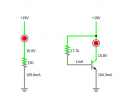
Consider the following two circuits featuring a ~100mA LED with a forward voltage of ~3.5V.
power-dissipation.png

In both cases, roughly the same amount of heat is going to be generated by the LED. However in the first case, the power dissipation through the resistor is going to be ~1.7W versus the second circuit where only ~0.02W flows through it.

So it appears that a current source would clearly be the most efficient way to go about it (in this obviously contrived example, at least). Are there any caveats to such an approach?
 

hrs

Joined Jun 13, 2014
520
The transistor also drops 15.8V from collector to emitter for some 15.8V*.104A=1.6W. So it's about the same as the 150 ohm resistor.
 

joeyd999

Joined Jun 6, 2011
6,204
Consider the following two circuits featuring a ~100mA LED with a forward voltage of ~3.5V.

View attachment 361745

In both cases, roughly the same amount of heat is going to be generated by the LED. However in the first case, the power dissipation through the resistor is going to be ~1.7W versus the second circuit where only ~0.02W flows through it.

So it appears that a current source would clearly be the most efficient way to go about it (in this obviously contrived example, at least). Are there any caveats to such an approach?
There is no free lunch.

If you want to eliminate (most of) the I^2 heating that is a natural consequence of DC bias, you need to use a switched inductor current-mode driver. Higher complexity, lower waste heat.
 

WBahn

Joined Mar 31, 2012
32,703
Consider the following two circuits featuring a ~100mA LED with a forward voltage of ~3.5V.

View attachment 361745

In both cases, roughly the same amount of heat is going to be generated by the LED. However in the first case, the power dissipation through the resistor is going to be ~1.7W versus the second circuit where only ~0.02W flows through it.

So it appears that a current source would clearly be the most efficient way to go about it (in this obviously contrived example, at least). Are there any caveats to such an approach?
And the transistor dissipates heat from both the base and collector currents (assuming your values are valid):

Ptran = Vbe*Ib + Vce*Ic = (1.3 V)(1 mA) + (15.8 V)(103.3 mA) = 1.3 mW + 1632.1 mW = 1.633 W

All you've done is shift heat away from a resistor, which is less sensitive to heat-induced damage, to the transistor, which is much less resilient.

Also, your numbers make no sense. A Vbe of 1.3 V (which comes from 19 V - 17.7 kΩ*1 mA) should put the transistor in deep saturation. Yet your Vce of 15.8 V puts it way into the active region. Where did these numbers come from?

This is actually a VERY bad way to try to drive your LED. It has no reasonable control over the current and will result in huge deviations from one device to another and as the parts heat up.
 

WBahn

Joined Mar 31, 2012
32,703
@xox: While it may not be what your main purpose was with this thread, if you would like to discuss ways to get 100 mA through the LED in a way that is pretty stable over temperature, device variation, and supply voltage, as well as considering where heat is dissipated, that might be a useful discussion for you. There are lots of ways to go about it, both linear and non-linear, and different participants can offer and discuss the pros and cons of different approaches.

But, it's your thread, so let us know where you would like it to go.
 

Thread Starter

xox

Joined Sep 8, 2017
936
And the transistor dissipates heat from both the base and collector currents (assuming your values are valid):


Ptran = Vbe*Ib + Vce*Ic = (1.3 V)(1 mA) + (15.8 V)(103.3 mA) = 1.3 mW + 1632.1 mW = 1.633 W


All you've done is shift heat away from a resistor, which is less sensitive to heat-induced damage, to the transistor, which is much less resilient.

....

This is actually a VERY bad way to try to drive your LED. It has no reasonable control over the current and will result in huge deviations from one device to another and as the parts heat up.
In hindsight I can't believe I overlooked that. When the thought first occurred to me, I got a little carried away by the idea that this might be a way to cut down on power dissipation in certain circumstances. I really could have thought that through better!

Also, your numbers make no sense. A Vbe of 1.3 V (which comes from 19 V - 17.7 kΩ*1 mA) should put the transistor in deep saturation. Yet your Vce of 15.8 V puts it way into the active region. Where did these numbers come from?
Yeah, the simulator I am using isn't the best. Something like LTSpice would be much more accurate, but unfortunately it doesn't play well with my Linux distro.

@xox: While it may not be what your main purpose was with this thread, if you would like to discuss ways to get 100 mA through the LED in a way that is pretty stable over temperature, device variation, and supply voltage, as well as considering where heat is dissipated, that might be a useful discussion for you. There are lots of ways to go about it, both linear and non-linear, and different participants can offer and discuss the pros and cons of different approaches.
Right, it was really more of an abstract question. I definitely wouldn't use something like that to power an actual LED! But I do wonder, using a regulating circuit to drop the voltage down near the forward-voltage of the LED would decrease the power dissipation significantly. Would that be a fairly optimal solution?
 

WBahn

Joined Mar 31, 2012
32,703
Right, it was really more of an abstract question. I definitely wouldn't use something like that to power an actual LED! But I do wonder, using a regulating circuit to drop the voltage down near the forward-voltage of the LED would decrease the power dissipation significantly. Would that be a fairly optimal solution?
Depends on how the voltage is dropped. If it is dropped by a linear circuit (including linear regulators), then there is NO savings at all, and mostly likely at least some increase in overall power consumption. You need some type of non-linear regulator, typically some kind of switch-mode regulator, to reduce the voltage. This is what @joeyd999 was referring to in his response.
 
Top