Potential Dividers

Thread Starter

Design Tech Tutor

Joined Oct 8, 2022
3
Hi - Newby here...

I teach several GCSE and A level DT students.

But I can never get my story straight about Potential Dividers! I know what they do but...

What are they used for etc...

Can someone give me a layman's explanation?

Many thanks in advance!

Jeremy
 

ericgibbs

Joined Jan 29, 2010
21,442
hi J,
Consider that you wish to monitor a 12V battery by using a Microcontroller , which can only accept a +5v maximum signal input.

You would use a resistive potential divider to reduce the 12v to 5v.
E
 

Ian0

Joined Aug 7, 2020
13,132
If you want to measure a potential (a voltage) but the measurement range of your measuring instrument is less that the voltage you want to measure, then you need a potential divider to divide that voltage by a fixed amount to get into a range that you can measure.

This handy utility
http://sim.okawa-denshi.jp/en/teikokeisan.htm
works out the resistor values for you.
 

Jon Chandler

Joined Jun 12, 2008
1,596
One important point to understand:

A voltage divider (as I would call it), is used to provide extreme low currents to shift the level of a signal. It cannot be used where it's supplying appreciable current or varying current.

Use Ohm's Law to see what happens when a load of a few to tens of mA is connected and the current through the 2 resistors isn't equal.
 

WBahn

Joined Mar 31, 2012
32,840
Hi - Newby here...

I teach several GCSE and A level DT students.

But I can never get my story straight about Potential Dividers! I know what they do but...

What are they used for etc...

Can someone give me a layman's explanation?

Many thanks in advance!

Jeremy
There are a number of uses for potential dividers (more commonly called a "voltage divider" here).

As others have said, they are commonly used to scale a signal voltage from a level that is too high to use down to one that is compatible with the components being used.

But another important role is to provide for the calibration of a signal.

For instance, let's say that we need a voltage that tells us what the difference is between the speed a car is traveling and the speed we want to maintain (for a cruise control, for instance). The voltage coming from the steering column where we set the speed might produce a voltage of 0.1 V/mph (so that, if we want 60 mph we would have a control signal of 6 V. If I am doing the subtraction via an analog circuit, I need the voltage that tells me how fast the car is actually traveling to also produce 0.1 V/mph. But perhaps it produces 0.239 V/mph. I could use a voltage divider to scale that down to the needed 0.1 V/mph.

Yet another common purpose is to provide a reference signal of a particular value. This might be used for any number or reasons, some setting the threshold on a comparison circuit (for instance, to establish the water level at which a sump pump should turn on) to setting the bias voltage for an amplifier circuit.
 

Papabravo

Joined Feb 24, 2006
22,082
hi D,
Yes, ref this image.
E
View attachment 278091
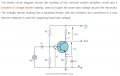
It is worth mentioning that the input impedance of the microprocessor A/D input should be much greater than the 5K impedance of R2. If the input impedance of the A/D is on the order of 5K it will seriously impact the A/D reading. This is one of the "defects" of voltage (potential) dividers. A better approach would be to use a unity gain follower after the potential divider. Like this:
1665414181265.png
Now, regardless of the input impedance of the A/D input, the high impedance of the unity gain buffer means that the value of the +12V supply will be accurately replicated for the A/D input. You can even calibrate for small errors due to offset voltage and input bias currents.
Note also that the 20mV P-P noise on the +12V supply is accurate replicated on the A/D Input as 8.33 mv P-P according to the resistor divider ration.
 

WBahn

Joined Mar 31, 2012
32,840
Thanks! Would that PD still be going to ground?
Usually, but not always. Sometimes there are reasons to refer a voltage divider to something other than "ground" or your 0 V common reference. One consideration might be the impact of reference selection on the noise performance of the circuit. If you refer your signal to common, then you will be more sensitive to noise on your power supply rail for many PNP and PFET based designs.

Also, many circuits (opamp circuits probably being the simplest example) feed a fraction of the output voltage back to the input in order to establish the gain (or other) behavior of the circuit. These are often voltage dividers that operate between two different signals (such as the output and the input voltage) as opposed to the common or even to a fixed reference voltage.
 

ericgibbs

Joined Jan 29, 2010
21,442
Hi Papa,
Of course, I would agree regarding the Source impedance the ADC input expects, many PIC MCU's will tolerate up to approx 10k.
Depending upon the required operating requirement, it is also possible to add a low value capacitor from the R1/R2 junction to 0v in order to minimize the source impedance effect of the ADC reading.

Considering the very basic nature of the TS's request, I try to give answers that can be clearly understood by the TS.

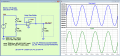
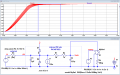
I did some LTS tests on this problem some years ago, I will try to find them.:rolleyes:

E

Added an example for a PIC.
The topic at that time was when the earliest sample time could be achieved.
I believe we are drifting off-topic, perhaps you would like to create a thread to discuss this topic.?

EG57_ 96.png
 

Attachments

Last edited:

Papabravo

Joined Feb 24, 2006
22,082
Hi Papa,
Of course, I would agree regarding the Source impedance the ADC input expects, many PIC MCU's will tolerate up to approx 10k.
Depending upon the required operating requirement, it is also possible to add a low value capacitor from the R1/R2 junction to 0v in order to minimize the source impedance effect of the ADC reading.

Considering the very basic nature of the TS's request, I try to give answers that can be clearly understood by the TS.

I did some LTS tests on this problem some years ago, I will try to find them.:rolleyes:

E

Added an example for a PIC.
The topic at that time was when the earliest sample time could be achieved.
I believe we are drifting off-topic, perhaps you would like to create a thread to discuss this topic.?

View attachment 278104
I don't think that is necessary. My only purpose was to alert the TS of the potential pitfalls of ASSUMING that a voltage divider could be used without consequences in this case. Once upon a time when processors were expensive and opamps (and engineers) were as cheap as chicklets**, they could be used to "protect" the static sensitive CMOS parts from the "environment". Thankfully we don't need to be that paranoid anymore.

** Chicklets
https://en.wikipedia.org/wiki/Chiclets
 

dl324

Joined Mar 30, 2015
18,328
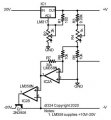
Here's another application:
clipimage.jpg
Three voltage dividers.

The circuit could be simplified. It was used as an exercise to teach a member how to design opamp circuits using building blocks.
 

BobaMosfet

Joined Jul 1, 2009
2,211
Hi - Newby here...

I teach several GCSE and A level DT students.

But I can never get my story straight about Potential Dividers! I know what they do but...

What are they used for etc...

Can someone give me a layman's explanation?

Many thanks in advance!

Jeremy
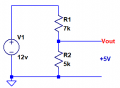
In layman's terms, a potential divider is a way to cut a single potential (that is voltage drop) into two equal or inequal voltage drops.
 
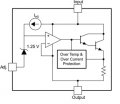
I would recommend using the LM317 linear voltage regulator as an example of using a potential divider as this is a really useful device for dropping an input voltage of a battery or DC power supply to an accurate lower voltage. If they understand how that works it will actuallly be very useful for them in practice. Interestingly, this device has cropped up in a number of threads recently - even one where I got the calculation wrong! Inside the LM317 there is a voltage reference diode and an Op Amp driving a darlington pair transistor.
1665425960193.jpeg

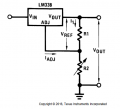
And this is a typical example of how the device is used to deliver a variable output voltage (with a current up to 5A. The LM317 can deliver up to 1,5A, the LM338 is the same but works up to 5A.

1665426098558.png
 
Top