Positive/Negative Pulses against One Pulse

Thread Starter

abuhafss

Joined Aug 17, 2010
318
Hi

I need to have two pulses against one pulse such that one is positive and the other is negative.

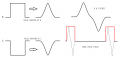
Have a look at the figure for better understanding.

a) "A" generates pulses such that the duty cycle remains the same, no matter what frequency is set.
b) For each pulse generated by "A", "B" generates a positive pulse such that the pulse duration is half of "A".
c) As soon as the pulse "B" is completed, "C" generates exactly same pulse but with reverse polarity.
d) Pulse duration of "A" = Pulse duration of "B" + Pulse duration of "C"

Question: Since the duration of the pulse "A" varies with frequency, how do we set the time for pulse "B" and "C"? Both, B and C may be any kind of suitable oscillators.
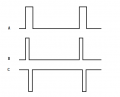
Pulses.png
 

crutschow

Joined Mar 14, 2008
38,322
So you always want the duration of pulse B and C to be 1/2 the pulse width of A, independent of frequency? If so that likely could be done easiest with a microprocessor.
 

KMoffett

Joined Dec 19, 2007
2,918
It sort of depends on the frequency range, the number of pulses at any frequency, and the accuracy needed from the first pulse at any frequency. The microprocessor would need at least one input pulse to determine the period before it could output signals of 1/2 the period. If the frequency changed constantly it might not keep up.

If not a homework problem, what are you actually trying to do? It's often easier to help solve your problem, than help solve your solution. ;)

Ken
 

Alec_t

Joined Sep 17, 2013
15,103
Are you allowed to create pulses B and C first, then manipulate them to get A? Or is A a given, from which B and C must be derived?
 

Thread Starter

abuhafss

Joined Aug 17, 2010
318
It sort of depends on the frequency range, the number of pulses at any frequency, and the accuracy needed from the first pulse at any frequency. The microprocessor would need at least one input pulse to determine the period before it could output signals of 1/2 the period. If the frequency changed constantly it might not keep up.

If not a homework problem, what are you actually trying to do? It's often easier to help solve your problem, than help solve your solution. ;)

Ken
Are you allowed to create pulses B and C first, then manipulate them to get A? Or is A a given, from which B and C must be derived?
Actually, I am trying to design a solid state simulator for a pulser/trigger coil. This is NOT an automotive modification project. It is just to have a helpful device for bench tests.

My idea was to
1) Generate pulse A .............which would be actually defining the frequency (RPM) using a POT.
2) Generate 2 pulses B and C corresponding to A.
3) Pulse shaping of B and C.
4) Mixing B and C.

Pulses 2.png

In the final pulse train, the width of one pulse varies with the frequency. The red pulse is the actual A, for reference. The mixed pulse would be a sort of mixture of sinusoidal and triangular pulse.
 
Last edited:

MrChips

Joined Oct 2, 2009
34,628
Your idea will not work.
The only solution is to measure the width of the pulse.
Of course, this only works if the pulses are repeating and only changes width slowly.
 

Thread Starter

abuhafss

Joined Aug 17, 2010
318
I am stuck at stage number 2, for which I have started this thread.
I have somehow worked out solutions for number 3 and 4.

As an alternate, I think we can generate pulse B and C simultaneously and directly (without involving A) using a twin POT.
 
Last edited:

RamaD

Joined Dec 4, 2009
328
The pulse width of A is known only after the pulse is completed. So it is not possible to have B half the pulse width of A, as it has to start with A and end at half the time of A!
 

Thread Starter

abuhafss

Joined Aug 17, 2010
318
The pulse width of A is known only after the pulse is completed. So it is not possible to have B half the pulse width of A, as it has to start with A and end at half the time of A!
Yes, you are right.
That's why I am thinking to exclude the generation of pulse "A".
Only, generate pulse "B" and "C" independently using a twin POT.
 

Alec_t

Joined Sep 17, 2013
15,103
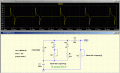
How about this? It's not quite what you want, since the pulse duty cycle varies by a factor of ~3 when the frequency is varied over a 10-to-1 range.
PosNegPulser.gif
 

KMoffett

Joined Dec 19, 2007
2,918
With the OP's requirements, I can't see any other simple way than a microcontroller with variable inputs (pots?) to adjust the "input" pulse frequency and pulse width. The µC program can then set the two output pulses to the appropriate width and phasing.

Out of curiosity what is the frequency and pulse width ranges of the "input" A

Ken
 

Thread Starter

abuhafss

Joined Aug 17, 2010
318
You can easily generate pulse B and pulse C. But how do you know the width of B and C?
B and C will be generated independently (without any involvement of A) and simultaneously such that C starts as soon B ends. Polarity of C would be negative.
Width of B and C can be controlled thru a ganged POT.
 

Thread Starter

abuhafss

Joined Aug 17, 2010
318
How about this? It's not quite what you want, since the pulse duty cycle varies by a factor of ~3 when the frequency is varied over a 10-to-1 range.
View attachment 73120
I already have similar output, well controlled in respect of frequency and duty cycle. Although it serves the need but the waveform does not imitate the trigger coil waveform.
 

MrChips

Joined Oct 2, 2009
34,628
If you don't care about the pulse-width of A, then just cascade two monostable mulitvibrators, TTL 74LS123 or CMOS 14538.
 
Top