How to use a negative voltage to switch betwen positive voltage and ground

Thread Starter

aagum.bae

Joined Oct 21, 2023
20
Basically the title, I want the output to be a positive voltage when the control voltage is negative and the output should either be ground or open when there is no control signal (it is left floating), please help me out thanks.

The exact problem is that,I am using a centre tapped battery supply to get dual power supply (i am using two 18650 li-ion batteries in series), and have added a battery protection IC the HY2120, but this IC only opens up the negative rail, so one of the battery will continue to discharge. I want to prevent this.

The batteries will be connected to positive and negative voltage regulators, and these regulators have a shutdown pin in them, the negative regulator gets switched off when the battery protection IC opens the negative rail, but the positive voltage regulator will still be in ON state and one of the battery continue to discharge.

The positive voltage regulator is in ON state when its shutdown pin is HIGH (above 1.2V) and is in OFF/SHUTDOWN state when its shutdown pin is GROUNDED or FLOATING.

The negative voltage regulator is in ON state when its shutdown pin is HIGH (above 1.6V and below -1.9V) and is in OFF/SHUTDOWN state when its shutdown pin is GROUNDED or FLOATING.

I need to turn OFF/SHUTDOWN the positive voltage regulator when the battery protection IC opens the negative rail, how do I achieve this?

Positive regulator: LT1761 https://www.analog.com/media/en/technical-documentation/data-sheets/1761sff.pdf
Negative regulator: LT1964 https://www.analog.com/media/en/technical-documentation/data-sheets/1964fb.pdf
 
Last edited:

crutschow

Joined Mar 14, 2008
38,316
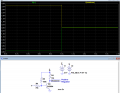
Below is the LTspice sim of a circuit that should do what you want, using three resistors and one NPN BJT (can be just about any small NPN transistor):
The positive regulator Shutdown signal (yellow trace) goes from the battery voltage to 0V when the negative battery voltage (green trace) goes from it's ON value to 0V
Edit: Simplified circuit.

1721751674426.png
 
Last edited:

Thread Starter

aagum.bae

Joined Oct 21, 2023
20
Below is the LTspice sim of a circuit that should do what you want, using three resistors and one NPN BJT (can be just about any small NPN transistor):
The positive regulator Shutdown signal (yellow trace) goes from the battery voltage to 0V when the negative battery voltage (green trace) goes from it's ON value to 0V
Edit: Simplified circuit.

View attachment 327672

Thanks! Could you explain how this circuit works?
 

Thread Starter

aagum.bae

Joined Oct 21, 2023
20
Below is the LTspice sim of a circuit that should do what you want, using three resistors and one NPN BJT (can be just about any small NPN transistor):
The positive regulator Shutdown signal (yellow trace) goes from the battery voltage to 0V when the negative battery voltage (green trace) goes from it's ON value to 0V
Edit: Simplified circuit.

View attachment 327672
How do I do this with a PNP transistor?
 

Ian0

Joined Aug 7, 2020
13,097
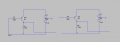
This circuit I tried does not work when I breadboarded it, but works in simulation, can you tell me why?
View attachment 327701
in real life R4 would not be open circuit, it would have some resistance to ground through other parts of the circuit not included in the simulation. With a gain of 100, it only takes 300nA base current to switch the transistor on. (It won’t be saturated, but will be on enough for anything following to see a logic high.)
 

Thread Starter

aagum.bae

Joined Oct 21, 2023
20
in real life R4 would not be open circuit, it would have some resistance to ground through other parts of the circuit not included in the simulation. With a gain of 100, it only takes 300nA base current to switch the transistor on. (It won’t be saturated, but will be on enough for anything following to see a logic high.)
Thanks a lot!

The following is taken from, https://www.allaboutcircuits.com/textbook/semiconductors/chpt-5/transistor-switch-jfet/
IS am curious to know howadding the bleeding resistor affects the switch other than giving a path to the current to ground from the capacitance.

Bleeding Resistor


This resistor’s value is not very important. The capacitance of the JFET’s gate-source junction is very small, and so even a rather high-value bleed resistor creates a fast RC time constant, allowing the transistor to resume conduction with little delay once the switch is opened.

Like the bipolar transistor, it matters little where or what the controlling voltage comes from. We could use a solar cell, thermocouple, or any other sort of voltage-generating device to supply the voltage controlling the JFET’s conduction. All that is required of a voltage source for JFET switch operation is sufficient voltage to achieve pinch-off of the JFET channel. This level is usually in the realm of a few volts DC, and is termed the pinch-off or cutoff voltage. The exact pinch-off voltage for any given JFET is a function of its unique design, and is not a universal figure like 0.7 volts is for a silicon BJT’s base-emitter junction voltage.


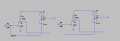
Here is my implementation in Ltspice:
1721815960089.png

Thanks a lot for your help
 

Thread Starter

aagum.bae

Joined Oct 21, 2023
20
Below is the LTspice sim of a circuit that should do what you want, using three resistors and one NPN BJT (can be just about any small NPN transistor):
The positive regulator Shutdown signal (yellow trace) goes from the battery voltage to 0V when the negative battery voltage (green trace) goes from it's ON value to 0V
Edit: Simplified circuit.

View attachment 327672
Thanks a lot! onceI bread board it and check, I will most probably move forward with this circuit.
 

Ian0

Joined Aug 7, 2020
13,097
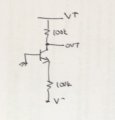
This is another possibility. The output is low when the negative voltage is present (the opposite to the other circuits).
D3455543-7445-4C11-BBAB-EE824F309FDF.jpegSorry that it’s fuzzy.
 

Thread Starter

aagum.bae

Joined Oct 21, 2023
20
This is another possibility. The output is low when the negative voltage is present (the opposite to the other circuits).
View attachment 327707Sorry that it’s fuzzy.
Could you explain how this circuit works? With the base grounded how is the base to emitter junction getting voltage greater than 0.7 volts when the V- is removed? Thanks.
 

Ian0

Joined Aug 7, 2020
13,097
Could you explain how this circuit works? With the base grounded how is the base to emitter junction getting voltage greater than 0.7 volts when the V- is removed? Thanks.
It gets 0.7V when the negative voltage is present, not when it is removed.
 

crutschow

Joined Mar 14, 2008
38,316
Could you explain how this circuit works?
In the post #2 circuit, when the negative voltage is available it pulls the base of the NPN transistor slightly negative through R6, so it is off (not conducting) and the Shutdown voltage is high.
When the negative voltage is zero, transistor base becomes forward biased through R5, turning on the transistor and pulling the collector (Shutdown) voltage to near zero.
 

Thread Starter

aagum.bae

Joined Oct 21, 2023
20
When the negative voltage is available it pulls the base of the NPN transistor slightly negative through R6, so it is off (not conducting) and the Shutdown voltage is high.
When the negative voltage is zero, transistor base becomes forward biased through R5, turning on the transistor and pulling the collector (Shutdown) voltage to near zero.
Yes got it, thanks! However I observed something strange and couldn't figure out why
When V+ is 5V Vout is 2.1V why is that? Also I changed the resistor value from 75k to 70k because that's what I used to breadboard the circuit. i used BC547, the readings are from the breadboard circuit and not the simulationIMG_20240724_173525039.jpg
 
Last edited:
Top